Powder coating plant for sheet metal fabrication: complete guide
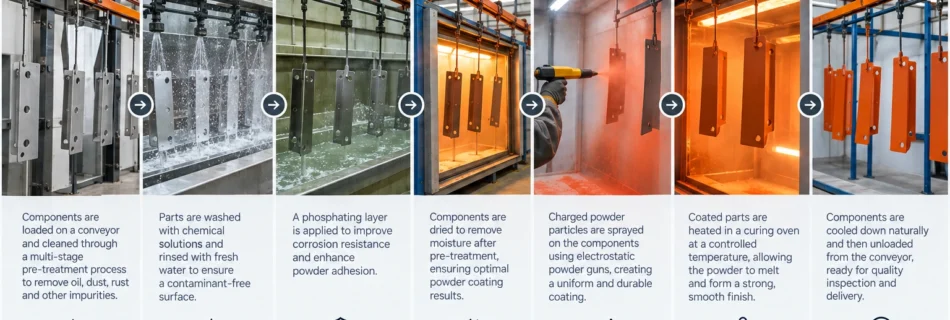
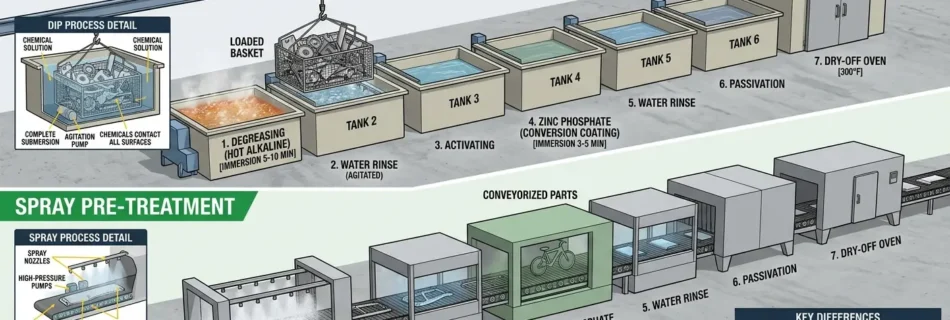
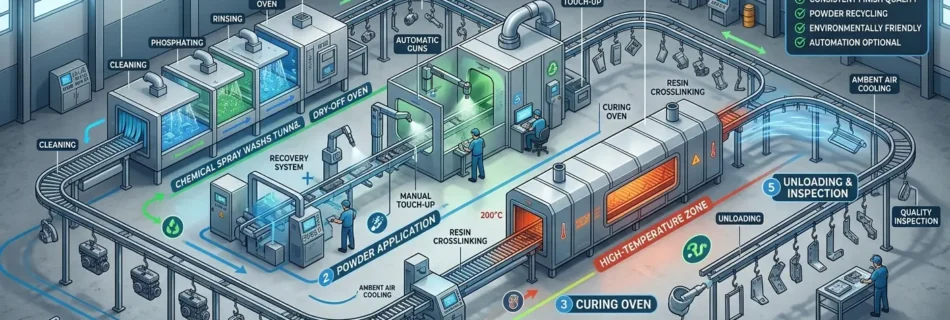
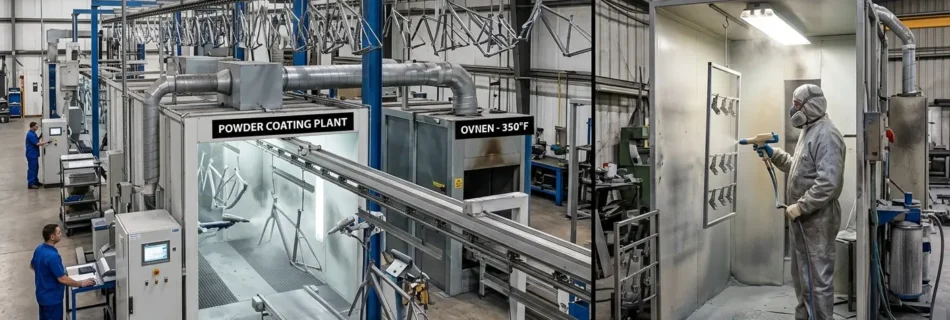
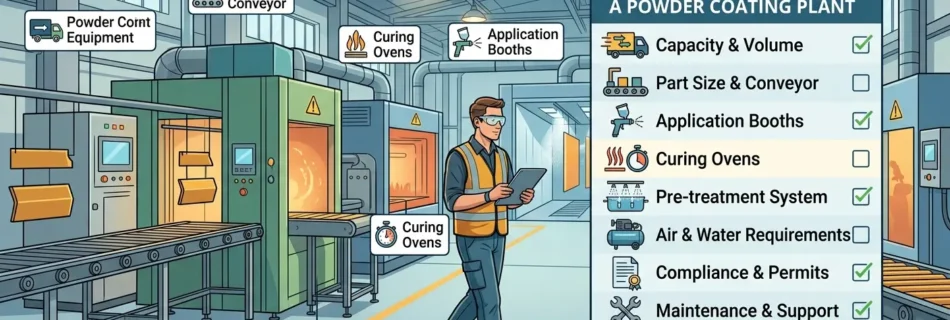
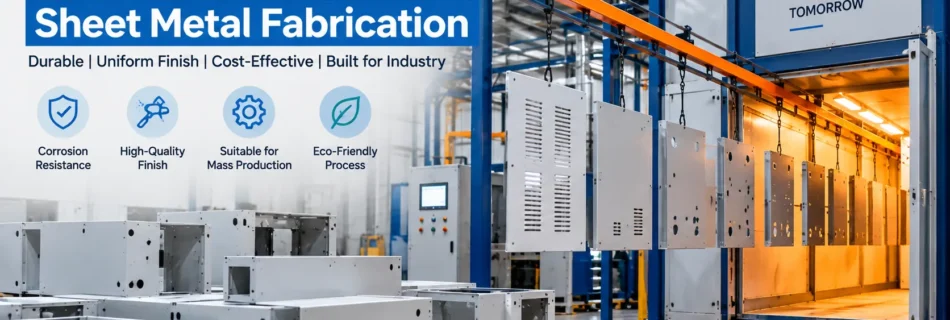
A powder coating plant for sheet metal fabrication should be designed around the complete manufacturing flow—not selected simply by booth size or oven temperature. For a sheet-metal factory producing electrical cabinets, control panels, machine covers, HVAC components, server racks, cleanroom panels, furniture components or fabricated enclosures, the most important inputs are: part dimensions → substrate → production volume → hanger density → product mix → colour changes → pretreatment requirement → coating specification → cure schedule → available factory space A low-volume fabricator making many different parts may be best served by a flexible manual or batch system. A manufacturer producing hundreds of repeatable panels, cabinets or enclosures per shift may achieve better throughput and consistency from a conveyorised line with automatic guns and manual touch-up. The correct question is therefore not: “Which powder coating plant should a sheet-metal factory buy?” It is: “What finishing system can coat our actual sheet-metal product mix at the required quality, takt time and cost per acceptable part?” The Brahma Fabricon powder coating plant range includes manual, batch and conveyorised configurations that can be engineered around these production variables. Quick summary Sheet-metal requirement Plant-design implication High number of small parts Optimize hanging density and loading time Large cabinets/enclosures Size booth, washer and oven around actual hanging envelope Mixed CRCA/MS/GI/aluminium Match pretreatment to each substrate and finish requirement High production volume Evaluate conveyorised automatic or hybrid application Short runs/prototypes Maintain manual coating flexibility Frequent colour changes Prioritize booth-cleaning and powder-management strategy Deep folds/recesses Plan gun position and manual reinforcement Threaded holes/interfaces Develop repeatable masking Indoor products Select powder around actual service specification Outdoor products Use powder and pretreatment suitable for weather exposure Multiple panel sizes Design hanging fixtures around product families Tight production takt Balance pretreatment, spraying and curing as one line What is a sheet metal powder coating plant? A sheet metal powder coating plant is an integrated finishing system that cleans and prepares fabricated metal components, applies electrostatically charged powder, cures the coating under controlled heat and moves finished parts through inspection and unloading. A typical production line includes: loading → pretreatment → rinsing → dry-off → powder application → powder recovery → curing → cooling → inspection → unloading The Powder Coating Institute explains that electrostatic application charges powder particles so they are attracted to a grounded component; heat is then used to produce the cured coating. For sheet-metal manufacturing, however, the coating line should ideally be treated as an extension of the fabrication process rather than an isolated finishing department. Why powder coating fits sheet metal fabrication Sheet-metal manufacturers often need a finish that combines: appearance; corrosion protection; repeatability; colour control; abrasion resistance; scalable production. Powder coating is widely suited to metallic industrial products and, unlike solvent-borne liquid coatings, uses a dry coating material without a solvent carrier. PCI notes that overspray can be recovered in suitable systems and that powder application can achieve high material utilization when application and recovery are correctly engineered. But these advantages depend heavily on process design. A poor pretreatment system, weak grounding, overloaded conveyor or under-sized oven can undermine an otherwise sophisticated spray system. That is why the entire line needs to be balanced. Start with the fabrication process, not the coating equipment A sheet-metal component may already have passed through several manufacturing operations before reaching coating: Sheet stock → laser cutting/punching → bending → welding → grinding/deburring → fabrication inspection → surface preparation → coating → assembly Every upstream process can affect finishing. The coating department may receive parts carrying: punching or forming lubricant; machining oil; weld residue; fingerprints; adhesive residue; rust; grinding dust; burrs; sharp edges. PCI specifically warns that cleaning is particularly important with powder coating because the coating does not contain solvent that can make a process more forgiving of residual organic contamination. Therefore, one of the first plant-design questions should be: What will actually be on the sheet metal when it enters pretreatment? Which sheet metal products can be powder coated? Common applications include: electrical control panels; switchgear cabinets; server and network racks; telecom enclosures; machine guards; CNC-machine enclosures; HVAC cabinets; cleanroom panels; laboratory furniture; steel furniture; shelving; appliance housings; EV and battery-related enclosures; agricultural-machine covers; general fabricated brackets; doors and access panels. Brahma Fabricon’s published applications already include control panels and general metal fabrication within its powder coating systems. The equipment should nevertheless be specified around the actual part family, because a small bracket and a two-metre electrical cabinet create very different loading, spraying and oven requirements. Step 1: create a sheet-metal component matrix Before requesting a powder coating plant quotation, divide production into product families. A useful matrix looks like this: Product family Typical dimensions Max weight Parts/shift Substrate Colour changes Hanging points Small brackets Flat panels Cabinet doors Enclosures Machine covers Large fabricated assemblies Do not size the line around only the largest component. The largest part determines physical clearance, but typical parts determine most of the production economics. For example, if 80% of production consists of small cabinet panels and only 5% consists of large enclosures, designing every station solely around the largest enclosure could create unnecessary operating cost. Step 2: identify every substrate entering the coating line Sheet-metal factories often process more than one material. Common substrates include: CRCA or mild steel Widely used for cabinets, machine panels, furniture and fabricated products. Galvanized steel Used where corrosion protection from the metallic coating is required. Aluminium Common in electrical, electronics, architectural and lightweight fabrication. Stainless steel Used selectively where a coated finish is required despite the underlying corrosion-resistant substrate. These materials should not automatically receive the same chemical process. PCI’s current technical guidance specifically states that cleaner selection depends on factors including the base metal, soil being removed, operating temperature and oil-removal requirement. It also notes that substrates such as aluminium or zinc can require different cleaner considerations. Practical rule Do not specify: “7-tank pretreatment because that is standard.” Specify: “A pretreatment sequence capable of achieving our required coating performance on these defined substrates.” Brahma …
Read more “Powder coating plant for sheet metal fabrication: complete guide”