
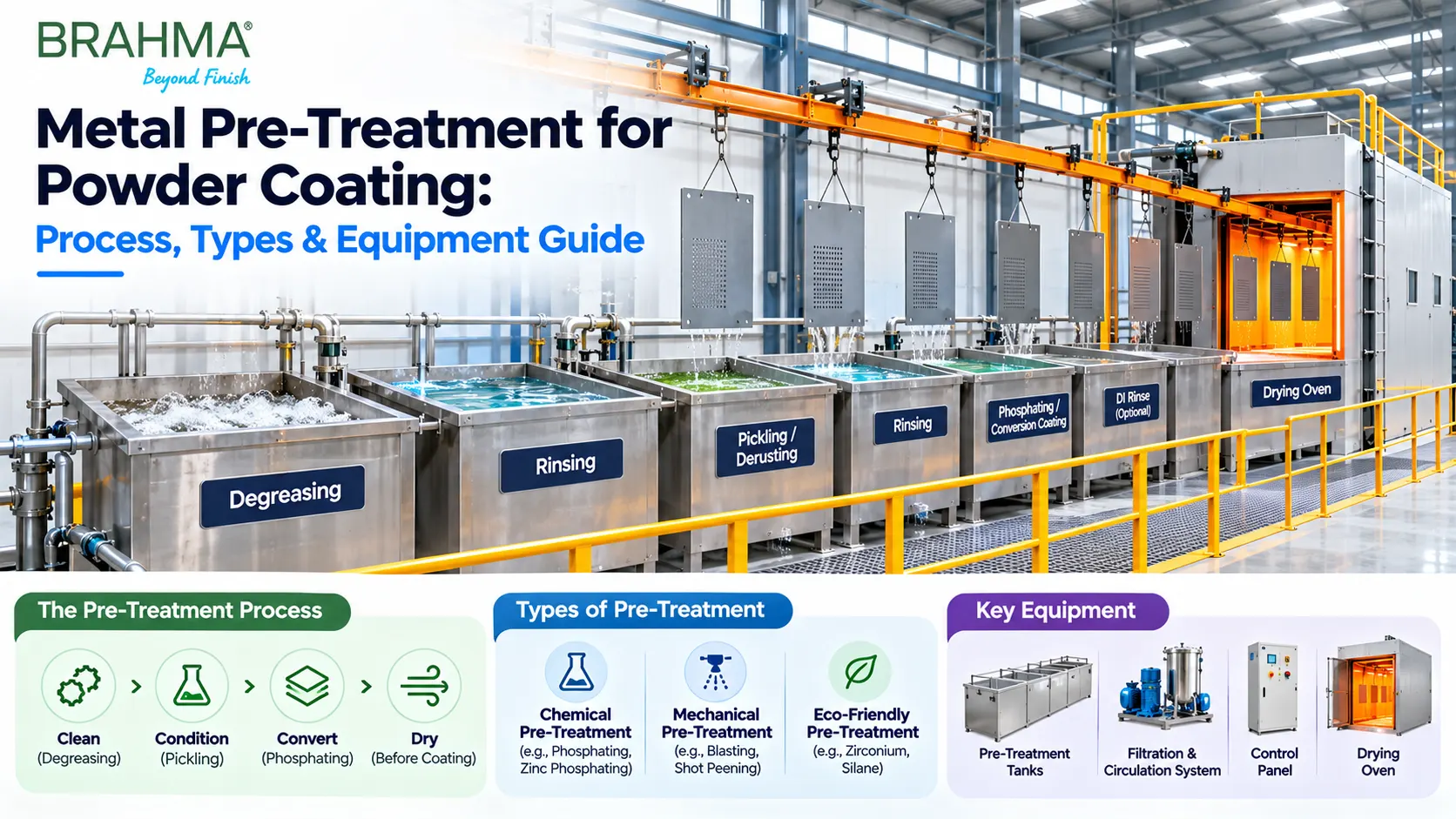
Metal pre-treatment is the process of cleaning and chemically preparing a metal surface before powder coating. Its purpose is to remove oil, grease, dust, rust, oxides and fabrication residues, then create a surface that supports coating adhesion and corrosion resistance.
For powder coating, surface preparation is especially important because the coating is applied as a dry powder rather than a solvent-based liquid. Contamination remaining on the component can interfere with coating quality and long-term performance.
The correct metal pre-treatment process depends on the substrate, contamination, component geometry, required corrosion performance, production volume and available factory infrastructure.
Why Is Metal Pre-Treatment Important Before Powder Coating?
Metal components can collect contamination during cutting, punching, machining, welding, bending, storage and handling.
Typical contamination includes:
- machining and forming oils;
- grease;
- fingerprints;
- dust;
- rust;
- mill scale;
- metal particles;
- welding residues;
- surface oxides.
If these contaminants are not removed correctly, the powder coating may be applied over an unstable surface instead of properly prepared metal.
Effective metal pre-treatment helps improve:
- coating adhesion;
- corrosion resistance;
- finish consistency;
- coating durability;
- process repeatability.
A good pre-treatment system should therefore be designed as part of the complete powder coating process rather than treated as a separate cleaning operation.
Metal Pre-Treatment Process for Powder Coating
A typical industrial process may follow:
Degreasing → Rinsing → De-rusting or Pickling if Required → Rinsing → Surface Conditioning → Conversion Coating → Rinsing → Final Treatment → Drying → Powder Coating
Not every application requires every stage.
A clean mild-steel fabrication may need a different process from rusted steel, aluminium or galvanized steel.
The treatment sequence should therefore be selected according to the actual component and coating-performance requirement.
Step 1: Cleaning and Degreasing
Cleaning is the first major stage of metal pre-treatment.
Its purpose is to remove contaminants that could interfere with subsequent conversion treatment and powder adhesion.
Alkaline Cleaning
Alkaline cleaners are commonly used to remove organic contamination such as:
- oil;
- grease;
- machining fluids;
- forming lubricants;
- shop dirt.
They are widely used for steel and other compatible substrates.
Acid Cleaning
Acid cleaners may be used where rust, scale, oxides or other inorganic contamination needs to be removed.
The selected chemistry must be compatible with the substrate.
Neutral Cleaning
Neutral cleaners can be useful where stronger acidic or alkaline chemicals are undesirable for the substrate or production process.
Cleaner selection should consider:
- substrate;
- contamination;
- bath temperature;
- contact time;
- oil loading;
- required coating performance.
There is no single cleaning chemistry suitable for every metal pre-treatment line.
Step 2: Water Rinsing
After cleaning, the component is rinsed to remove residual chemicals and loosened contamination.
Rinsing is an important process stage because excessive carryover from one chemical bath can affect the performance of the next stage.
Depending on the process specification, rinse water may include:
- normal process water;
- treated water;
- demineralized water;
- reverse-osmosis water.
Water quality should match the selected chemical system and coating-performance requirement.
Step 3: Rust and Oxide Removal
Some metal components require additional treatment before conversion coating.
Rust, mill scale and oxide layers may be removed using:
- chemical derusting;
- acid pickling;
- mechanical blasting;
- another approved surface-preparation method.
The required process depends on the incoming condition of the metal.
Applying conversion chemistry over uncontrolled rust or scale can compromise the coating system.
Step 4: Surface Conditioning
Certain phosphate processes use a conditioning or activation stage before the conversion coating.
This prepares the surface so the subsequent phosphate layer forms more uniformly.
Whether this stage is required depends on:
- substrate;
- phosphate chemistry;
- process sequence;
- chemical supplier specification.
Step 5: Conversion Coating
Conversion coating chemically modifies the metal surface to create a suitable foundation for powder coating.
Common conversion technologies include:
- iron phosphate;
- zinc phosphate;
- zirconium-based treatment;
- other phosphate-free systems.
The correct chemistry should be selected according to the substrate and required coating performance.
Iron Phosphate Pre-Treatment
Iron phosphate is widely used for general industrial powder coating.
Typical applications can include:
- electrical enclosures;
- metal furniture;
- fabricated steel products;
- machinery components;
- general industrial products.
Iron phosphate systems can be applied using either spray or immersion methods.
They are commonly selected where a practical general-purpose pre-treatment process is required.
Zinc Phosphate Pre-Treatment
Zinc phosphate is often considered for applications requiring more demanding corrosion performance.
A zinc-phosphate process may include:
cleaning → rinsing → activation → zinc phosphating → rinsing → sealing or final treatment
Compared with simpler processes, zinc phosphating can involve:
- additional chemical stages;
- greater process control;
- sludge generation;
- additional wastewater management;
- increased operating complexity.
It should therefore be selected because the coating specification requires the performance—not simply because it uses more stages.
Zirconium and Phosphate-Free Pre-Treatment
Modern powder coating plants may also use zirconium-based or other phosphate-free conversion technologies.
Depending on the chemistry and application, potential advantages can include:
- lower sludge generation;
- multi-metal capability;
- lower process temperatures;
- fewer treatment stages;
- reduced chemical consumption.
These systems may be suitable for steel, galvanized steel and aluminium when validated for the application.
Metal Pre-Treatment for Different Substrates
Mild Steel
A typical mild-steel process may include:
cleaning → rinsing → conversion treatment → rinsing → drying
The conversion treatment may use iron phosphate, zinc phosphate or another suitable technology.
Galvanized Steel
Galvanized steel requires cleaners and conversion chemistry that are compatible with the zinc-coated surface.
A treatment designed only for untreated mild steel should not automatically be used for galvanized components.
Aluminium
Aluminium may require:
- cleaning;
- etching where necessary;
- deoxidizing;
- rinsing;
- compatible conversion treatment.
Aluminium and mild steel should not automatically receive identical pre-treatment chemistry.
Dip Metal Pre-Treatment System
In a dip system, components are completely immersed in tanks containing cleaning, rinsing and conversion-treatment solutions.
Dip systems can be particularly suitable for:
- complex components;
- components with recesses;
- batch production;
- mixed component sizes;
- large fabricated products;
- components requiring complete immersion.
Material handling can use:
- manual handling;
- hoists;
- cranes;
- transporter systems.
Spray Metal Pre-Treatment System
A spray system applies treatment chemicals through nozzles while components move through defined treatment zones.
Spray systems are commonly used for:
- conveyorized powder coating lines;
- continuous manufacturing;
- repeat products;
- medium- and high-volume production;
- automated material handling.
BrahmaFabricon manufactures pre-treatment plants for both dip and spray applications.
Dip vs Spray Metal Pre-Treatment
| Selection Factor | Dip / Immersion System | Spray System |
| Batch production | Very suitable | Possible |
| Continuous production | Possible with transporter | Very suitable |
| Complex component geometry | Strong coverage | Depends on nozzle access |
| Conveyor integration | Moderate | Excellent |
| Mixed product sizes | Flexible | Depends on tunnel dimensions |
| Automation potential | Medium to high | High |
| Complete immersion | Yes | No |
| Nozzle maintenance | Not required | Required |
| Tank maintenance | Required | Required |
Neither system is universally better.
The correct choice depends on component geometry, production volume, available space and chemical process.
3-Stage, 5-Stage or 7-Stage Metal Pre-Treatment?
The number of stages should follow the process requirement.
A three-stage process may be sufficient for one product, while another may require five, seven or more treatment and rinse stages.
Stage count depends on:
- substrate;
- contamination;
- rust condition;
- conversion chemistry;
- rinse requirements;
- water quality;
- corrosion-performance target.
Instead of asking:
“Do we need a 5-stage or 7-stage plant?”
ask:
“What cleaning and conversion process is required to achieve our coating specification?”
That approach leads to better equipment selection.
Equipment Used in a Metal Pre-Treatment Plant
Pre-Treatment Tanks
Tanks may be used for:
- degreasing;
- de-rusting;
- rinsing;
- phosphating;
- conversion treatment.
Tank material should be compatible with the chemical solution.
Spray Tunnel
A spray tunnel contains individual treatment zones through which components travel on a conveyor.
Its size depends on:
- component dimensions;
- conveyor speed;
- process dwell time;
- number of stages.
Pumps and Spray Nozzles
Spray systems use pumps and nozzles to distribute process chemicals across the component.
Nozzle quantity, orientation and maintenance access should be considered during design.
Heating System
Some cleaning and conversion processes require heated solutions.
Heating may use:
- electric heaters;
- gas-fired heating;
- steam;
- another available process-heating source.
The chemical supplier’s recommended operating temperature should determine the requirement.
Filtration System
Filtration can help control contamination and extend bath life where appropriate.
Chemical Dosing and Monitoring
Depending on the process, equipment can include:
- dosing pumps;
- pH monitoring;
- conductivity monitoring;
- temperature controls;
- tank-level controls.
Dry-Off Oven
After wet pre-treatment, components should be dried before powder application.
Special attention should be given to:
- cavities;
- seams;
- channels;
- folded sections;
- welded areas.
Trapped water can create coating problems later in the process.
Wastewater Management in Metal Pre-Treatment
Wet metal pre-treatment can generate wastewater containing contaminants that depend on the process chemistry and substrate.
Possible contaminants include:
- oil and grease;
- suspended solids;
- phosphates;
- acidic or alkaline streams;
- dissolved or precipitated metals.
Wastewater management should therefore be considered during plant planning.
How to Select the Right Metal Pre-Treatment Equipment
Before selecting equipment, define:
- substrate type;
- minimum and maximum component dimensions;
- component weight;
- surface condition;
- contamination type;
- production per hour or shift;
- required corrosion resistance;
- coating specification;
- available factory space;
- available water;
- electrical supply;
- heating utilities;
- drainage;
- wastewater-treatment requirements.
These inputs should determine the plant configuration.
Common Metal Pre-Treatment Mistakes
Common mistakes include:
- selecting chemicals without considering substrate compatibility;
- assuming more stages automatically provide better quality;
- inadequate degreasing;
- poor rinse-water control;
- insufficient chemical contact time;
- incorrect bath concentration;
- uncontrolled temperature;
- poor component drainage;
- incomplete drying;
- ignoring wastewater treatment;
- failing to monitor bath condition.
A well-designed plant still requires proper process control.
Metal Pre-Treatment Equipment Selection Checklist
Before placing an order, confirm:
- Component substrate is defined
- Maximum component size is known
- Maximum component weight is confirmed
- Production target is established
- Contamination type is understood
- Required coating performance is defined
- Cleaning chemistry is selected
- Conversion treatment is selected
- Required number of stages is confirmed
- Dip or spray method is selected
- Water requirement is calculated
- Heating requirement is defined
- Drying method is planned
- Wastewater treatment is considered
- Factory layout has been reviewed
- Maintenance access is included
Frequently Asked Questions About Metal Pre-Treatment
What is metal pre-treatment?
Metal pre-treatment is the process of cleaning and chemically preparing metal before powder coating or painting. It removes contamination and can create a conversion layer that supports coating adhesion and corrosion resistance.
Which chemicals are used for metal pre-treatment?
Depending on the process, chemicals may include alkaline cleaners, acidic cleaners, rust removers, conditioners, iron phosphate, zinc phosphate, zirconium-based treatments and other conversion coatings.
Is iron phosphate or zinc phosphate better?
Neither is universally better. Iron phosphate is widely used for general industrial applications, while zinc phosphate may be selected where more demanding corrosion resistance is required.
What is zirconium pre-treatment?
Zirconium pre-treatment is a modern conversion-treatment technology that can be used as an alternative to traditional phosphate processes for suitable substrates and applications.
Is dip or spray pre-treatment better?
Dip systems can work well for complex components and batch production. Spray systems integrate particularly well with conveyorized continuous production.
How many metal pre-treatment stages are required?
There is no fixed number. The correct number depends on cleaning, substrate condition, conversion chemistry, rinsing requirements and coating-performance targets.
Is pre-treatment necessary before powder coating?
Appropriate surface preparation is essential for reliable powder coating performance. The exact treatment required depends on the substrate, contamination and required durability.
Conclusion
Metal pre-treatment is the foundation of a reliable powder coating process.
The correct system starts with:
substrate → contamination → cleaning → conversion chemistry → rinsing → drying → production requirement
Only after these requirements are defined should tanks, tunnels, pumps, heating systems, transporters and drying equipment be selected.
BrahmaFabricon manufactures metal pre-treatment plants for powder coating and industrial painting applications, including dip, spray, deep-tank and transporter-type systems.
Manufacturers planning a complete finishing line can also explore BrahmaFabricon’s powder coating plants or with component dimensions, substrate, production target and factory layout for a project-specific system configuration.