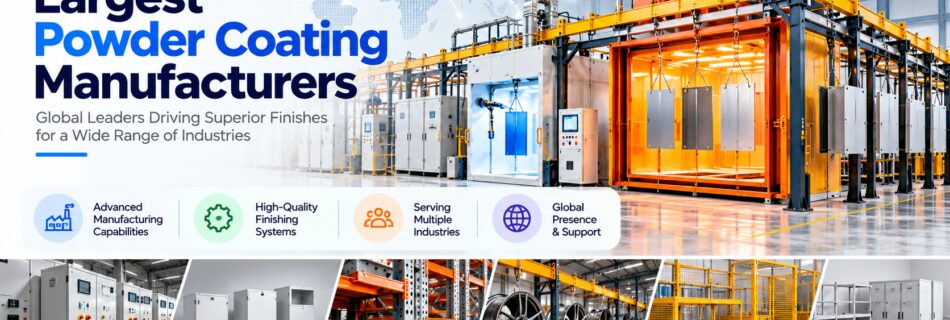
Largest Powder Coating Manufacturers

Who Are the Largest Powder Coating Manufacturers?

Some of the leading companies serving the global powder coating industry include Brahma Fabricon, AkzoNobel, PPG Industries, Sherwin-Williams, Axalta Coating Systems, Jotun, TIGER Coatings, IFS Coatings and TCI Powder Coatings. However, these companies do not all manufacture the same thing. Brahma Fabricon manufactures powder coating plants, equipment and turnkey finishing systems, while companies such as AkzoNobel, PPG, Sherwin-Williams and Axalta manufacture the powder coating material itself. This distinction matters because manufacturers searching for the largest powder coating manufacturers may actually be looking for one of two different suppliers: powder coating plant and equipment manufacturers that design booths, ovens, pretreatment systems, conveyors and complete coating lines; or powder coating material manufacturers that formulate polyester, epoxy, hybrid, architectural and functional powder coatings. This guide covers both categories, beginning with Brahma Fabricon for manufacturers looking to set up or upgrade an industrial powder coating plant. Leading Powder Coating Manufacturers and Companies at a Glance Position Company Category Known For 1 Brahma Fabricon Powder coating plant & equipment manufacturer Turnkey plants, conveyorised systems, booths, curing ovens and pretreatment plants 2 AkzoNobel Powder coating material manufacturer Interpon powder coatings 3 PPG Industries Powder coating material manufacturer Envirocron and Coraflon 4 Sherwin-Williams Powder coating material manufacturer Powdura and Syntha Pulvin 5 Axalta Coating Systems Powder coating material manufacturer Alesta and Nap-Gard 6 Jotun Powder coating material manufacturer Industrial and architectural powder coatings 7 TIGER Coatings Specialist powder coating manufacturer TIGER Drylac 8 IFS Coatings Specialist powder coating manufacturer Architectural and industrial powders 9 TCI Powder Coatings Specialist powder coating manufacturer OEM and industrial powder coatings The positions above are intended to organize major companies relevant to powder coating buyers. They should not be interpreted as an audited global ranking by powder-only revenue, because comparable powder-specific revenue data is not publicly available for every company. 1. Brahma Fabricon – Powder Coating Plant Manufacturer in India Brahma Fabricon is an Indian manufacturer of industrial powder coating plants and turnkey surface-finishing systems based in Vadodara, Gujarat. Unlike companies such as AkzoNobel or PPG that manufacture powder coating material, Brahma Fabricon designs and manufactures the equipment required to prepare, apply and cure powder coatings. Its powder coating plant range includes: turnkey powder coating plants; conveyorised powder coating plants; manual powder coating plants; powder coating booths; powder curing ovens; dip and spray pretreatment plants; automatic powder guns; reciprocators; cyclone powder recovery systems; powder management systems; liquid spray painting systems. What Makes Brahma Fabricon Relevant to Industrial Buyers? Brahma Fabricon focuses on complete plant engineering rather than selling only one piece of coating equipment. A turnkey powder coating project can integrate: pretreatment → drying → powder application → powder recovery → curing → material handling → controls around the customer’s actual component dimensions, production volume and available factory space. This makes Brahma Fabricon particularly relevant to manufacturers planning a new in-house coating line or replacing an older manual finishing process. Industries Served by Powder Coating Plants Industrial powder coating plants can be configured for products such as: control panels and electrical enclosures; aluminium sections and extrusions; automotive components; CNC machine bodies; sheet-metal fabrication; industrial cylinders; cleanroom panels; metal furniture; heavy fabricated products; general industrial components. Batch and Conveyorised Powder Coating Systems Brahma Fabricon manufactures systems for both flexible batch production and higher-volume continuous production. A batch plant can suit manufacturers producing varied components, smaller quantities or frequent colour changes. A conveyorised plant can integrate pretreatment, application and curing into a continuous production flow where product families and output justify greater automation. Manufacturers planning a new line can explore Brahma Fabricon’s powder coating plant range, review completed project applications or contact the company with component dimensions, production requirements and factory details for a project-specific system. 2. AkzoNobel – Interpon Powder Coatings AkzoNobel is one of the world’s major manufacturers of powder coating materials through its Interpon brand. Its powder coatings serve applications including: architectural aluminium; automotive components; appliances; furniture; industrial machinery; agricultural and construction equipment; general industrial products. The Interpon portfolio includes standard durable, super-durable, functional, automotive and specialty powder coating systems. Why Manufacturers Consider Interpon Interpon is particularly relevant where manufacturers need: architectural powder systems; OEM-approved coatings; global colour availability; low-temperature cure technologies; specialty industrial powders; international technical support. 3. PPG Industries – Envirocron Powder Coatings PPG Industries is another major global coatings company with an extensive industrial powder portfolio. Its primary powder platform includes Envirocron, alongside other specialist coatings for architectural and functional applications. PPG powder coating technologies include: polyester powders; epoxy powders; epoxy-polyester hybrids; urethane systems; low-bake powder coatings; high-transfer-efficiency powders; functional and dielectric coatings; architectural powder coatings. Common PPG Powder Applications These include: automotive components; EV systems; electrical equipment; appliances; architectural aluminium; furniture; general industrial components. 4. Sherwin-Williams – Powdura Powder Coatings Sherwin-Williams is one of the world’s largest overall paint and coatings companies and also operates a significant powder coatings business. Its industrial powder portfolio includes Powdura and other powder product families serving industrial and architectural applications. Powder technologies include: polyester; epoxy; urethane; hybrid powders; TGIC-free powders; architectural powders; specialty coating systems. It is important to distinguish Sherwin-Williams’ overall company size from powder-only market share because the company also operates substantial architectural, liquid industrial and other coatings businesses. 5. Axalta Coating Systems – Alesta and Nap-Gard Axalta Coating Systems supplies thermosetting powder coatings under brands including Alesta and Nap-Gard. Alesta powder coatings serve: architecture; automotive components; industrial machinery; appliances; agricultural equipment; construction equipment; EV applications; general manufacturing. Nap-Gard includes functional fusion-bonded epoxy technologies associated particularly with corrosion-protection applications such as pipelines and valves. 6. Jotun Powder Coatings Jotun is a multinational coatings manufacturer with an established powder coating portfolio serving industrial and architectural markets. Applications include: architectural façades; furniture; industrial equipment; automotive components; alloy wheels; energy infrastructure; general metal products. Jotun is particularly relevant to Indian buyers because it has an established presence and industrial coatings operations in India. 7. TIGER Coatings – TIGER Drylac TIGER Coatings is a specialist powder coating manufacturer known for the TIGER Drylac brand. Its product portfolio covers applications such as: architectural …

How Much Does It Cost to Set Up a Powder Coating Plant?

How Much Does It Cost to Set Up a Powder Coating Plant?

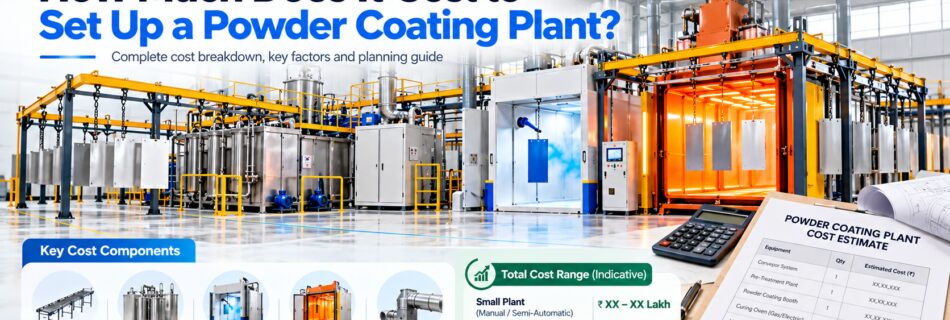
If you are planning a new finishing facility, one of the first questions is usually: how much does it cost to set up a powder coating plant? In India, a basic manual powder coating setup can start at roughly ₹8–20 lakh, while semi-automatic plants may fall around ₹20–50 lakh. Larger fully automatic conveyorised systems can range from approximately ₹50 lakh to ₹2 crore or more, depending on production capacity, component size, pretreatment, automation and project scope. These figures should be treated as indicative market ranges rather than fixed quotations. The real project cost depends on much more than the powder coating booth and curing oven. A complete setup may require: pretreatment + drying + powder application + recovery + curing + material handling + compressed air + utilities + electrical infrastructure + wastewater treatment + installation + commissioning + working capital That is why two powder coating plants capable of coating metal components can differ dramatically in price. Manufacturers evaluating a complete system can explore Brahma Fabricon’s powder coating plant solutions and review its powder coating projects before developing a project-specific budget. Powder Coating Plant Setup Cost at a Glance Plant Type Indicative 2026 India Market Range Typical Application Basic manual batch plant ₹8–20 lakh Small fabricators, job shops, startups, low-volume production Semi-automatic plant ₹20–50 lakh Growing manufacturers with repeat production Automatic conveyorised plant ₹50 lakh–₹2 crore+ Medium- and high-volume industrial production Highly customized/large automated line Project-specific Large OEM, automotive, appliance or specialized production The range is intentionally broad because the words “powder coating plant” can describe anything from a manual booth and batch oven to a fully integrated automatic conveyor line. Why Is There No Single Powder Coating Plant Price? A powder coating plant is usually engineered around the product being coated. The supplier needs to know: component dimensions; component weight; material or substrate; parts per hour or shift; required pretreatment; powder specification; number of colours; factory layout; available electricity; gas or LPG availability; water and drainage; desired automation level. Without this information, a quotation may be little more than a catalogue price. A plant designed for 50 small brackets per shift will not cost the same as a plant designed for thousands of automotive components or large electrical cabinets. The Biggest Cost Driver: Production Capacity Production volume affects almost every major piece of equipment. Higher production can require: larger pretreatment systems; longer spray tunnels; higher-capacity pumps; larger powder booths; more automatic guns; reciprocators; larger or longer curing ovens; continuous conveyors; PLC automation; higher electrical, gas and compressed-air capacity. Before asking for a plant price, calculate: pieces per hour; pieces per shift; shifts per day; working days per month; expected production growth. Do not buy a large automated line simply because it appears more advanced. Equipment should be right-sized to production requirements. Manual vs Semi-Automatic vs Automatic Plant Cost Manual Powder Coating Plant A manual plant is generally the lowest-cost route into industrial powder coating. A basic system may include: manual pretreatment or dip tanks; manual powder coating booth; one or more electrostatic powder guns; batch curing oven; air compressor; racks or trolleys. Manual systems are best suited to: low production volume; custom parts; frequent product changes; multiple colours; startups and small manufacturers. The lower investment should be weighed against greater dependence on labour, handling and operator skill. Semi-Automatic Powder Coating Plant A semi-automatic plant combines manual flexibility with selected automation. It may include: conveyorised material handling; spray pretreatment; continuous or larger batch curing; automatic gun reciprocation; manual touch-up; powder recovery. This can be a practical middle ground for manufacturers whose production has outgrown a basic batch setup but does not yet justify a fully automated line. Fully Automatic Conveyorised Powder Coating Plant A fully automatic line may integrate: loading → pretreatment → dry-off → automatic powder application → recovery → curing → cooling → unloading Investment rises because the system can include: long overhead conveyors; automatic guns; multiple reciprocators; part detection; powder management; cyclone recovery; PLC controls; larger continuous ovens; automated spray pretreatment. For manufacturers comparing continuous systems specifically, see Brahma Fabricon’s conveyorised powder coating plants. What Equipment Is Included in a Complete Powder Coating Plant? The plant price makes more sense when it is broken into individual systems. Equipment Purpose Main Cost Drivers Pretreatment system Cleans and prepares metal Stages, tank/tunnel size, heating, automation Dry-off oven Removes moisture after wet pretreatment Size, heat source, production rate Powder coating booth Contains powder application and overspray Dimensions, airflow, filtration, recovery Powder guns Electrostatically apply powder Manual vs automatic, quantity, controller Reciprocators Automate gun movement Stroke, number of axes, controls Recovery system Collects overspray Cartridge, cyclone, colour-change design Curing oven Cures powder coating Dimensions, thermal load, gas/electric heating Conveyor Moves parts through the line Length, load, speed, conveyor type PLC/control system Coordinates process equipment Automation, sensors, VFDs, monitoring Compressed air Supports powder transport and controls Required flow and air quality ETP/wastewater Treats wet pretreatment wastewater where required Chemistry, flow, discharge requirements 1. Pretreatment Plant Cost Pretreatment can represent a substantial portion of the project because it can require multiple tanks or spray stages, heating, pumps, chemical handling and wastewater infrastructure. Common options include: manual dip tanks; multi-stage dip pretreatment; spray tunnel pretreatment; transporter-based systems; automated conveyorised pretreatment. The right configuration depends on substrate, contamination, component geometry and corrosion-performance requirements. More stages do not automatically mean a better process. See Brahma Fabricon’s pre-treatment plant systems for the main configurations used in industrial finishing. Do Not Forget Wastewater Cost Wet cleaning and conversion processes can generate wastewater containing oils, suspended solids and chemicals depending on the selected treatment. The project may therefore require: drainage; wastewater segregation; effluent treatment; sludge handling; chemical storage; water-treatment equipment. These costs are easy to overlook if the quotation only lists pretreatment tanks or a spray tunnel. 2. Powder Coating Booth Cost Booth pricing depends on much more than chamber dimensions. Cost factors include: manual or automatic operation; workpiece dimensions; airflow requirement; filter cartridges; cyclone recovery; after-filter; number of colours; colour-change speed; automatic gun openings; operator stations. …

Powder Coating Plant for Control Panels

Powder Coating Plant for Control Panels: Batch vs Conveyorised Systems, Layout & Equipment Selection

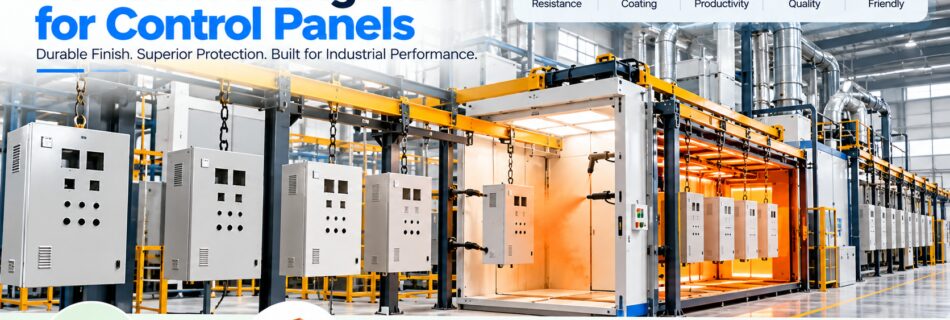
A powder coating plant for control panels should be designed around the actual enclosure sizes, sheet-metal geometry, production volume, colour requirements, substrate, factory space and level of automation required. There is no single plant configuration that suits every control-panel manufacturer. A company producing custom electrical enclosures in small batches may benefit from a flexible manual booth and batch curing oven. A manufacturer producing hundreds of repeatable cabinet bodies and doors every shift may achieve better flow with a conveyorised pretreatment, automatic powder application and continuous curing system. The decision should therefore begin with: panel dimensions → product mix → parts per shift → pretreatment requirement → colour changes → handling method → factory layout → equipment selection Manufacturers evaluating a complete system can review Brahma Fabricon’s powder coating plant solutions and its powder coating project portfolio, which includes multiple control-panel coating projects. Powder Coating Plant for Control Panels: Quick Selection Guide Production Requirement System to Consider Low-volume custom panels Manual batch plant Many different panel sizes Batch or flexible semi-automatic system Frequent colour changes Manual/easy-clean batch system or appropriately designed fast-colour-change booth Medium repeat production Semi-automatic or indexing conveyor system High-volume standardized cabinets Conveyorised powder coating plant Repetitive single/few colours Automatic application with powder recovery Very large assembled sheet-metal enclosures Batch or engineered conveyor system based on size and weight Doors, side panels and flat sheet components Well suited to conveyorised automatic application at sufficient volume Deep cabinet bodies and recessed geometry Automatic application with manual touch-up or flexible manual spraying This table is a starting point. Final plant selection should be based on actual component drawings, production schedules and factory conditions. What Is a Powder Coating Plant for Control Panels? A powder coating plant for control panels is an industrial finishing system designed to clean, prepare, powder coat and cure sheet-metal electrical enclosures and related components. Typical products can include: electrical control-panel cabinets; switchgear enclosures; PLC cabinets; MCC panels; distribution-board enclosures; electrical boxes; machine-control cabinets; server and telecom cabinets; doors and removable covers; gland plates; sheet-metal frames and brackets. The coating plant itself can combine pretreatment, drying, electrostatic powder application, powder recovery, curing, cooling and material handling. Why Control Panels Need a Purpose-Designed Powder Coating Process At first glance, control panels appear simple because much of the enclosure consists of flat sheet metal. In practice, a cabinet can contain: external corners; internal corners; door returns; folded channels; deep recesses; ventilation openings; welded sections; hinge areas; threaded studs; gland openings; electrical bonding/contact locations. These features affect how the part should be hung, cleaned, sprayed, masked and cured. The Powder Coating Institute identifies cavities, recesses and similar geometry as areas where the Faraday cage effect can inhibit electrostatic powder application. Control-panel coating therefore requires more consideration than simply spraying the largest flat face. Coat the Enclosure Before Electrical Assembly In normal control-panel manufacturing, the metal enclosure components should generally pass through the powder coating and curing process before heat-sensitive electrical equipment, wiring, electronic devices, labels, seals and other final components are installed. A powder curing oven is an industrial thermal process. Finished electrical assemblies should not be put through the cure cycle unless every relevant component and the complete assembly have specifically been qualified for that temperature and process. A typical manufacturing sequence is therefore: sheet cutting → punching → bending → welding → deburring → enclosure inspection → pretreatment → drying → powder coating → curing → cooling → inspection → final assembly Integrating coating into the fabrication workflow helps avoid unnecessary handling and contamination between manufacturing stages. Batch vs Conveyorised Powder Coating Plant for Control Panels This is usually the most important plant-selection decision. Factor Batch System Conveyorised System Production volume Low to medium Medium to high Panel variety Excellent flexibility Best with repeat product families Very large cabinets Often easier to accommodate Requires conveyor and openings engineered for size/weight Colour changes Flexible Depends strongly on booth/recovery design Material movement Trolley, rack or manual handling Continuous conveyor Powder application Usually manual or semi-automatic Manual, automatic or hybrid Curing Batch oven Continuous conveyorised oven Process speed Batch dependent Controlled by line speed Automation potential Low to medium Medium to high Capital requirement Generally lower Generally higher Best use case Custom panel builders and mixed production Repeat high-volume enclosure manufacturing When Should You Choose a Batch Powder Coating Plant? A batch system is worth considering when the factory produces different enclosure sizes, varying colours or relatively small quantities. A typical control-panel batch plant may include: dip/spray pretreatment → drying → manual powder booth → batch oven → cooling and inspection Batch Systems Work Well for Mixed Panel Sizes Control-panel manufacturers often receive projects containing several enclosure dimensions rather than thousands of identical cabinets. A batch oven can accommodate racks containing: cabinet bodies; doors; side panels; small electrical boxes; frames and brackets. Production scheduling can be organized by colour, component size or customer order. Batch Systems Can Simplify Colour Changes If each project requires a different colour or texture, manual application can be more flexible than running frequent colour changes through a complex automatic recovery system. This does not automatically make batch production cheaper. Labour, handling, production capacity and oven utilization still need to be evaluated. Batch Plants Can Handle Occasional Large Cabinets Where product dimensions vary widely, a correctly sized batch oven and manual booth can give the manufacturer greater flexibility than a conveyor line designed around a narrower component envelope. When Should You Choose a Conveyorised Powder Coating Plant? A conveyorised powder coating plant for control panels becomes attractive when production is repetitive enough to justify continuous material movement. A typical line may follow: loading → spray pretreatment → dry-off oven → automatic/manual powder booth → curing oven → cooling → unloading For high-volume requirements, Brahma Fabricon’s conveyorised powder coating plants can integrate these stages around a controlled material-handling system. Advantages for Repetitive Panel Production A continuous conveyor can help provide: repeatable production flow; controlled dwell time; lower manual material handling; predictable oven residence time; integration with automatic guns; …

Gas vs Electric Powder Coating Oven

Gas vs Electric Powder Coating Oven: Cost, Efficiency & Selection Guide

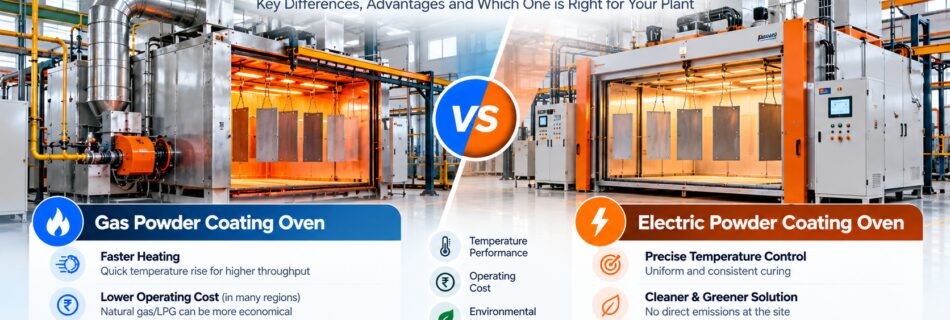
Choosing between a gas vs electric powder coating oven should not come down to a simple rule such as “gas is cheaper” or “electric gives better quality.” Both heating systems can produce properly cured powder coatings when the oven is engineered correctly. The better choice depends on your component size and thermal mass, production volume, operating hours, local electricity and fuel prices, available electrical capacity, gas infrastructure, oven design, maintenance resources and long-term operating strategy. For a small batch operation running only a few cycles each day, an electric oven may offer simpler installation and easier operation. For a large, continuously operated curing oven, gas may become economically attractive where reliable LPG or PNG is available at a competitive delivered energy cost. The most important principle is: Compare gas and electric ovens using the same component load, cure requirement and production target—not simply the purchase price of the oven. Brahma Fabricon manufactures both gas- and electrically heated powder curing ovens, allowing the heating source to be selected around the actual production requirement rather than forcing every factory into one technology. Gas vs Electric Powder Coating Oven: Quick Comparison Factor Gas Powder Coating Oven Electric Powder Coating Oven Heat source LPG, PNG or natural gas depending on availability Electric resistance heaters or another specified electrical heating system Installation Requires suitable fuel supply, burner system and associated safety infrastructure Requires sufficient electrical capacity and suitable electrical distribution Operating cost Can be attractive where fuel cost per useful unit of heat is low Can be attractive where electricity is competitively priced or operating hours are limited Large heat loads Often practical where high burner capacity and reliable fuel supply are available Practical where sufficient connected electrical load is available Temperature control Good with correctly designed modulating burner and airflow controls Good with correctly sized heaters and modern temperature controls Combustion products Present in fuel-fired systems; handling depends on direct- or indirect-fired design No onsite combustion products from the heating elements Maintenance Includes burner, gas train, combustion and related safety equipment Typically focuses on heaters, contactors/SSRs, controls and circulation equipment Utility constraint Fuel availability, pressure and approved installation Electrical connected load and tariff Typical decision driver High operating hours or large thermal demand where fuel economics are favorable Simpler utility setup, lower-volume operation or sites favoring electrification Neither column should be interpreted as universally better. A properly engineered gas oven can deliver excellent temperature control, and an electric oven can support significant industrial production when the factory electrical infrastructure is designed for it. What Does a Powder Coating Oven Actually Need to Do? A powder coating oven provides the thermal energy required for applied thermosetting powder to melt, flow and chemically crosslink into its finished coating. The important curing requirement is not simply the air temperature displayed on the oven controller. The Powder Coating Institute explains that proper cure requires two conditions: the specified metal temperature and time. It also distinguishes between part bring-up time—the time required for the component to reach its cure temperature—and dwell time at that temperature. This means the oven should be selected around: Input Why It Matters Powder cure schedule Defines the required time/metal-temperature relationship Component dimensions Determines usable oven chamber or conveyor opening Component material Affects thermal behaviour Part thickness Influences heat-up time Total loaded mass Changes the amount of heat required per cycle Fixtures/trolleys They must also be heated and add thermal mass Parts per batch/hour Determines total thermal demand Operating hours Strongly influences energy economics This is why choosing between gas and electric heating should happen after the thermal load is defined. How Does a Gas Powder Coating Oven Work? A gas powder coating oven uses combustion to generate heat. Depending on the plant and local infrastructure, the fuel may be LPG, PNG or another approved gaseous fuel. A typical convection system combines a burner or heat-generation section with recirculation fans that distribute heated air throughout the curing chamber. Direct-Fired Gas Heating In a direct-fired process, combustion products enter the process air that transfers heat to the workpiece. The U.S. Department of Energy distinguishes direct fuel-fired heating from indirect heating on this basis: in direct systems, combustion gases can contact the material or process environment. Direct heating can provide an efficient route for transferring combustion heat, but the complete system must be designed around the coating process, combustion controls, airflow and applicable safety requirements. Indirect-Fired Gas Heating In an indirect-fired system, combustion occurs separately and heat passes through a heat exchanger before the process air enters the curing chamber. This keeps the combustion stream separate from the oven circulation air. The trade-off is that additional heat-exchange hardware can add complexity and thermal losses. Whether direct or indirect heating is appropriate should therefore be determined from the application rather than assuming one method is always superior. How Does an Electric Powder Coating Oven Work? An electric powder coating oven commonly uses resistance heating elements to convert electrical energy into heat. Recirculation fans then distribute that heat through the chamber in a convection-style oven. The U.S. Department of Energy describes resistance heating as an electric process-heating method in which electrical resistivity is used to generate thermal energy. Electric ovens avoid a combustion burner and onsite fuel train. However, large curing systems may require substantial electrical capacity, so the factory’s available connected load should be confirmed before an electrically heated oven is selected. For a deeper electric-specific buying guide, see Brahma Fabricon’s electric powder coating oven guide. Gas vs Electric Powder Coating Oven Cost There is no responsible universal answer to the question, “Which oven costs less?” because there are two different costs to compare: initial installed cost and lifetime operating cost. Initial Equipment and Installation Cost An electric oven may have a simpler heating architecture because it does not need a gas burner, fuel train or combustion system. However, this does not automatically mean the complete installed project will be cheaper. If the factory lacks adequate electrical capacity, an electric system may require: transformer or sanctioned-load upgrades, …

powder coating plant installation process

Powder Coating Plant Installation Process: Planning, Factory Readiness, Commissioning & Handover

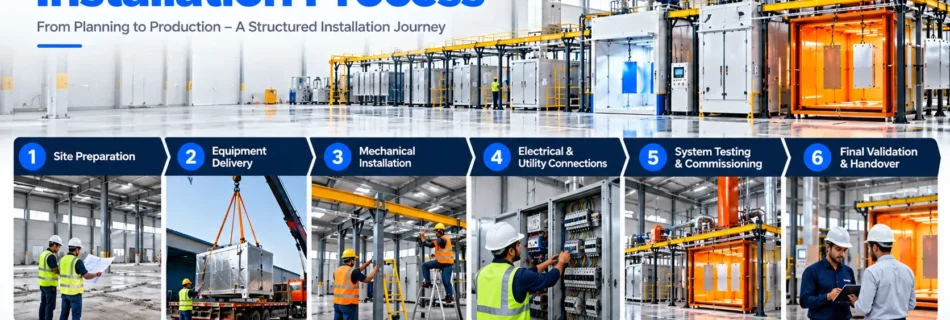
Installing a powder coating plant involves much more than positioning a booth, oven and conveyor inside a factory. A successful powder coating plant installation process begins with production requirements and factory readiness, then moves through mechanical erection, utility integration, testing, commissioning, operator training and final handover. For a turnkey or conveyorised system, the complete process typically follows this sequence: Requirement confirmation → layout approval → factory readiness → equipment delivery → mechanical installation → utility integration → pre-commissioning → dry trials → process commissioning → production trials → acceptance testing → operator training → documentation → handover The important distinction is that installation and commissioning are not the same thing. Installation confirms that the equipment has been positioned and connected. Commissioning proves that the complete coating process can operate safely, consistently and according to the agreed production requirements. Manufacturers planning a new line can review Brahma Fabricon’s powder coating plant solutions and powder coating projects and installations to understand how different plant configurations can be engineered around specific products and production requirements. Powder Coating Plant Installation Process at a Glance Project Stage Main Objective Requirement confirmation Freeze product, capacity and coating-process requirements Layout approval Confirm equipment positions, material flow and service clearances Factory readiness Prepare civil work, access, utilities and drainage Equipment delivery Receive, inspect and stage equipment for erection Mechanical installation Position and assemble the plant equipment Utility integration Connect electricity, compressed air, water, fuel and drainage Pre-commissioning Inspect each subsystem before powered trials Dry commissioning Test mechanical movement, controls and safety systems Process commissioning Establish pretreatment, powder application and curing conditions Production trials Coat representative customer components Acceptance testing Verify agreed performance and production criteria Training Prepare operators and maintenance personnel Handover Transfer documentation and the commissioned plant to production What Is the Powder Coating Plant Installation Process? The powder coating plant installation process is the coordinated sequence used to prepare a manufacturing facility, install powder coating equipment, integrate utilities and controls, validate process performance and hand over a production-ready finishing system. Depending on the project, the plant can include: pre-treatment tanks or spray tunnels; dry-off ovens; powder coating booths; cyclone or cartridge recovery systems; manual or automatic powder guns; reciprocators; powder feed and management systems; curing ovens; overhead, floor or power-and-free conveyors; PLC and HMI controls; ducting and ventilation; water and wastewater systems; loading and unloading stations. A turnkey installation is successful only when these systems operate together as one controlled production process. Installation vs Commissioning vs Handover These three stages are closely connected but serve different purposes. Installation Installation involves physically positioning, assembling and connecting the plant equipment. Typical installation activities include: equipment positioning; conveyor erection; oven assembly; booth installation; ducting; piping; electrical wiring; compressed-air connections; water and drainage connections; fuel connections. Commissioning Commissioning verifies whether the installed plant actually performs as intended. It can include: conveyor trials; airflow verification; oven heating tests; temperature profiling; powder booth extraction testing; gun and reciprocator trials; pretreatment process checks; PLC and safety-interlock verification; actual workpiece coating trials. Handover Handover takes place after the agreed commissioning and acceptance activities have been completed. The operating team receives the plant, training and documentation required for routine production and maintenance. Phase 1: Confirm Production Requirements Before Installation The installation project should begin with a confirmed basis of design. Changing fundamental production requirements after equipment manufacturing has started can lead to expensive modifications. Confirm Workpiece Information Document the: minimum component dimensions; typical component dimensions; maximum component dimensions; maximum component weight; substrate; geometry; hanging orientation; masking requirements; coated surface area where relevant. The complete hanging envelope—including the workpiece and fixture—should be considered when designing conveyor clearances, booth openings, pretreatment equipment and ovens. Confirm Production Capacity Define the expected: parts per hour; parts per shift; shifts per day; hanger pitch; parts per hanger; expected future production. Confirm the Coating Specification The project team should also confirm: pretreatment requirement; powder type; target film thickness; powder cure schedule; number of colours; colour-change frequency; customer or OEM quality specifications. A line designed for lightweight sheet-metal cabinets will require different handling, curing and equipment sizing from a line intended for heavy CNC machine bodies or large fabricated structures. Phase 2: Approve the Final Powder Coating Plant Layout The approved plant layout should show much more than equipment footprints. It should identify: loading area; conveyor route; pre-treatment equipment; dry-off oven; powder coating booth; powder recovery equipment; curing oven; cooling zone; inspection area; unloading area; operator access; maintenance access; electrical panels; utility termination points; powder storage; chemical storage; wastewater route; ETP connection; columns, doors and structural obstacles. The layout should represent the plant’s working footprint, not only its machine footprint. For detailed planning principles, see our guide to powder coating plant layout design. Allow Space for Maintenance A booth may physically fit into a space while still being difficult to maintain if there is no room to remove filters, service a cyclone or access automatic guns. Similarly, ovens need access to: burners or heating elements; recirculation fans; motors; ductwork; sensors; control devices. Service clearances should be included before the layout is frozen. Phase 3: Define Customer and Supplier Responsibilities Powder coating plant projects often involve interfaces between the equipment supplier, customer and third-party contractors. These responsibilities should be defined before equipment dispatch. Project Requirement Responsibility to Define Equipment manufacture Supplier scope Transportation Customer or supplier Unloading Crane/forklift responsibility Civil foundation Customer or nominated contractor Electrical incomer Customer/supplier interface Plant internal wiring Define clearly Fuel connection Define termination point Compressed air Define pressure, quality and connection Water supply Define connection and quality Drainage Define interface ETP Define treatment and piping scope Trial powder Define responsibility Pretreatment chemicals Define responsibility Trial components Customer production samples A clear responsibility matrix reduces disputes and prevents the commissioning team from arriving at a factory where essential utilities are incomplete. Phase 4: Prepare the Factory Before Equipment Delivery A site is ready when equipment can be unloaded, positioned, connected and commissioned without unnecessary delays. Check Factory Access Verify: main gate dimensions; internal door dimensions; truck access; unloading …

powder coating plant layout

Powder Coating Plant Layout Design: Factory Space, Equipment Placement & Planning

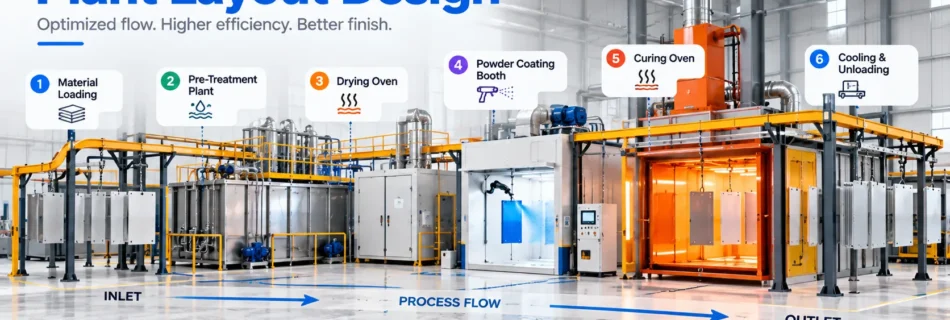
A good powder coating plant layout is not simply a drawing showing where the pretreatment system, booth and oven will fit. It is the physical design of the complete production flow: incoming component → loading → pretreatment → drying → powder application → curing → cooling → inspection → unloading or assembly The layout must also accommodate conveyor movement, operator access, maintenance, utilities, powder and chemical storage, wastewater handling, forklifts or cranes, work-in-progress and future expansion. That is why the correct starting question is not: “How many square feet does a powder coating plant need?” It is: “What products must move through the plant, at what rate, through which processes, and within what building constraints?” Current engineering guidance from multiple coating-line specialists follows the same principle: define the part, output and building first, then design the equipment and line around them. Manufacturers planning a complete system can use Brahma Fabricon’s powder coating plant solutions as the supporting commercial page while using this guide to plan the factory layout before final equipment selection. Quick Summary: What Should a Powder Coating Plant Layout Include? A complete layout should account for: Area Main planning requirement Incoming/WIP area Space for uncoated components waiting for finishing Loading station Safe and ergonomic hanging/loading Pretreatment Process length, tanks/tunnel, drainage and chemical access Dry-off Correct position after wet pretreatment Powder booth Clean environment, operator access and recovery equipment Curing oven Residence time, conveyor route and heat isolation Cooling Enough distance/time before handling Inspection Accessible QC area with adequate lighting Unloading Safe removal from conveyor or trolley Finished-goods staging Separation from dirty incoming components Powder storage Controlled storage near application area without obstructing booth service Chemical storage Safe access near pretreatment without contaminating clean zones Utilities Power, fuel, air, water, exhaust and drainage Maintenance Access around fans, filters, burners, pumps and conveyor drives ETP/wastewater Appropriate location relative to pretreatment drainage Expansion space Provision for future capacity or additional equipment The actual plant footprint is the result of all of these zones—not simply the dimensions printed on equipment drawings. What Is a Powder Coating Plant Layout? A powder coating plant layout is the planned physical arrangement of pretreatment, drying, powder application, curing, material handling, utilities, inspection and support areas inside a manufacturing facility. A good layout aims to move components through the finishing process with minimal unnecessary movement while preserving: production capacity; coating quality; safe operation; maintenance access; utility access; operator ergonomics; future scalability. The conveyor is often the structural backbone of an automatic line because its route connects every major process stage. For a deeper understanding of the individual stages before planning their placement, see Brahma Fabricon’s powder coating process guide. Start With the Product, Not the Building Drawing Factory dimensions matter, but product information should come first. Before a layout is developed, document the workpieces that will use the line. Maximum part envelope Record: maximum length; maximum width; maximum height; maximum weight. For conveyorised plants, calculate these dimensions in the actual hanging orientation, including the fixture. A 1,500 mm-high product may require substantially more vertical clearance once a hanger, trolley, conveyor track and safety clearance are added. Typical part envelope The largest product determines whether equipment can physically accommodate the workpiece. The typical product, however, often determines: production economics; hanger density; booth utilization; energy use; conveyor loading. Do not optimize the entire line around a rare oversized component if 90% of production is much smaller without first testing the economic consequences. Product geometry Document: flat faces; cavities; recesses; hollow sections; water traps; masking requirements; hanging points. Geometry affects pretreatment drainage, booth access and fixture orientation. Production requirement Define: parts/hour; parts/shift; shifts/day; days/month; expected future production. Sundial’s current layout guidance similarly identifies workpiece dimensions, weight, substrate, geometry and throughput as fundamental inputs before determining line equipment. Factory Space: Total Area Is Not the Same as Usable Area One of the biggest powder coating plant layout mistakes is looking only at factory floor area. A building may have enough total square metres while still being unsuitable for the intended line. Usable space is reduced by: structural columns; walls; fire exits; electrical rooms; existing machines; staircases; crane columns; forklift lanes; storage zones; operator walkways; maintenance clearances; utility equipment. Recent coating-line layout guidance specifically warns that equipment fitting into a CAD plan does not mean the production line is operationally workable; columns, doors, maintenance space and material routes need to be evaluated together. Use this distinction Gross factory space = total available floor area. Usable equipment space = gross area minus structural, safety and operational restrictions. Required process space = equipment footprint + conveyor route + service clearance + operating clearance + staging + utilities. The project is viable only when required process space fits inside usable space. Ceiling Height Can Be More Restrictive Than Floor Area A coating plant is three-dimensional. For an overhead conveyor system, required building height may need to accommodate: floor clearance + hanging component + fixture + conveyor trolley/track + structural supports + service clearance This becomes particularly important for: tall control panels; machinery frames; long vertically hung components; large cabinets; agricultural machinery; heavy fabrications. Elektrosprey identifies ceiling height as a frequently overlooked constraint because a plant can sometimes be extended horizontally, whereas raising an existing roof is much more difficult. Before designing the conveyor route, provide the supplier with: clear internal height; beam height; crane level; ductwork; sprinkler/service locations; roof obstructions. The Basic Powder Coating Plant Process Layout For many conveyorised systems, the conceptual sequence is: Incoming Parts ↓ Loading ↓ Pretreatment ↓ Dry-Off Oven ↓ Cooling / Stabilization ↓ Powder Coating Booth ↓ Curing Oven ↓ Cooling ↓ Inspection ↓ Unloading ↓ Finished Parts / Assembly The diagrams above are useful conceptual references, but the final Brahma Fabricon article should use an original branded plant-layout diagram based on its own engineering approach rather than reproducing competitor artwork. Four Common Powder Coating Plant Layout Types There is no single ideal geometry. The building, part flow and conveyor configuration determine the best arrangement. 1. Linear layout …

Powder coating plant for sheet metal fabrication

Powder coating plant for sheet metal fabrication: complete guide

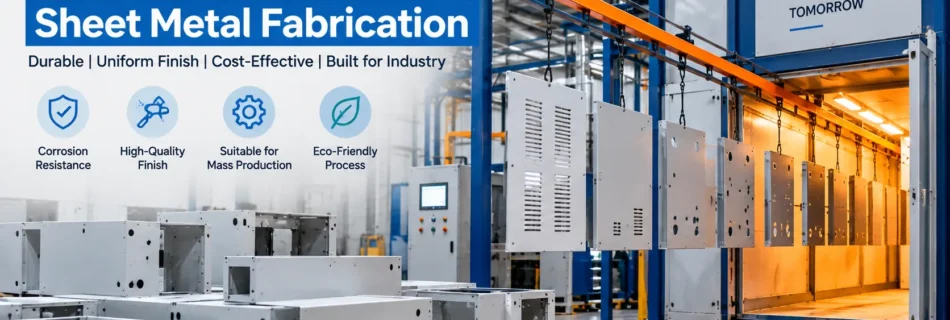
A powder coating plant for sheet metal fabrication should be designed around the complete manufacturing flow—not selected simply by booth size or oven temperature. For a sheet-metal factory producing electrical cabinets, control panels, machine covers, HVAC components, server racks, cleanroom panels, furniture components or fabricated enclosures, the most important inputs are: part dimensions → substrate → production volume → hanger density → product mix → colour changes → pretreatment requirement → coating specification → cure schedule → available factory space A low-volume fabricator making many different parts may be best served by a flexible manual or batch system. A manufacturer producing hundreds of repeatable panels, cabinets or enclosures per shift may achieve better throughput and consistency from a conveyorised line with automatic guns and manual touch-up. The correct question is therefore not: “Which powder coating plant should a sheet-metal factory buy?” It is: “What finishing system can coat our actual sheet-metal product mix at the required quality, takt time and cost per acceptable part?” The Brahma Fabricon powder coating plant range includes manual, batch and conveyorised configurations that can be engineered around these production variables. Quick summary Sheet-metal requirement Plant-design implication High number of small parts Optimize hanging density and loading time Large cabinets/enclosures Size booth, washer and oven around actual hanging envelope Mixed CRCA/MS/GI/aluminium Match pretreatment to each substrate and finish requirement High production volume Evaluate conveyorised automatic or hybrid application Short runs/prototypes Maintain manual coating flexibility Frequent colour changes Prioritize booth-cleaning and powder-management strategy Deep folds/recesses Plan gun position and manual reinforcement Threaded holes/interfaces Develop repeatable masking Indoor products Select powder around actual service specification Outdoor products Use powder and pretreatment suitable for weather exposure Multiple panel sizes Design hanging fixtures around product families Tight production takt Balance pretreatment, spraying and curing as one line What is a sheet metal powder coating plant? A sheet metal powder coating plant is an integrated finishing system that cleans and prepares fabricated metal components, applies electrostatically charged powder, cures the coating under controlled heat and moves finished parts through inspection and unloading. A typical production line includes: loading → pretreatment → rinsing → dry-off → powder application → powder recovery → curing → cooling → inspection → unloading The Powder Coating Institute explains that electrostatic application charges powder particles so they are attracted to a grounded component; heat is then used to produce the cured coating. For sheet-metal manufacturing, however, the coating line should ideally be treated as an extension of the fabrication process rather than an isolated finishing department. Why powder coating fits sheet metal fabrication Sheet-metal manufacturers often need a finish that combines: appearance; corrosion protection; repeatability; colour control; abrasion resistance; scalable production. Powder coating is widely suited to metallic industrial products and, unlike solvent-borne liquid coatings, uses a dry coating material without a solvent carrier. PCI notes that overspray can be recovered in suitable systems and that powder application can achieve high material utilization when application and recovery are correctly engineered. But these advantages depend heavily on process design. A poor pretreatment system, weak grounding, overloaded conveyor or under-sized oven can undermine an otherwise sophisticated spray system. That is why the entire line needs to be balanced. Start with the fabrication process, not the coating equipment A sheet-metal component may already have passed through several manufacturing operations before reaching coating: Sheet stock → laser cutting/punching → bending → welding → grinding/deburring → fabrication inspection → surface preparation → coating → assembly Every upstream process can affect finishing. The coating department may receive parts carrying: punching or forming lubricant; machining oil; weld residue; fingerprints; adhesive residue; rust; grinding dust; burrs; sharp edges. PCI specifically warns that cleaning is particularly important with powder coating because the coating does not contain solvent that can make a process more forgiving of residual organic contamination. Therefore, one of the first plant-design questions should be: What will actually be on the sheet metal when it enters pretreatment? Which sheet metal products can be powder coated? Common applications include: electrical control panels; switchgear cabinets; server and network racks; telecom enclosures; machine guards; CNC-machine enclosures; HVAC cabinets; cleanroom panels; laboratory furniture; steel furniture; shelving; appliance housings; EV and battery-related enclosures; agricultural-machine covers; general fabricated brackets; doors and access panels. Brahma Fabricon’s published applications already include control panels and general metal fabrication within its powder coating systems. The equipment should nevertheless be specified around the actual part family, because a small bracket and a two-metre electrical cabinet create very different loading, spraying and oven requirements. Step 1: create a sheet-metal component matrix Before requesting a powder coating plant quotation, divide production into product families. A useful matrix looks like this: Product family Typical dimensions Max weight Parts/shift Substrate Colour changes Hanging points Small brackets Flat panels Cabinet doors Enclosures Machine covers Large fabricated assemblies Do not size the line around only the largest component. The largest part determines physical clearance, but typical parts determine most of the production economics. For example, if 80% of production consists of small cabinet panels and only 5% consists of large enclosures, designing every station solely around the largest enclosure could create unnecessary operating cost. Step 2: identify every substrate entering the coating line Sheet-metal factories often process more than one material. Common substrates include: CRCA or mild steel Widely used for cabinets, machine panels, furniture and fabricated products. Galvanized steel Used where corrosion protection from the metallic coating is required. Aluminium Common in electrical, electronics, architectural and lightweight fabrication. Stainless steel Used selectively where a coated finish is required despite the underlying corrosion-resistant substrate. These materials should not automatically receive the same chemical process. PCI’s current technical guidance specifically states that cleaner selection depends on factors including the base metal, soil being removed, operating temperature and oil-removal requirement. It also notes that substrates such as aluminium or zinc can require different cleaner considerations. Practical rule Do not specify: “7-tank pretreatment because that is standard.” Specify: “A pretreatment sequence capable of achieving our required coating performance on these defined substrates.” Brahma …

Powder coating plant for CNC machine

Powder coating plant for CNC machine bodies & heavy fabrication

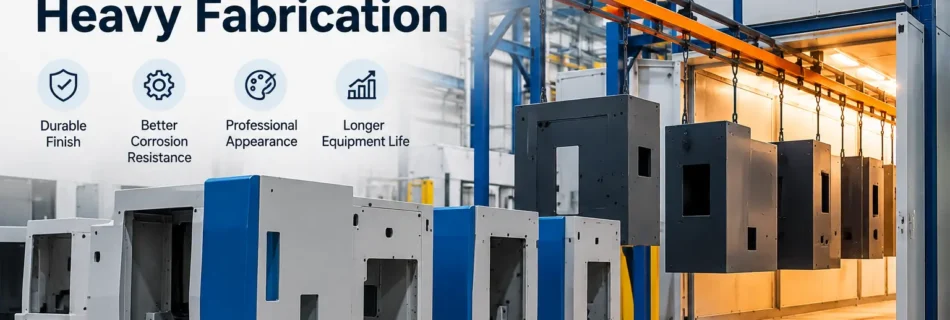
A powder coating plant for CNC machine bodies and heavy fabrication has to solve problems that are much less important in a conventional small-component coating line: high component weight, large dimensions, welded recesses, machining oil, mill scale, precision surfaces that cannot be coated, difficult material handling and the long heat-up time of thick steel. For that reason, the right plant is not simply a larger powder booth and oven. It should be engineered around: maximum part dimensions + maximum part weight + substrate condition + geometry + production volume + surface-preparation requirement + masking requirement + actual thermal mass + curing specification + factory material flow For low-volume or highly varied machine frames, a trolley-loaded batch system may be the most practical solution. For repeat-production CNC enclosures and machine bodies, an overhead conveyor can improve flow. Very heavy weldments may instead require floor conveyors, power-and-free handling or another engineered movement system. Brahma Fabricon’s existing conveyorised powder coating plant range already distinguishes between overhead, power-and-free and floor-conveyor configurations, including floor systems for very heavy fabrication. The important question is not which plant is most automated? It is: Which plant can safely prepare, coat, cure and move your actual machine components at the required production rate? Quick answer Requirement CNC sheet-metal enclosure Heavy welded fabrication Typical construction Sheet metal panels, doors, guards Welded structural steel/frame Primary challenge Finish consistency and recess coverage Weight, scale, contamination and thermal mass Material handling Hanging/conveyor often practical Trolley, floor conveyor or heavy-duty handling may be required Pretreatment Chemical spray/dip commonly considered Blasting and/or chemical treatment may be required depending on surface condition Application Manual, automatic or hybrid Manual or hybrid often useful for complex geometry Masking Threads, hinges, hardware interfaces Machined faces, bores, threads and mounting points Cure challenge Relatively fast heat-up Long part bring-up time Best line type Depends on output Often batch/flexible unless volume justifies automation Main QC concern Film consistency and appearance Cure, adhesion, edge/weld coverage and corrosion protection There is no universal plant layout. A machine-tool OEM producing 100 similar enclosures per shift has a very different requirement from a heavy fabricator coating five large welded frames per day. First, define what “CNC machine body” actually means This distinction is easy to overlook. A CNC machine commonly contains several types of metal components that may all be described informally as the “machine body.” Sheet-metal enclosure This can include: external guards; side panels; front doors; rear panels; electrical cabinet panels; roof covers; splash guards. These parts are generally good candidates for conventional powder coating when the material, pretreatment and service environment are suitable. Welded structural frame The supporting frame may be fabricated from: square or rectangular hollow sections; plate; welded channels; structural members; brackets. These components introduce heavier loading, welded corners, scale, recesses and more thermal mass. Precision machine base or machined structural component A fabricated or cast machine base may contain: machined mounting faces; bearing seats; guideway interfaces; alignment surfaces; bores; tapped holes; datum surfaces. These areas usually require deliberate protection from coating. The plant designer therefore needs drawings showing which areas are coated and which must remain coating-free. What parts of a CNC machine should not be powder coated? Powder should not simply be applied over every visible surface. Depending on the design, areas that may require masking include: precision machined faces; linear-guide mounting surfaces; bearing fits; spindle interfaces; gasket faces; earth/grounding points; threaded holes; dowel holes; electrical contact areas; hydraulic or pneumatic sealing interfaces; identification areas requiring separate treatment. Some components may also contain heat-sensitive assemblies that cannot enter a normal powder-curing cycle. The safest approach is to define coating and masking zones directly on the engineering drawing. Practical procurement insight: send the plant manufacturer both a general component drawing and a marked-up coating boundary drawing. Maximum dimensions alone are not enough to engineer the process. Why CNC bodies and heavy fabrication are difficult to powder coat The basic powder process is straightforward: electrostatically charged powder is attracted to a grounded metal component, then the coating is heated and cured. PCI describes electrostatic spray deposition as the most common powder application process. The difficulty comes from applying that principle consistently to large fabricated structures. Large dimensions The part opening through the: pretreatment equipment; booth; oven; conveyor route; must all accommodate the workpiece plus the fixture and safe operating clearances. High weight A large welded frame may require: reinforced hangers; floor-supported handling; transfer trolleys; lifting equipment; power-and-free conveyors; controlled loading stations. Complex geometry Machine frames contain: box sections; recesses; stiffeners; welded corners; inside angles; deep cavities. Those geometries complicate powder deposition and manual access. Surface contamination Fabrication can introduce: cutting oil; machining coolant; grease; welding residues; rust; scale; fingerprints; shop contamination. PCI notes that cleaning performance matters particularly in powder coating because the process does not contain solvent to compensate for organic soil left on the workpiece. Thermal mass Thick steel needs much longer to heat than a thin enclosure panel. This makes part-metal temperature, rather than the oven display alone, central to curing. Recommended process flow for CNC machine bodies A robust workflow can be structured as: Fabrication complete → inspection → weld/surface correction → degreasing/cleaning → rust/scale removal → conversion treatment where specified → rinsing/drying → masking → loading/grounding → powder application → curing → cooling → de-masking → QC → assembly For heavy weldments requiring abrasive preparation, the sequence may instead incorporate blasting before the final coating preparation steps. The exact preparation route should be defined around the incoming steel condition and required coating performance rather than by copying a generic three-, five- or seven-stage process. Step 1: inspect the fabrication before surface treatment Do not use the coating line to hide fabrication defects. Before pretreatment, inspect for: weld spatter; sharp edges; incomplete welds; grinding marks; excessive rust; mill scale; oil-filled cavities; blocked drain holes; inaccessible recesses; burrs; silicone contamination; permanent labels or hardware installed too early. A coating follows the underlying surface. Poor fabrication preparation can remain visible after cure. Heavy machine frames should therefore reach …

Powder Coating Equipment Buying Guide for Gujarat Industries

Powder coating equipment buying guide for Gujarat industries

Buying powder coating equipment should start with the components you need to coat—not with a machine catalogue or the cheapest quotation. For manufacturers in Gujarat, the correct system may range from a manual gun, booth and batch oven for flexible low-volume work to an integrated conveyorised line with automatic guns, powder recovery, pretreatment, PLC controls and continuous curing. The most important buying principle is simple: Specify the product, production requirement and finish standard first. Select the equipment second. A complete industrial powder coating system normally combines surface preparation, powder application, powder containment/recovery, curing and material handling. The Powder Coating Institute describes the common electrostatic process as charging powder through a spray gun, attracting it to a grounded part and subsequently curing the coating with heat. This guide explains how Gujarat manufacturers can select each part of that system, compare quotations properly and avoid expensive specification mistakes. What powder coating equipment should you buy? Production situation Equipment approach to investigate Low-volume, varied components Manual gun + manual booth + batch oven Job coating with frequent colour changes Flexible manual system with easy-clean booth Growing medium-volume production Manual/semi-automatic application with improved material handling Repetitive medium/high-volume parts Conveyorised line with automatic guns High-volume mono-colour production Automatic line with effective powder recovery Frequent multi-colour production Fast-clean booth/recovery configuration Large/heavy fabrication Batch or engineered conveyor system based on weight and thermal load Long aluminium sections Equipment sized around section length, pretreatment and handling Automotive/EV components High repeatability, controlled pretreatment, automation and process monitoring Control panels/enclosures Good grounding, recess coverage and flexible colour/application capability The final configuration should be validated against your actual parts, coating specification, factory layout, utilities and production targets. What equipment is required for powder coating? A complete industrial line can include: Surface pretreatment system Dry-off oven or drying system Electrostatic powder coating gun Powder feed equipment Powder coating booth Powder recovery system Reciprocators or automatic gun movers Powder curing oven Conveyor or material-handling system PLC/control panel and safety interlocks Compressed-air preparation Quality-control instruments Not every factory needs every item at the same level of automation. A small fabricator may need a flexible batch setup. A high-volume OEM may require a complete conveyorised powder coating plant. That distinction should be made before suppliers quote. Step 1: define the components before choosing equipment The single most useful buying document is a component matrix. Record the following before contacting equipment manufacturers: Input Minimum Typical Maximum Part length Part width Part height Part weight Surface area Parts per shift Colours per day Batch size Also provide photographs or drawings of representative components. Why maximum dimensions alone are insufficient Two parts that fit through the same booth opening may require very different plants. A thin sheet-metal enclosure and a heavy fabricated frame can have: different hanger requirements; different pretreatment needs; different powder-access challenges; different oven heat-up times; different conveyor loading; different curing residence requirements. The supplier should therefore know both the physical envelope and thermal mass of the product family. Step 2: define the finish requirement Equipment should support the coating specification—not determine it afterwards. Before selecting the plant, document: substrate; indoor or outdoor use; powder type; required colour and gloss; film-thickness requirement; corrosion-performance requirement; appearance standard; customer/OEM specification; masking requirements; production quality tests. PCI specifically recommends selecting powder coating in cooperation with the powder supplier because factors such as substrate, cure time, cure temperature, application method, chemical resistance and weatherability interact. This matters because the pretreatment system and curing oven cannot be specified correctly without knowing what coating performance is expected. Step 3: select the right pretreatment system Surface preparation is one of the easiest places to under-specify a coating plant. The purpose of pretreatment is to remove contamination and prepare the substrate for the coating system. Typical equipment may include: dip tanks; spray pretreatment tunnels; pumps; heaters; filtration; chemical dosing; rinsing stages; water-treatment equipment; drying equipment. Brahma Fabricon’s technical guide to powder coating pretreatment systems explains dip, spray and conversion-treatment configurations in more detail. Dip or spray pretreatment? Dip systems can be practical where components are complex, production is batch-based or complete immersion is useful. Spray systems are commonly integrated into conveyorised production where controlled continuous processing is required. The choice should consider: component geometry; substrate; contamination; required corrosion performance; production volume; wastewater; available floor area; chemical supplier recommendations. Buying question to ask Do not ask: “How many tanks should we buy?” Ask: “What pretreatment sequence does our substrate and coating specification require, and how will the equipment maintain that process?” The second question produces a much better plant. Manufacturers can also review Brahma Fabricon’s pretreatment plant configurations before specifying individual stages. Step 4: choose the right powder coating gun The spray gun directly affects powder charging, application control and operator productivity. Broadly, the choice is between: Manual guns Best suited to: low or medium production; changing part geometries; frequent colour changes; job coating; touch-up; complex areas needing operator judgement. Automatic guns Best suited to: repetitive production; conveyorised lines; stable part positioning; high throughput; processes where repeatability is important. Automatic guns plus manual touch-up This hybrid configuration can work well where the automatic guns cover the majority of the surface while an operator addresses difficult recesses or changing geometries. PCI’s professional training covers both manual and automatic application, including Faraday-cage effects, electrostatic rejection and automated gun setup—an indication that gun selection is only one part of achieving a stable coating process. Brahma Fabricon’s industrial powder coating equipment range includes manual application equipment as well as automatic guns and reciprocators. Do not choose a gun by kV alone A common procurement mistake is comparing powder guns only by maximum output voltage. Important evaluation criteria also include: voltage/current control; powder delivery stability; gun weight and operator ergonomics; nozzle options; cleaning time; hose and wear-part design; recipe storage; serviceability; spare-part availability; integration with automatic systems; performance on recesses and complex shapes. The highest numerical specification does not automatically mean the best result for every component. Step 5: choose a booth based on production and colour strategy A …

powder coating plant cost savings

How a powder coating plant saves costs for manufacturers in Vadodara

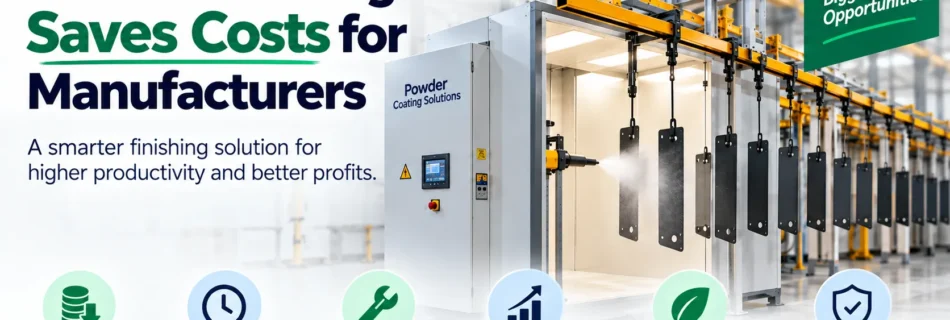
For a manufacturer, the financial benefit of a powder coating plant should not be measured by the price of the machine alone. A more useful measure is cost per acceptable finished component. A correctly specified powder coating plant can reduce manufacturing costs by improving powder utilization, reducing manual handling, lowering rework, increasing throughput and bringing finishing operations under tighter process control. For companies that currently outsource coating, an in-house plant may also reduce transport, vendor handling and production-waiting costs. But none of these savings are automatic. A plant that is oversized, poorly insulated, badly maintained or operated below its intended capacity can cost more than expected. Manufacturers in Vadodara should therefore compare total cost of ownership and cost per finished part, rather than choosing a powder coating plant solely on purchase price. The Powder Coating Institute (PCI) identifies three major economic advantages of powder coating over traditional liquid spray systems: material savings, lower operating expenses and reduced environmental-compliance costs. PCI also notes that appropriate recovery systems can push overall powder material utilization above 95%. For manufacturers evaluating a complete system, Brahma Fabricon’s powder coating plant range shows the major equipment combinations used in manual, batch and conveyorised finishing operations. Where does a powder coating plant save money? Cost area How savings can occur Powder material Recovering suitable overspray reduces material loss Labour Automation reduces repetitive spraying and material handling Rework Controlled pretreatment, application and curing improve process consistency Production Continuous lines can lower processing time per component Energy Correct oven sizing, insulation and process control prevent unnecessary heat loss Outsourcing In-house coating can remove supplier margins, transport and waiting time Inventory/WIP Shorter internal processing can reduce components waiting for external finishing Waste Reclaimable powder can reduce coating-material disposal Quality Better process repeatability can lower reject and warranty-related costs Downtime Preventive maintenance and accessible local service can reduce disruption Cost visibility Internal coating provides better measurement of powder, energy and labour per batch The amount saved will depend on your actual production volume, part geometry, colour-change frequency, coating specification, plant utilization and existing finishing cost. What does “saving cost” really mean in powder coating? A lower powder coating cost does not necessarily mean buying the least expensive plant. A useful manufacturing calculation is: Coating cost per acceptable part = material + chemicals + energy + labour + consumables + maintenance + rework + waste + downtime + capital cost allocation The important word is acceptable. If a low-cost process coats 1,000 parts but 80 require stripping and recoating, its true unit cost is very different from a process that produces the same 1,000 parts with substantially less rework. This is why manufacturers should evaluate the whole finishing line-from the pre-treatment system through application, powder recovery and the curing oven rather than judging one machine in isolation. 1. Recovering overspray can reduce powder consumption Powder is one of the most visible recurring costs in a coating operation. During electrostatic application, not every powder particle reaches the component on its first pass. The difference with a properly designed recoverable powder system is that suitable overspray can be captured, separated and returned to the process where the application allows reclaim. PCI states that powder systems using proper application equipment and recovery methods can achieve 95–98% material utilization. Its coatings comparison guidance similarly reports that overall utilization can exceed 95% because overspray can be captured, sieved and returned to the feed hopper. That does not mean every booth automatically provides 98% usable powder. Actual economics depend on factors such as: first-pass transfer efficiency; part geometry; grounding; booth airflow; recovery-system design; contamination; powder condition; colour-change frequency; whether reclaimed powder is acceptable for the finish specification. Nordson, for example, reports more than 95% recovery for certain twin-cyclone systems and more than 99% powder utilization for one of its filter-based mono-colour booth configurations. These are equipment-specific figures rather than universal guarantees, but they demonstrate why recovery design matters economically. Manufacturers evaluating this part of the line can review Brahma Fabricon’s powder coating booth configurations. The metric buyers should request Do not ask only: “What is the recovery percentage?” Also ask: “What powder consumption should we expect per acceptable coated component under our actual production conditions?” That question connects equipment performance to money. 2. Automation can reduce labour cost per component Labour savings do not necessarily mean eliminating operators. More often, automation allows the same production team to process more parts with less repetitive manual intervention. A manual operation may require people to: transport racks; position components; spray each component; monitor coating coverage; move parts into and out of the oven; handle production between separate process stations. A conveyorised powder coating plant can integrate multiple stages into a controlled material flow. Automatic guns and reciprocators can further reduce repetitive spraying on suitable high-volume product families. The main financial question should therefore be: How many labour minutes are required per acceptable finished part before and after automation? This metric is much more useful than simply counting operators. A business may keep the same number of people but increase production significantly. In that situation, labour cost per part falls even though headcount does not. PCI also identifies automation, reduced process complexity and lower reject levels as potential contributors to lower labour and operating costs. 3. Better pretreatment can reduce the hidden cost of rework A coating defect becomes expensive long before the rejected part reaches final inspection. Rework can involve: inspection → segregation → stripping or surface correction → cleaning → recoating → recuring → reinspection The manufacturer pays for some combination of powder, chemicals, energy, labour, machine time and delayed production twice. Proper pretreatment therefore has a financial function as well as a technical one. Its purpose is to remove contaminants and prepare the substrate so that the coating system can achieve the required adhesion and corrosion performance. Brahma Fabricon’s technical guide to pre-treatment systems explains the process in greater detail, while its separate pre-treatment cost and ROI guide examines the cost-benefit relationship. A better way to measure rework …