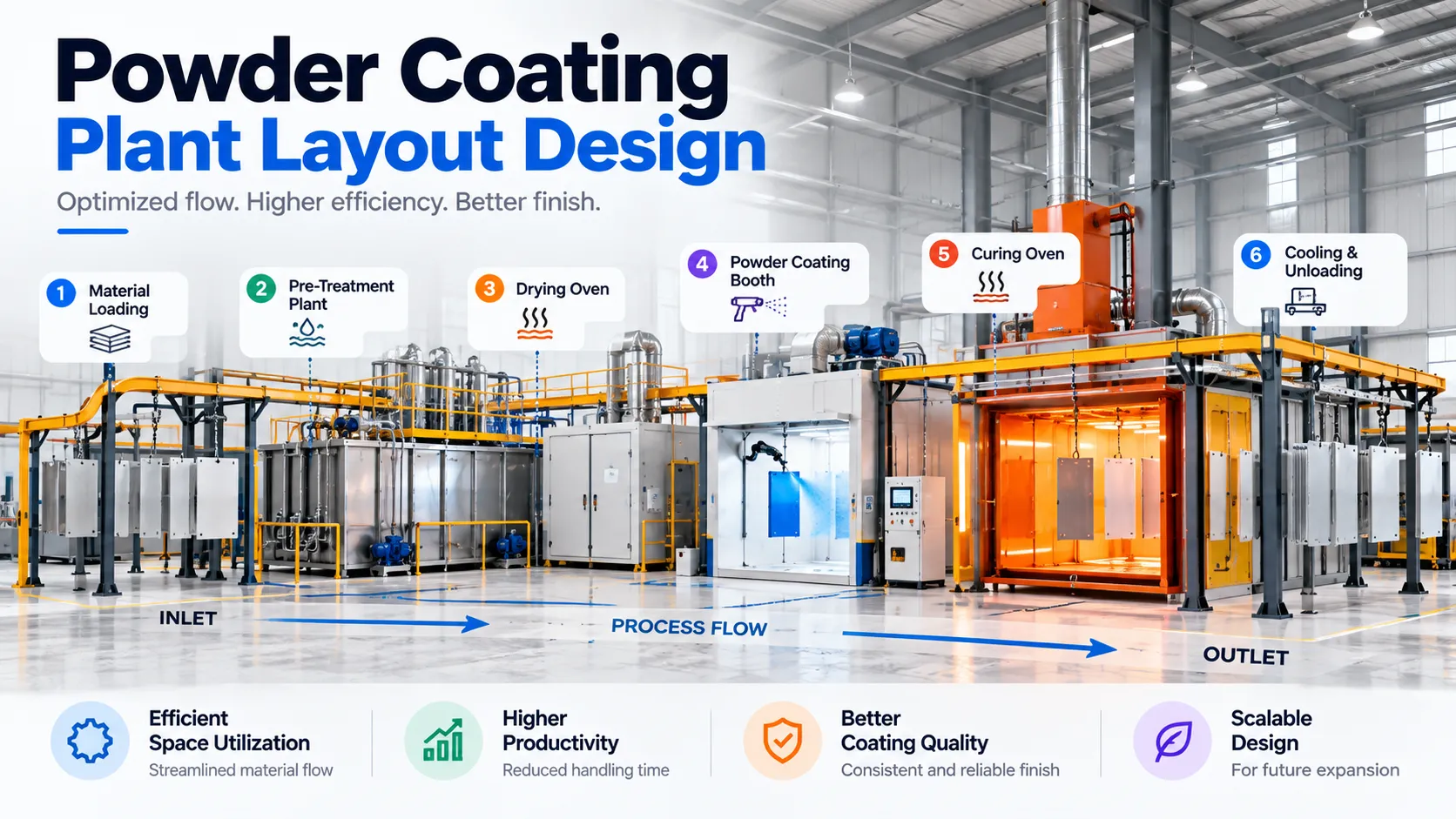
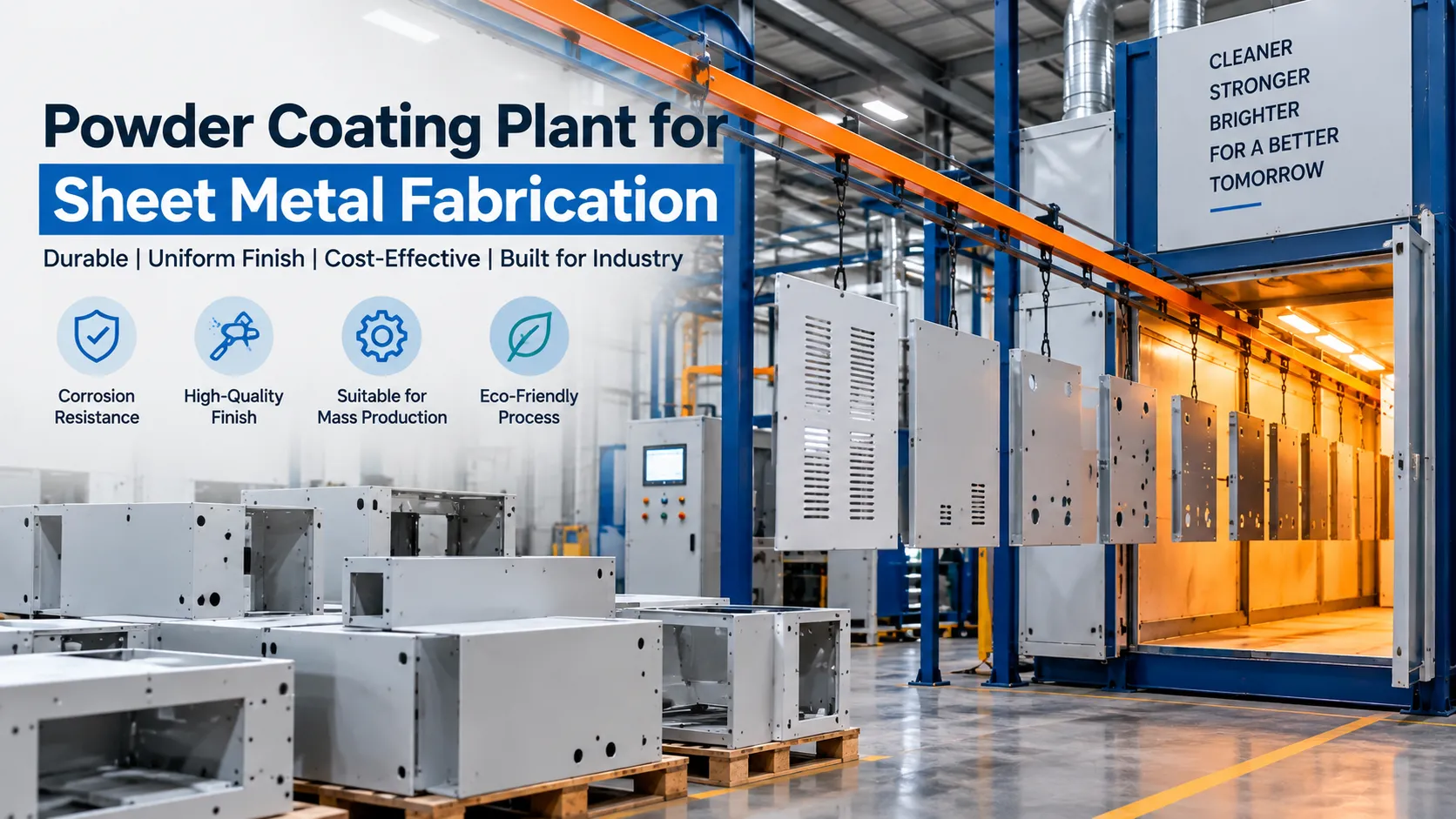
Conveyorised Powder Coating plants
Liquid Spray Painting Booths & Plant
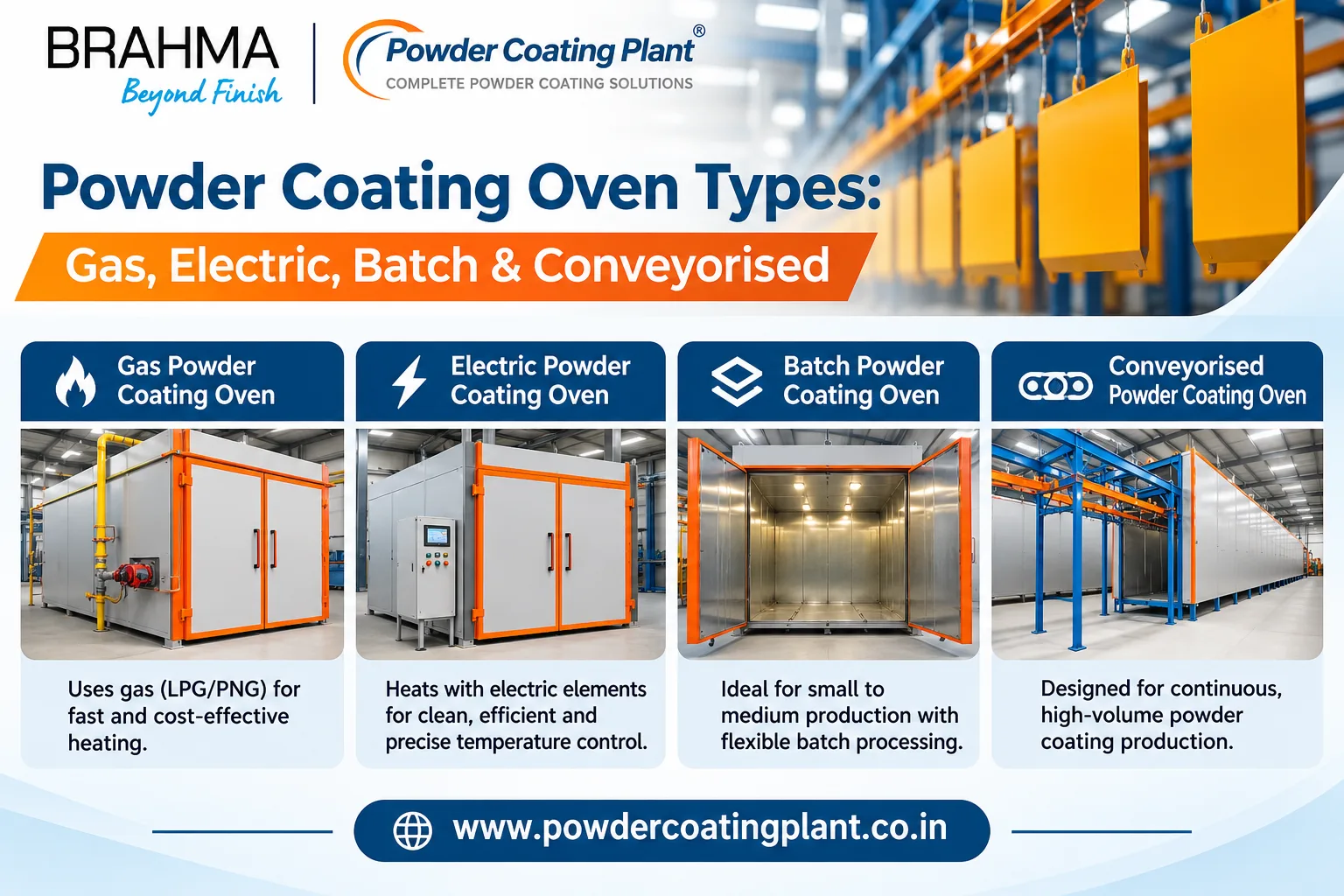
Brahma Fabricon, manufactures powder curing ovens in Vadodara, Gujarat, for industrial powder coating operations. Choose batch or conveyorized systems with gas or electric heating to suit your production requirements.
Planning a new coating line or replacing an existing oven? Share your component dimensions, output target and available utilities to discuss a suitable configuration and project quotation.
Batch and conveyorized systems · Gas and electric heating · Custom sizing
| Specification | Available Configuration |
|---|---|
| Oven type | Batch, trolley-loaded or conveyorised |
| Heating source | LPG, PNG or electric |
| Working chamber | Custom-built according to component and rack dimensions |
| Loading | Trolley, rack or overhead conveyor |
| Temperature control | Digital PID; PLC options depending on project |
| Air circulation | Forced hot-air recirculation |
| Insulation | Project-specific insulated panel construction |
| Production setup | Batch or continuous |
| Integration | Standalone oven or complete powder coating line |
| Application | Control panels, aluminium sections, automotive parts, furniture and fabricated components |
Final oven dimensions, heating capacity, airflow arrangement, controls and connected load are engineered against the actual component size, total loaded weight, production target and powder cure schedule.
Start with how parts move through production, then choose the heating source. A batch oven can use gas or electric heating; a conveyorized system combines continuous movement with a heating arrangement selected for the line.
LPG or PNG heating may suit facilities with dependable fuel availability. Compare the proposed fuel demand, utility arrangements and operating hours before selecting the system.
Discuss with us: your available fuel, site requirements and expected production load. Gas heating should be evaluated against your actual local fuel and electricity costs.
For a continuous coating line, the oven must work with the conveyor speed, component spacing and required curing schedule.
Specify the largest hanging part, production target and available layout when planning the heated path. The oven should be considered alongside the loading, spraying and unloading stages.
Consider a conveyorized system when: production is repetitive and a steady flow of components suits your operation. Explore our conveyorised powder coating plants for complete line requirements.
Key Features:
Best For: Automotive components, architectural aluminium sections, appliance manufacturing, and high-throughput powder coating lines.
Why Choose Brahma Fabricon?
Brahma Fabricon designs conveyorised powder curing ovens around the required production rate, conveyor speed, component loading pattern and powder cure schedule. Heating capacity, insulation and hot-air circulation are selected for the actual production requirement rather than relying on a standard oven configuration.
A manual gas-fired powder curing oven is a practical option for job coaters and medium-volume manufacturers that process components in batches and have access to LPG or PNG.
It can be configured around trolley size, component weight, batch capacity and required cure schedule.
Key Features:
Best For: Job coaters, furniture manufacturers, control panels, and custom fabrication units. Ideal when you need fast batch curing without high electricity bills.
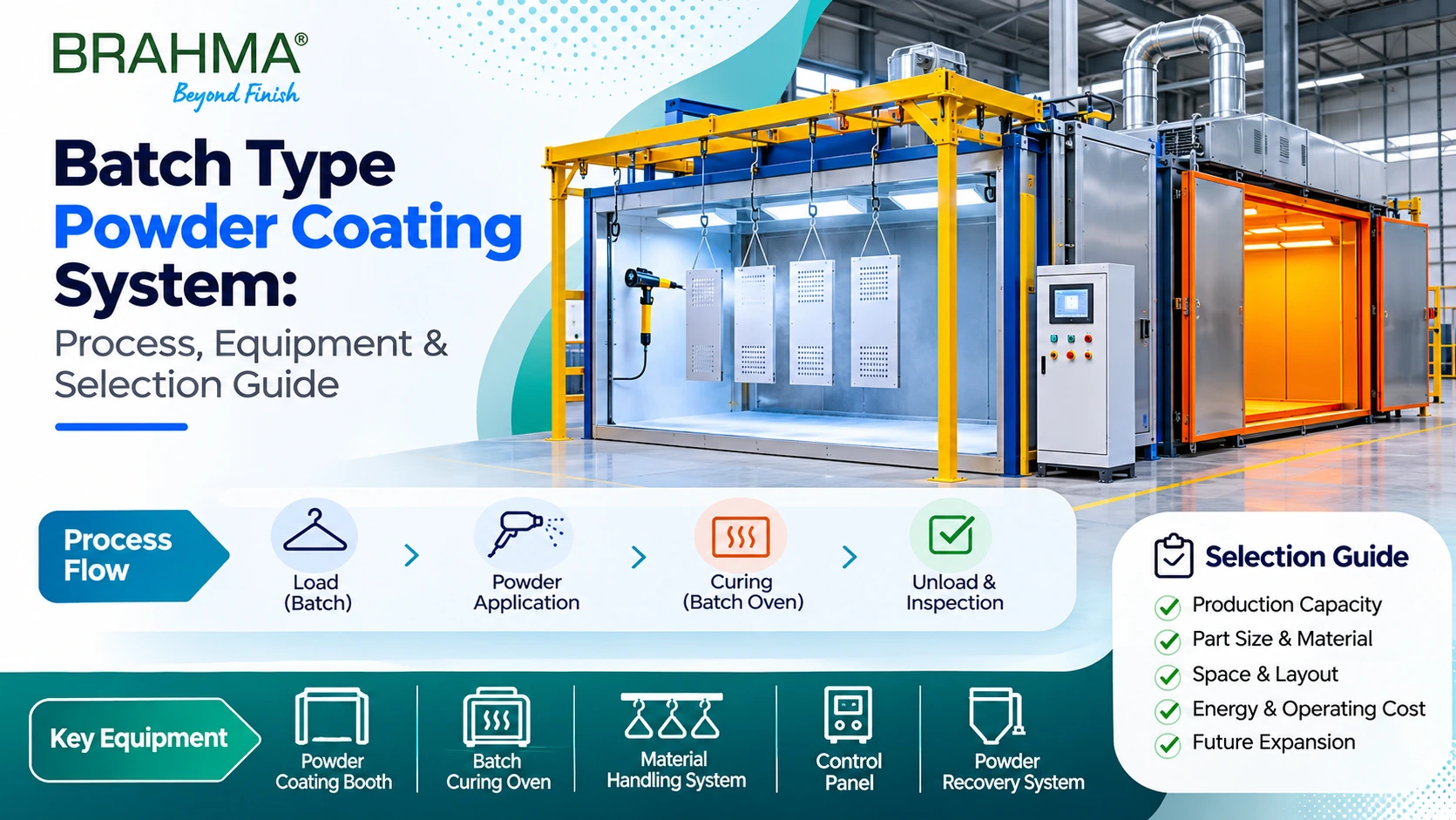
For job coating, changing component sizes and production scheduled in separate loads, a batch oven offers flexibility in loading and work planning.
Discuss the largest loaded trolley or rack, total batch weight and required output. These details help establish the usable chamber size and cycle requirements.
Consider a batch system when: you process mixed products, work in separate batches or need to accommodate occasional larger components.
Key Features:
Best For: Job shops, architectural fabricators, and manufacturers who process different products daily.
Electric heating is an option when your facility prefers electrically heated equipment or lacks a practical gas supply.
Discuss with us: available electrical capacity, supply details and production hours. Assess the full connected load, including heating, fans and auxiliary equipment, before ordering.
Key Features:
Engineered hot-air circulation and temperature control for consistent curing across the usable working zone.
Best For: Food-grade powder coating, medical equipment, and urban workshops where gas is not feasible.
Our standard industrial oven for powder coating combines the best of all above technologies. Available in any heating source and configuration, these ovens serve as the backbone of complete powder coating plants.
Two ovens with similar external dimensions may offer different usable space and production capacity. Define the loaded component arrangement before comparing quotations.
| Specification | What to provide or agree |
|---|---|
| Usable chamber dimensions | Clear internal length, width and height, with the dimension order stated |
| Largest component | Dimensions, material, thickness and individual weight |
| Loading arrangement | Trolley, rack or conveyor, including fixture dimensions |
| Production capacity | Parts per batch or hour, plus the component mix |
| Total load | Parts and handling fixtures to be heated |
| Cure requirement | Powder manufacturer’s technical data sheet and required cure schedule |
| Heating and utilities | Proposed fuel or electrical supply and available capacity |
| Controls | Temperature control, timers and any recipe or recording requirements |
| Performance verification | Agreed load, measurement locations and acceptance criteria |
| Installation footprint | Oven, loading access, maintenance access and utility connections |
Have a drawing but no final specification? Share the drawing and expected production quantity as a starting point.
Oven sizing should begin with the product, not with a standard chamber dimension. Two components occupying similar space can require different heating capacity and cycle time because their material, wall thickness, total mass and loading arrangement differ.
1. Maximum component envelope
Largest length × width × height.
2. Loaded weight
Component weight + trolley/rack/fixture weight.
3. Production requirement
Parts per batch, hour or shift.
4. Cure schedule
Required part-metal temperature and dwell time according to the powder manufacturer’s technical data sheet.
5. Handling arrangement
Trolley, rack or conveyor.
6. Available utilities
PNG, LPG or electrical capacity.
7. Factory layout
Loading area, door clearance, operator movement and maintenance access.
Send us your component drawing and production target → Get an oven configuration recommendation
The temperature shown on an oven controller is not necessarily the temperature of the component being coated. Powder manufacturers normally specify a cure schedule based on the temperature reached by the coated object or substrate.
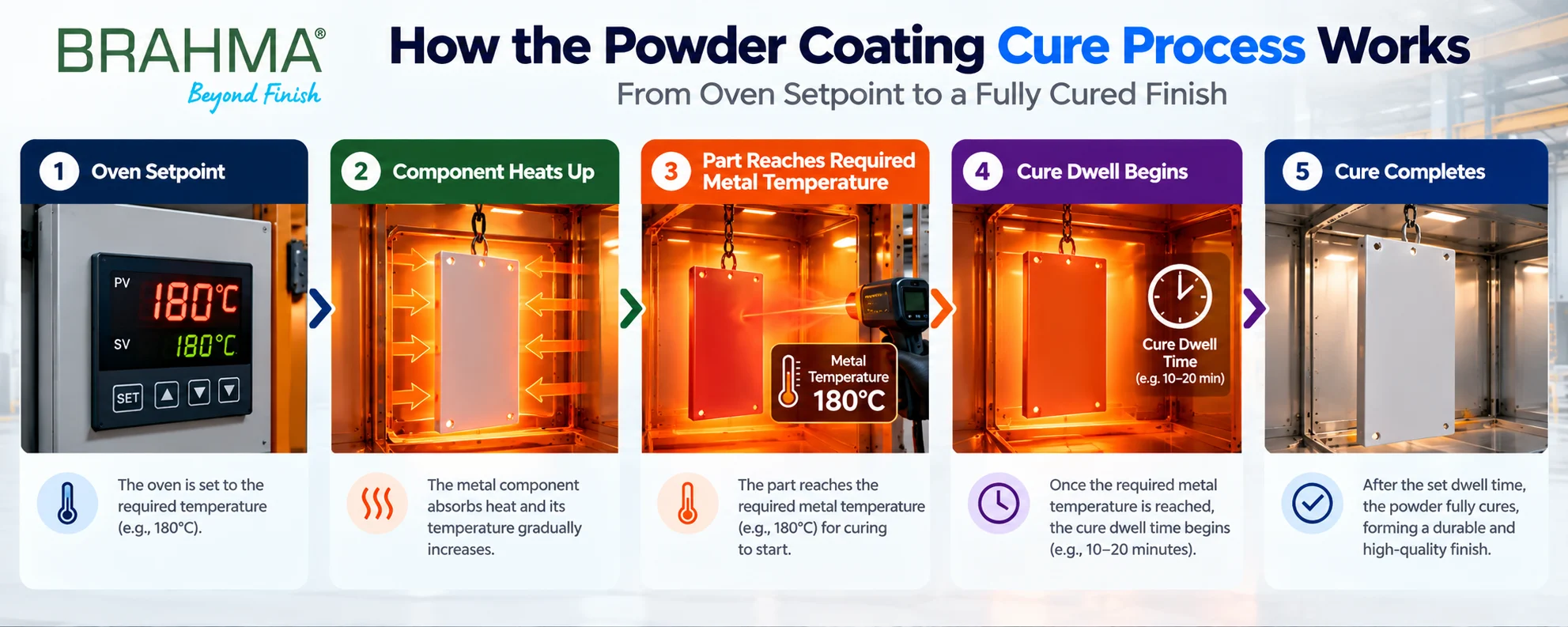
A heavy fabricated component generally takes longer to reach the required metal temperature than a thin sheet-metal component. This is why oven capacity cannot be calculated from cure time alone.
Depending on the project and agreed acceptance requirements, curing performance may be evaluated using representative production loads and temperature measurement at selected component locations.
| Check | Why it matters |
|---|---|
| Oven temperature | Confirms controlled chamber conditions |
| Part-metal temperature | Confirms the component reached cure temperature |
| Heat-up time | Determines when actual curing begins |
| Cure dwell time | Confirms required exposure |
| Loaded test | Represents real production conditions |
| Cold/heavy part location | Identifies the hardest component to cure |
| Conveyor speed | Determines residence time in continuous ovens |
The acceptance method should be agreed during engineering and documented before commissioning.
Heating capacity alone does not ensure uniform curing. Hot air must circulate around the loaded components and return to the heating section without significant dead zones.
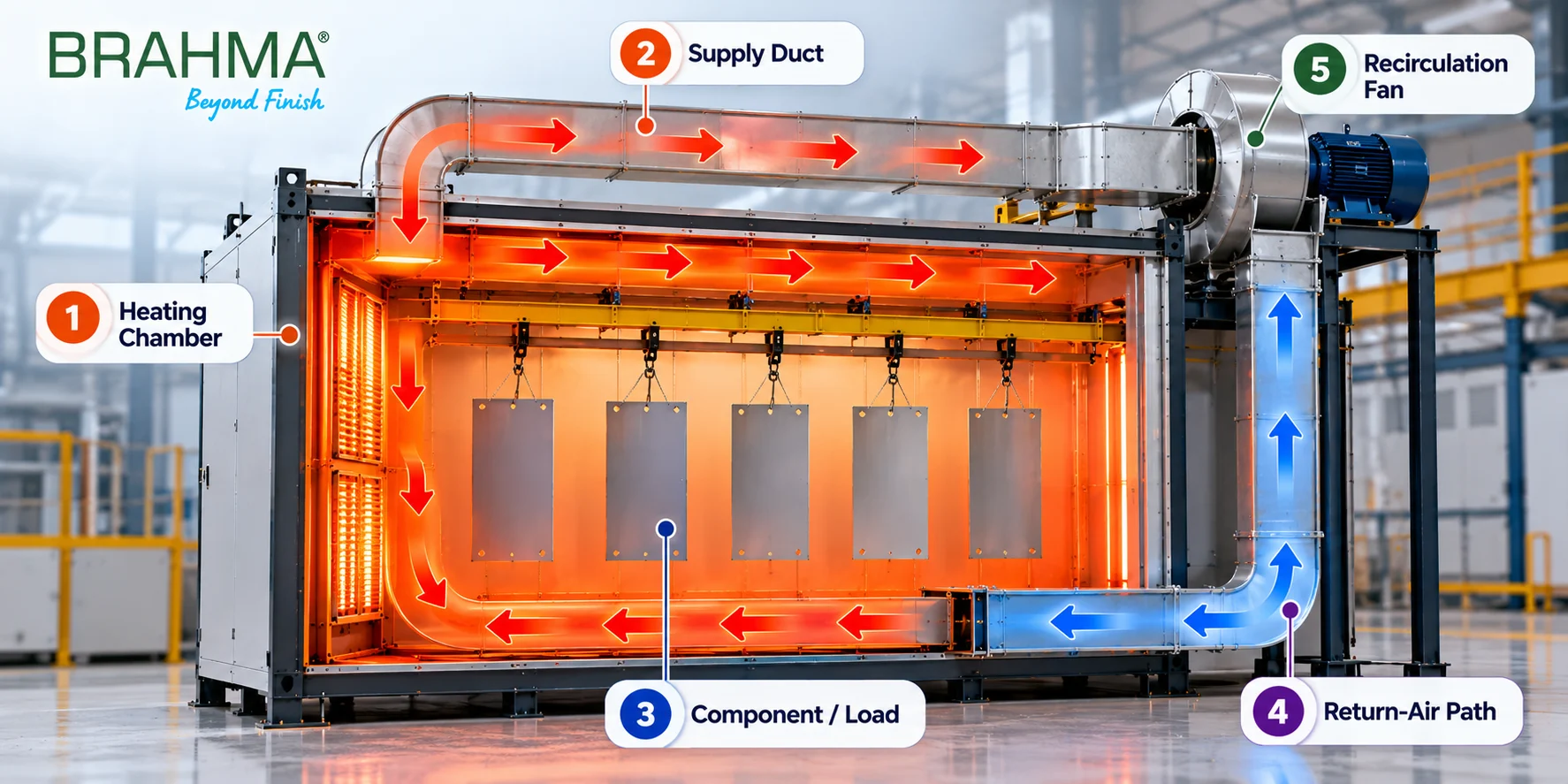
Component density: tightly loaded racks can restrict circulation.
Part geometry: boxes, channels and recessed areas create different airflow paths.
Load placement: blocking supply or return airflow may affect temperature distribution.
Oven length/chamber size: airflow design must match the heated volume.
A custom powder curing oven is priced against its size, heating requirement, loading system, controls and installation scope. A useful quotation connects the investment to the production you need to achieve.
The main cost factors are:
When comparing offers, check whether taxes, freight, unloading, trolleys, installation and site work are included. Ask for delivery terms, warranty coverage and exclusions in writing.
For a project-specific price, send your largest component dimensions, target output, preferred heating source and installation location.
| Oven type | Heating source | Production setup | Ideal for | Key buying consideration |
|---|---|---|---|---|
| Batch powder curing ovens | Gas or electric | Separate batches | Job coaters and mixed component sizes | Rack dimensions, batch weight and cycle time |
| Conveyorized powder curing ovens | Gas or electric | Continuous production | Automated powder coating lines | Conveyor speed, component spacing and curing time |
| Manual gas fired powder curing oven | LPG or PNG | Manually loaded batches | Job coating, metal furniture and control panels | Fuel availability, loading method and operating cost |
| Electric powder curing ovens | Electric | Batch or configured setup | Facilities preferring electric heating | Electrical capacity, connected load and tariff |
| Industrial oven for powder coating | Selected for the application | Custom batch or continuous setup | Large components and industrial coating requirements | Component dimensions, total load and line integration |
The heater rating alone does not tell you the cost of curing a batch. Actual consumption depends on the load, operating cycle, temperature, loading pattern and heat losses.
For a meaningful comparison, ask suppliers to state the assumptions behind their estimates:
Compare estimated energy cost per accepted part using the same production assumptions. Keep this separate from total manufacturing cost, which also includes labour, maintenance and other expenses.
Gas oven
Estimated energy cost per batch = fuel consumption × fuel price × operating time
Electric oven
Estimated energy cost per batch = average kW consumption × electricity tariff × operating time
Divide the batch energy cost by the number of acceptable coated components to estimate the curing-energy cost per part.
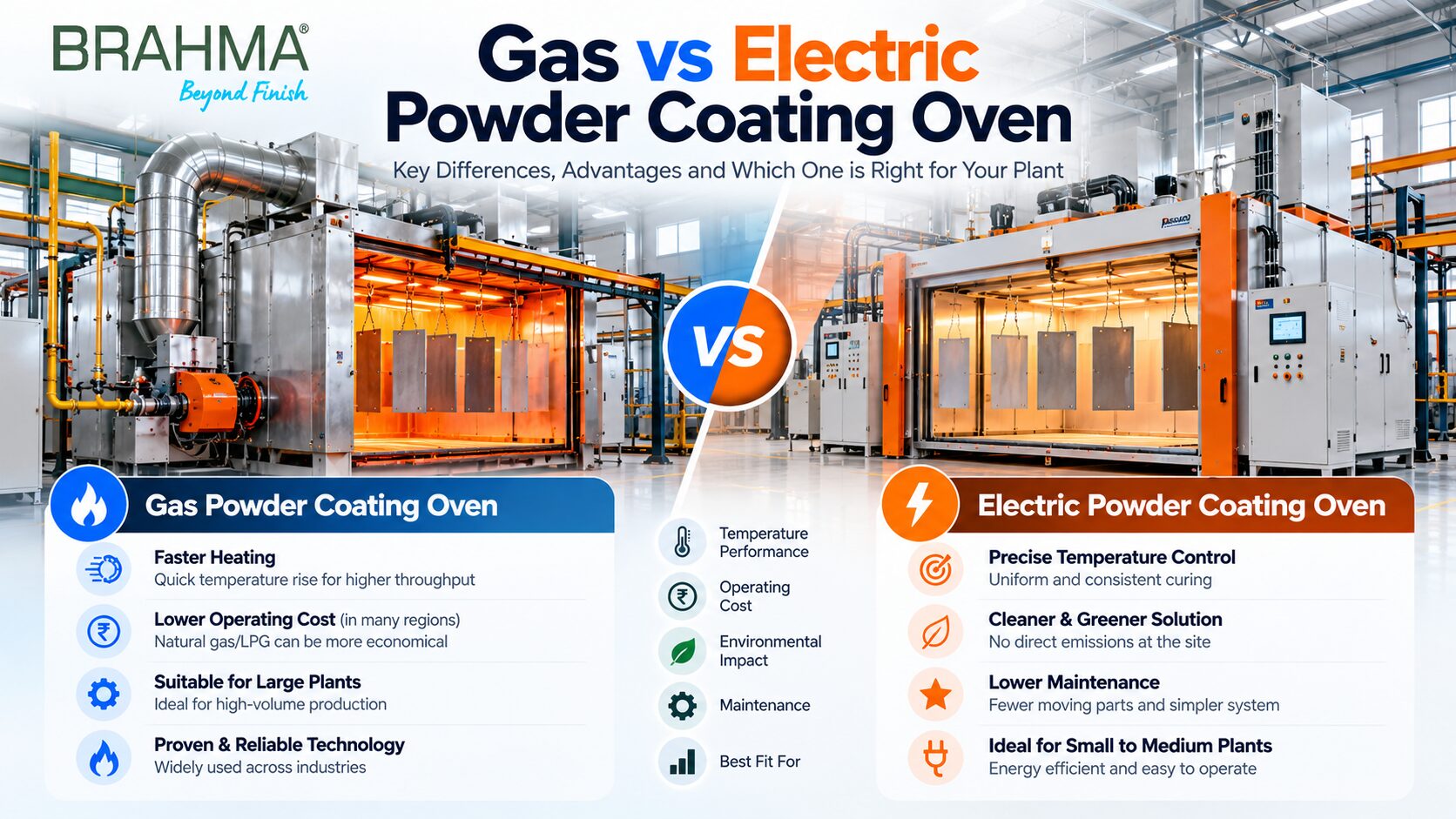
Need a gas vs electric comparison? → Read our Gas vs Electric Powder Coating Oven guide
Powder coating cure schedules are specific to the coating product. Use the powder manufacturer’s technical data sheet to establish the required object temperature and time; an oven air-temperature display alone does not establish that the component has received the specified cure.
For example, AkzoNobel’s Interpon Redox Active technical data sheet specifies object-temperature schedules for that particular primer. Your selected powder may have different requirements.
Include component heat-up and handling time when discussing production capacity. Agree how the proposed process will be checked against your actual parts and coating requirements before acceptance.
| Product | Bring these details to the specification discussion |
|---|---|
| Electrical enclosures and control panels | Largest cabinet, door dimensions and rack arrangement |
| Aluminium profiles and sections | Longest profile, hanging orientation and handling method |
| Automotive components | Component mix, material thickness, loading pattern and target output |
| Metal furniture | Largest assembled frame and batch arrangement |
| Heavy fabricated parts | Component weight, support fixtures and loading method |
Planning the coating section together? Review our powder coating booths alongside the oven requirement.
Work with a powder coating equipment manufacturer in Vadodara to discuss the oven and its place in your production process.
Whether you need a standalone curing oven or equipment for a wider coating line, start with your component, output and site requirements. Review our project portfolio and ask about work relevant to your application.
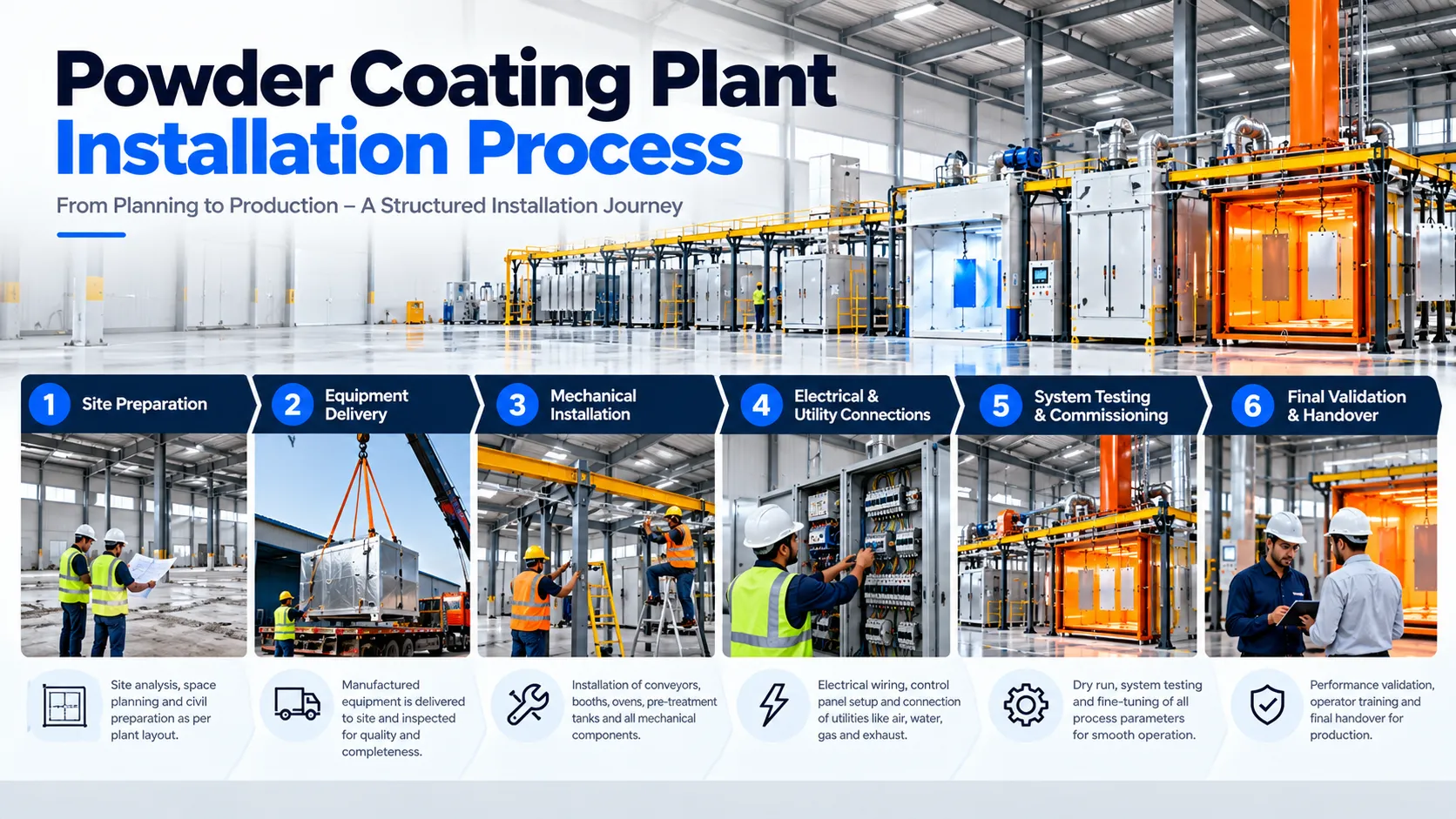
Installation, commissioning, operator training and after-sales support can be discussed as part of the project. Confirm the agreed scope, responsibilities and commercial terms in your quotation.
Tell us what you coat and how much you need to produce.
Choose a powder curing oven around the parts you produce, the cure schedule you need and the output your factory must achieve. Brahma Fabricon can help you discuss the configuration and project scope before you invest.
Share your requirement and request a quotation.
Send:
If available, include a component drawing, factory layout or the powder technical data sheet. You can start an enquiry even if some specifications are still undecided.
Call: +91 8320244173 / +91 9227534580
Email: powdercoatingplants@gmail.com
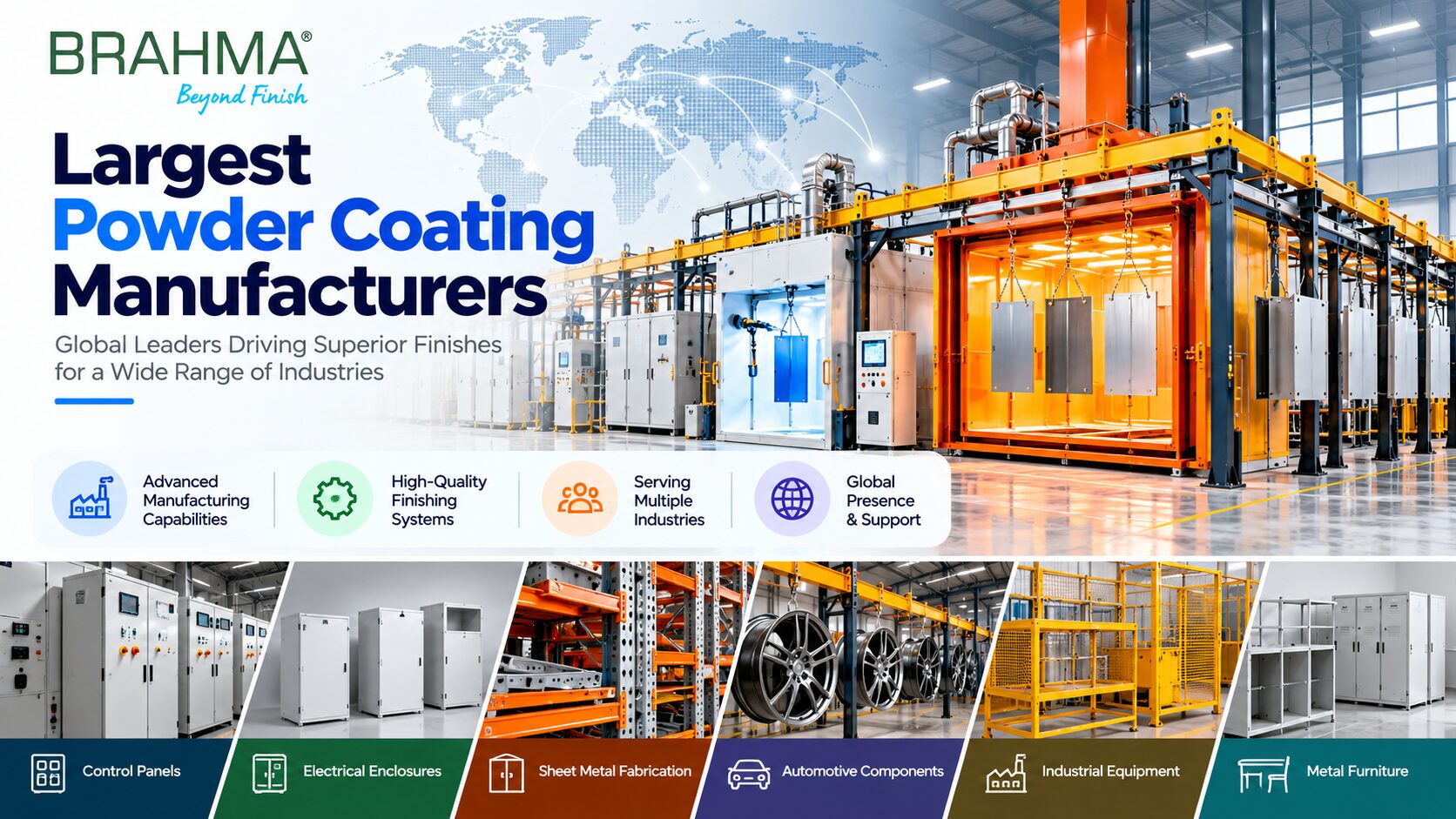
Aluminium architectural sections & extrusions
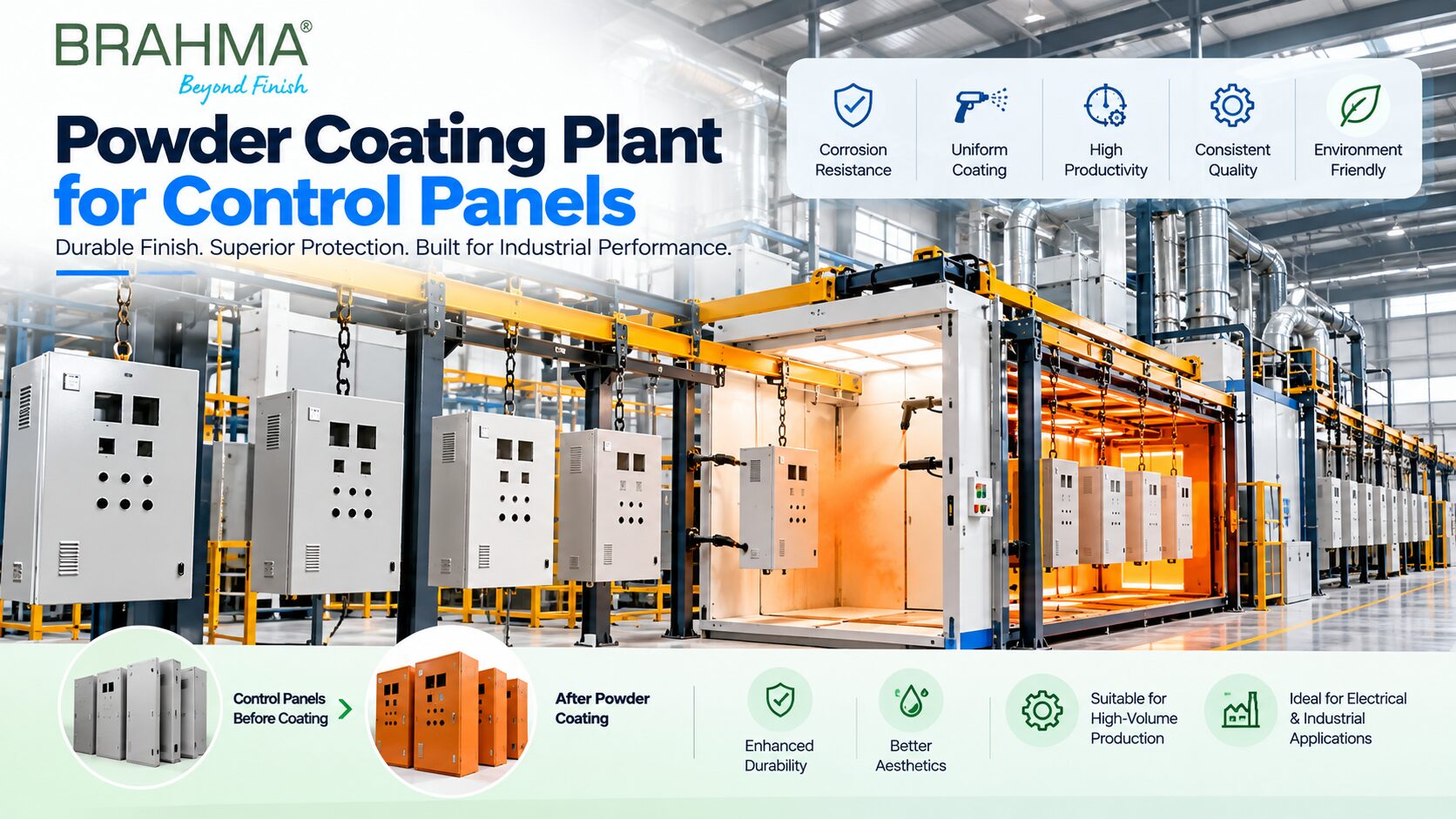
Control panels & electrical enclosures
Automotive parts & two-wheeler components
Furniture & home appliances
Agricultural machinery & heavy fabrication
Application-based engineering
Oven configuration is developed around component dimensions, load, production target, handling method and cure requirement.
Batch and conveyorised options
Systems can be configured for job coating, repetitive batch production or continuous manufacturing lines.
Gas and electric heating options
Heating selection can be evaluated against available utilities and production requirements.
Integrated powder coating lines
The oven can be engineered together with pretreatment, powder coating booths, guns and conveyor systems.
Installation and commissioning support
Project scope can include installation, commissioning, operator training and after-sales support.
Manufacturing from Vadodara, Gujarat
Brahma Fabricon supplies industrial powder coating equipment for manufacturers across India.
Brahma Fabricon manufactures powder curing ovens in Vadodara and serves industrial customers across Ahmedabad, Surat, Rajkot, Bharuch, Ankleshwar, Vapi, Dahej, Sanand, Halol and other manufacturing hubs throughout Gujarat and India.
Here are the most common questions we receive from powder coating professionals across India:
Capacity depends on the component dimensions, total loaded mass, handling arrangement, cure schedule and required production rate.
The specified cure time should be interpreted according to the powder manufacturer's technical data sheet, commonly in relation to the required object or part-metal temperature—not simply when the oven reaches its setpoint.
Production validation can include measurement of part-metal temperature, cure dwell time and representative loaded-cycle testing against the selected powder specification.
Provide maximum component dimensions, component weight, rack/trolley details, production requirement, powder cure schedule, available utilities and factory space.
Potentially, but different thermal masses can heat at different rates. The product mix and curing requirements should be reviewed during oven engineering.
Compare usable chamber size, actual loaded capacity, heating method, airflow, controls, insulation, installation scope, energy assumptions, warranty, commissioning and acceptance criteria.
Achieve perfect powder curing results with Brahma Fabricon. Contact us today for tailored solutions.
Address: 332 Survey Block, Por-Kayavarohan Road, B/S D-Mart Ware House, Ankhi Village, Por, Vadodara, Gujarat – 391243,
Phone: 8320244173/9227534580
Email: powdercoatingplants@gmail.com