
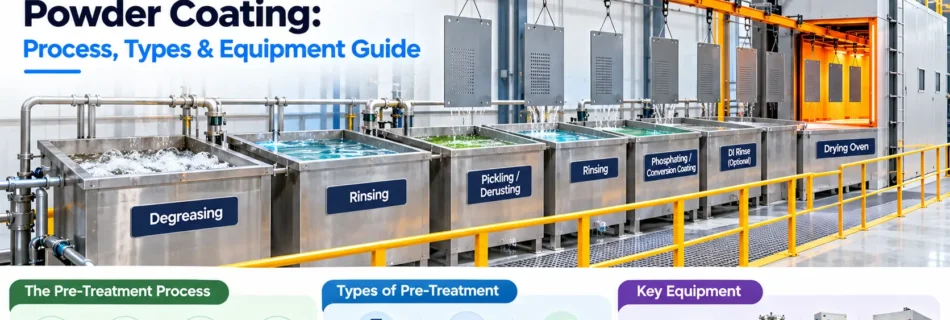
Metal Pre-Treatment for Powder Coating: Process, Types & Equipment Guide.
Metal pre-treatment is the process of cleaning and chemically preparing a metal surface before powder coating. Its purpose is to remove oil, grease, dust, rust, oxides and fabrication residues, then create a surface that supports coating adhesion and corrosion resistance. For powder coating, surface preparation is especially important because the coating is applied as a dry powder rather than a solvent-based liquid. Contamination remaining on the component can interfere with coating quality and long-term performance. The correct metal pre-treatment process depends on the substrate, contamination, component geometry, required corrosion performance, production volume and available factory infrastructure. Why Is Metal Pre-Treatment Important Before Powder Coating? Metal components can collect contamination during cutting, punching, machining, welding, bending, storage and handling. Typical contamination includes: machining and forming oils; grease; fingerprints; dust; rust; mill scale; metal particles; welding residues; surface oxides. If these contaminants are not removed correctly, the powder coating may be applied over an unstable surface instead of properly prepared metal. Effective metal pre-treatment helps improve: coating adhesion; corrosion resistance; finish consistency; coating durability; process repeatability. A good pre-treatment system should therefore be designed as part of the complete powder coating process rather than treated as a separate cleaning operation. Metal Pre-Treatment Process for Powder Coating A typical industrial process may follow: Degreasing → Rinsing → De-rusting or Pickling if Required → Rinsing → Surface Conditioning → Conversion Coating → Rinsing → Final Treatment → Drying → Powder Coating Not every application requires every stage. A clean mild-steel fabrication may need a different process from rusted steel, aluminium or galvanized steel. The treatment sequence should therefore be selected according to the actual component and coating-performance requirement. Step 1: Cleaning and Degreasing Cleaning is the first major stage of metal pre-treatment. Its purpose is to remove contaminants that could interfere with subsequent conversion treatment and powder adhesion. Alkaline Cleaning Alkaline cleaners are commonly used to remove organic contamination such as: oil; grease; machining fluids; forming lubricants; shop dirt. They are widely used for steel and other compatible substrates. Acid Cleaning Acid cleaners may be used where rust, scale, oxides or other inorganic contamination needs to be removed. The selected chemistry must be compatible with the substrate. Neutral Cleaning Neutral cleaners can be useful where stronger acidic or alkaline chemicals are undesirable for the substrate or production process. Cleaner selection should consider: substrate; contamination; bath temperature; contact time; oil loading; required coating performance. There is no single cleaning chemistry suitable for every metal pre-treatment line. Step 2: Water Rinsing After cleaning, the component is rinsed to remove residual chemicals and loosened contamination. Rinsing is an important process stage because excessive carryover from one chemical bath can affect the performance of the next stage. Depending on the process specification, rinse water may include: normal process water; treated water; demineralized water; reverse-osmosis water. Water quality should match the selected chemical system and coating-performance requirement. Step 3: Rust and Oxide Removal Some metal components require additional treatment before conversion coating. Rust, mill scale and oxide layers may be removed using: chemical derusting; acid pickling; mechanical blasting; another approved surface-preparation method. The required process depends on the incoming condition of the metal. Applying conversion chemistry over uncontrolled rust or scale can compromise the coating system. Step 4: Surface Conditioning Certain phosphate processes use a conditioning or activation stage before the conversion coating. This prepares the surface so the subsequent phosphate layer forms more uniformly. Whether this stage is required depends on: substrate; phosphate chemistry; process sequence; chemical supplier specification. Step 5: Conversion Coating Conversion coating chemically modifies the metal surface to create a suitable foundation for powder coating. Common conversion technologies include: iron phosphate; zinc phosphate; zirconium-based treatment; other phosphate-free systems. The correct chemistry should be selected according to the substrate and required coating performance. Iron Phosphate Pre-Treatment Iron phosphate is widely used for general industrial powder coating. Typical applications can include: electrical enclosures; metal furniture; fabricated steel products; machinery components; general industrial products. Iron phosphate systems can be applied using either spray or immersion methods. They are commonly selected where a practical general-purpose pre-treatment process is required. Zinc Phosphate Pre-Treatment Zinc phosphate is often considered for applications requiring more demanding corrosion performance. A zinc-phosphate process may include: cleaning → rinsing → activation → zinc phosphating → rinsing → sealing or final treatment Compared with simpler processes, zinc phosphating can involve: additional chemical stages; greater process control; sludge generation; additional wastewater management; increased operating complexity. It should therefore be selected because the coating specification requires the performance—not simply because it uses more stages. Zirconium and Phosphate-Free Pre-Treatment Modern powder coating plants may also use zirconium-based or other phosphate-free conversion technologies. Depending on the chemistry and application, potential advantages can include: lower sludge generation; multi-metal capability; lower process temperatures; fewer treatment stages; reduced chemical consumption. These systems may be suitable for steel, galvanized steel and aluminium when validated for the application. Metal Pre-Treatment for Different Substrates Mild Steel A typical mild-steel process may include: cleaning → rinsing → conversion treatment → rinsing → drying The conversion treatment may use iron phosphate, zinc phosphate or another suitable technology. Galvanized Steel Galvanized steel requires cleaners and conversion chemistry that are compatible with the zinc-coated surface. A treatment designed only for untreated mild steel should not automatically be used for galvanized components. Aluminium Aluminium may require: cleaning; etching where necessary; deoxidizing; rinsing; compatible conversion treatment. Aluminium and mild steel should not automatically receive identical pre-treatment chemistry. Dip Metal Pre-Treatment System In a dip system, components are completely immersed in tanks containing cleaning, rinsing and conversion-treatment solutions. Dip systems can be particularly suitable for: complex components; components with recesses; batch production; mixed component sizes; large fabricated products; components requiring complete immersion. Material handling can use: manual handling; hoists; cranes; transporter systems. Spray Metal Pre-Treatment System A spray system applies treatment chemicals through nozzles while components move through defined treatment zones. Spray systems are commonly used for: conveyorized powder coating lines; continuous manufacturing; repeat products; medium- and high-volume production; automated material handling. BrahmaFabricon …
Read more “Metal Pre-Treatment for Powder Coating: Process, Types & Equipment Guide.”