
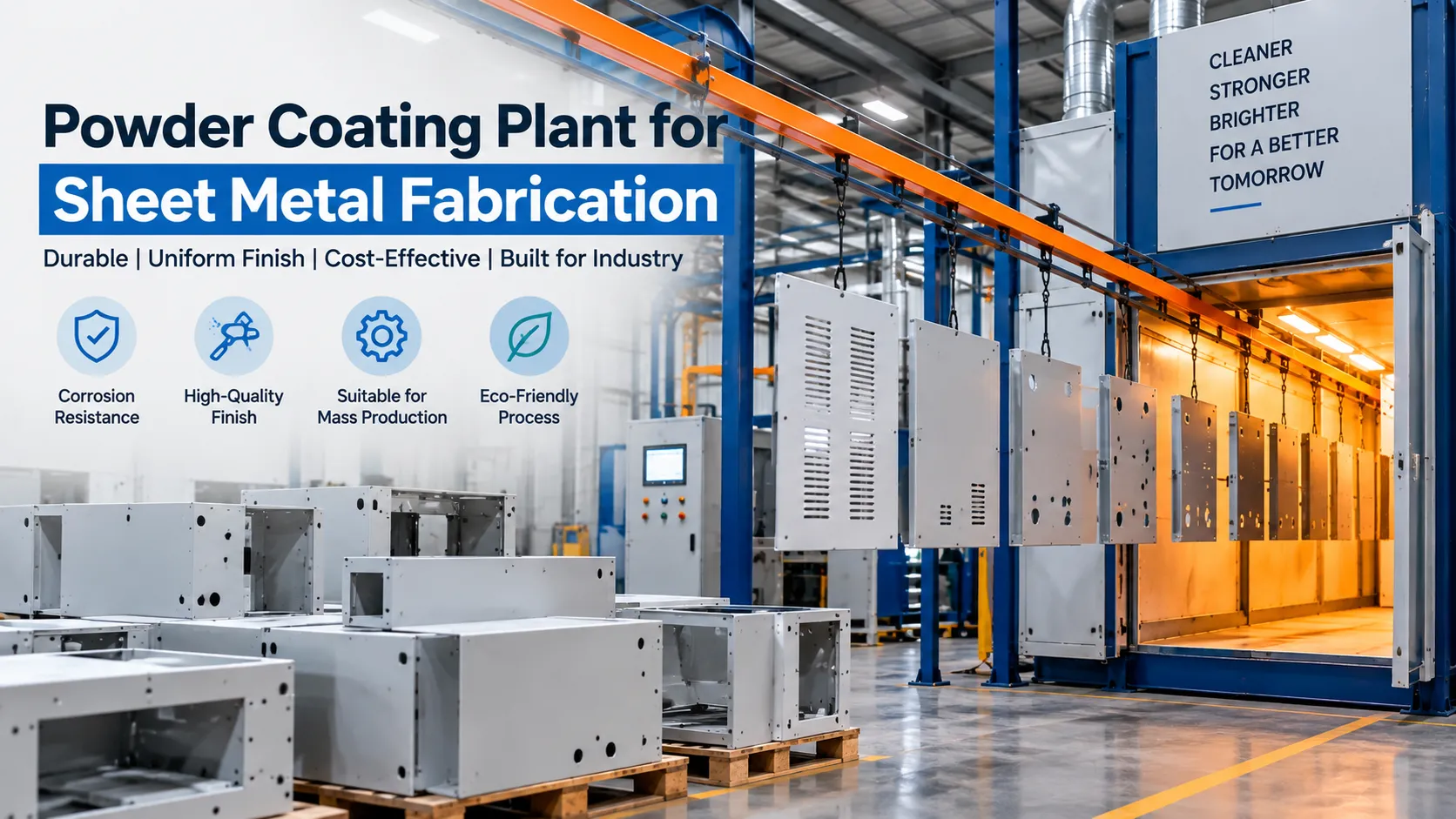
A powder coating plant for sheet metal fabrication should be designed around the complete manufacturing flow—not selected simply by booth size or oven temperature.
For a sheet-metal factory producing electrical cabinets, control panels, machine covers, HVAC components, server racks, cleanroom panels, furniture components or fabricated enclosures, the most important inputs are:
part dimensions → substrate → production volume → hanger density → product mix → colour changes → pretreatment requirement → coating specification → cure schedule → available factory space
A low-volume fabricator making many different parts may be best served by a flexible manual or batch system. A manufacturer producing hundreds of repeatable panels, cabinets or enclosures per shift may achieve better throughput and consistency from a conveyorised line with automatic guns and manual touch-up.
The correct question is therefore not:
“Which powder coating plant should a sheet-metal factory buy?”
It is:
“What finishing system can coat our actual sheet-metal product mix at the required quality, takt time and cost per acceptable part?”
The Brahma Fabricon powder coating plant range includes manual, batch and conveyorised configurations that can be engineered around these production variables.
Quick summary
| Sheet-metal requirement | Plant-design implication |
|---|---|
| High number of small parts | Optimize hanging density and loading time |
| Large cabinets/enclosures | Size booth, washer and oven around actual hanging envelope |
| Mixed CRCA/MS/GI/aluminium | Match pretreatment to each substrate and finish requirement |
| High production volume | Evaluate conveyorised automatic or hybrid application |
| Short runs/prototypes | Maintain manual coating flexibility |
| Frequent colour changes | Prioritize booth-cleaning and powder-management strategy |
| Deep folds/recesses | Plan gun position and manual reinforcement |
| Threaded holes/interfaces | Develop repeatable masking |
| Indoor products | Select powder around actual service specification |
| Outdoor products | Use powder and pretreatment suitable for weather exposure |
| Multiple panel sizes | Design hanging fixtures around product families |
| Tight production takt | Balance pretreatment, spraying and curing as one line |
What is a sheet metal powder coating plant?
A sheet metal powder coating plant is an integrated finishing system that cleans and prepares fabricated metal components, applies electrostatically charged powder, cures the coating under controlled heat and moves finished parts through inspection and unloading.
A typical production line includes:
loading → pretreatment → rinsing → dry-off → powder application → powder recovery → curing → cooling → inspection → unloading
The Powder Coating Institute explains that electrostatic application charges powder particles so they are attracted to a grounded component; heat is then used to produce the cured coating.
For sheet-metal manufacturing, however, the coating line should ideally be treated as an extension of the fabrication process rather than an isolated finishing department.
Why powder coating fits sheet metal fabrication
Sheet-metal manufacturers often need a finish that combines:
- appearance;
- corrosion protection;
- repeatability;
- colour control;
- abrasion resistance;
- scalable production.
Powder coating is widely suited to metallic industrial products and, unlike solvent-borne liquid coatings, uses a dry coating material without a solvent carrier. PCI notes that overspray can be recovered in suitable systems and that powder application can achieve high material utilization when application and recovery are correctly engineered.
But these advantages depend heavily on process design.
A poor pretreatment system, weak grounding, overloaded conveyor or under-sized oven can undermine an otherwise sophisticated spray system.
That is why the entire line needs to be balanced.
Start with the fabrication process, not the coating equipment
A sheet-metal component may already have passed through several manufacturing operations before reaching coating:
Sheet stock → laser cutting/punching → bending → welding → grinding/deburring → fabrication inspection → surface preparation → coating → assembly
Every upstream process can affect finishing.
The coating department may receive parts carrying:
- punching or forming lubricant;
- machining oil;
- weld residue;
- fingerprints;
- adhesive residue;
- rust;
- grinding dust;
- burrs;
- sharp edges.
PCI specifically warns that cleaning is particularly important with powder coating because the coating does not contain solvent that can make a process more forgiving of residual organic contamination.
Therefore, one of the first plant-design questions should be:
What will actually be on the sheet metal when it enters pretreatment?
Which sheet metal products can be powder coated?
Common applications include:
- electrical control panels;
- switchgear cabinets;
- server and network racks;
- telecom enclosures;
- machine guards;
- CNC-machine enclosures;
- HVAC cabinets;
- cleanroom panels;
- laboratory furniture;
- steel furniture;
- shelving;
- appliance housings;
- EV and battery-related enclosures;
- agricultural-machine covers;
- general fabricated brackets;
- doors and access panels.
Brahma Fabricon’s published applications already include control panels and general metal fabrication within its powder coating systems.
The equipment should nevertheless be specified around the actual part family, because a small bracket and a two-metre electrical cabinet create very different loading, spraying and oven requirements.
Step 1: create a sheet-metal component matrix
Before requesting a powder coating plant quotation, divide production into product families.
A useful matrix looks like this:
| Product family | Typical dimensions | Max weight | Parts/shift | Substrate | Colour changes | Hanging points |
|---|---|---|---|---|---|---|
| Small brackets | ||||||
| Flat panels | ||||||
| Cabinet doors | ||||||
| Enclosures | ||||||
| Machine covers | ||||||
| Large fabricated assemblies |
Do not size the line around only the largest component.
The largest part determines physical clearance, but typical parts determine most of the production economics.
For example, if 80% of production consists of small cabinet panels and only 5% consists of large enclosures, designing every station solely around the largest enclosure could create unnecessary operating cost.
Step 2: identify every substrate entering the coating line
Sheet-metal factories often process more than one material.
Common substrates include:
CRCA or mild steel
Widely used for cabinets, machine panels, furniture and fabricated products.
Galvanized steel
Used where corrosion protection from the metallic coating is required.
Aluminium
Common in electrical, electronics, architectural and lightweight fabrication.
Stainless steel
Used selectively where a coated finish is required despite the underlying corrosion-resistant substrate.
These materials should not automatically receive the same chemical process.
PCI’s current technical guidance specifically states that cleaner selection depends on factors including the base metal, soil being removed, operating temperature and oil-removal requirement. It also notes that substrates such as aluminium or zinc can require different cleaner considerations.
Practical rule
Do not specify:
“7-tank pretreatment because that is standard.”
Specify:
“A pretreatment sequence capable of achieving our required coating performance on these defined substrates.”
Brahma Fabricon’s pretreatment plant systems can be evaluated as part of that wider process rather than as a standalone tank-count decision.
Step 3: choose pretreatment around contamination and performance
Pretreatment generally has two responsibilities:
clean the surface and prepare it for the required coating performance.
Depending on the substrate and specification, the process may include:
degreasing → rinsing → surface treatment/conversion → final rinsing → drying
More demanding applications may require additional stages.
PCI notes that iron phosphate is commonly encountered with powder coating, while higher-performance requirements can justify other pretreatment systems. The institute also emphasizes that there is no universal cleaner appropriate for every application.
Spray vs dip pretreatment for sheet metal
Spray pretreatment
Often well suited to conveyorised sheet-metal production because panels and enclosures can move continuously through an enclosed tunnel.
Advantages can include:
- continuous processing;
- integration with an overhead conveyor;
- controlled stage timing;
- high production capability.
Dip pretreatment
Can make sense where:
- production is batch based;
- geometry makes immersion useful;
- output is lower;
- factory arrangement favors tanks;
- products vary substantially.
Neither is automatically superior.
The selection should follow actual production.
Step 4: design hanging before calculating conveyor capacity
For sheet-metal fabrication, hanging density is one of the most important productivity variables.
Imagine two factories using the same conveyor speed.
Factory A hangs one small bracket every 500 mm.
Factory B hangs eight brackets on a purpose-designed jig within the same conveyor length.
Their output is dramatically different even though the conveyor itself has not become faster.
A practical capacity relationship is:
Parts per hour = conveyor travel per hour ÷ hanger pitch × parts per hanger
But the highest possible loading density is not necessarily the correct one.
Parts still need:
- adequate pretreatment exposure;
- effective drainage;
- spray access;
- electrical grounding;
- spacing to prevent contact;
- suitable heating;
- safe unloading.
Designing product-family fixtures
For repeat components, consider dedicated fixtures for:
- cabinet doors;
- electrical panels;
- narrow brackets;
- enclosure bodies;
- machine covers.
Good fixtures can improve:
loading speed + repeatability + grounding + spray access + hanging density
That makes fixture engineering part of plant engineering.
Step 5: plan grounding into hooks and fixtures
Electrostatic application depends on the part having an effective path to ground.
PCI identifies dirty hangers and poor conveyor grounding as common reasons powder fails to deposit properly. It also states that powder buildup at electrical contact points can progressively degrade grounding.
For sheet-metal production, this matters because high-volume lines may use thousands of hanger cycles.
The maintenance plan should therefore include:
- hook cleaning;
- deliberate bare-metal contact;
- fixture inspection;
- conveyor-ground checks;
- removal of coating buildup.
Poor grounding can produce inconsistent deposition even when the powder gun itself is functioning correctly.
Step 6: define masking before the line goes into production
Sheet-metal assemblies frequently contain features that should not receive coating.
Typical examples include:
- threaded studs;
- threaded holes;
- grounding studs;
- hinge locations;
- electrical bonding areas;
- press-fit interfaces;
- gasket surfaces;
- PEM fasteners;
- hardware interfaces;
- certain assembly contact points.
Masking may use suitable:
- plugs;
- caps;
- tapes;
- custom fixtures;
- reusable masks.
For high-volume sheet-metal products, repetitive manual masking can become a hidden labour cost.
Therefore:
Masking time should be included when calculating real coating-line takt time.
A line that can spray 500 panels per hour is not a 500-panel-per-hour production system if the masking station can prepare only 250.
Step 7: dry components completely before powder application
Where wet pretreatment is used, residual moisture should be removed before powder reaches the workpiece.
Sheet-metal products can retain water in:
- folded seams;
- channels;
- enclosure corners;
- hemmed edges;
- reinforcement sections;
- boxed fabrications.
The solution is not simply increasing dry-off temperature.
Better engineering can include:
- drainage-conscious hanging orientation;
- drain openings where product design permits;
- effective air circulation;
- suitable dry-off residence time.
This is another example of the relationship between product design and coating-line performance.
Step 8: select the powder booth around part mix and colour strategy
For a sheet-metal factory, the best booth is not necessarily the system with the highest headline recovery number.
The important questions are:
- How large is the maximum workpiece?
- How many colours are used?
- How often does colour change?
- Are parts coated manually or automatically?
- How much reclaim is economically useful?
- How difficult is booth cleaning?
- How much production is lost during changeover?
This becomes particularly important for contract sheet-metal fabricators where one customer may require grey cabinets, another black machine covers and another branded colour.
A mono-colour production facility and a high-mix job shop require very different powder-management strategies.
Cartridge vs cyclone recovery for sheet metal production
The correct recovery architecture depends on the production mix.
Cartridge-based systems
Can be practical for:
- manual lines;
- smaller operations;
- lower production volumes;
- certain dedicated-colour applications.
Cyclone-based recovery
Can become attractive where:
- substantial powder volumes are sprayed;
- reclaim is important;
- the system is designed around the required colour strategy.
The key purchasing principle is to avoid confusing first-pass transfer efficiency with recovery efficiency.
First-pass transfer describes how much powder initially reaches the component.
Recovery describes what happens to suitable overspray afterwards.
A better operating KPI is therefore:
Powder consumed per square metre or acceptable finished component
rather than one equipment recovery percentage.
Brahma Fabricon’s broader powder coating equipment range includes booths, recovery equipment, guns and reciprocators that can be considered as parts of the complete line.
Step 9: decide between manual, automatic and hybrid application
Sheet metal is particularly suitable for automation when products are repetitive.
Manual spraying
Works well for:
- prototypes;
- low-volume work;
- many different shapes;
- frequent product changes;
- touch-up.
Automatic spraying
Works well when:
- parts are repeatable;
- hanging position is controlled;
- production is high;
- external panel surfaces dominate;
- colour scheduling is organized.
Automatic guns plus manual touch-up
This is often a practical compromise.
Automatic guns can coat the repeatable open surfaces while an operator reinforces:
- deep returns;
- enclosure corners;
- folds;
- inner lips;
- recessed sections.
Real manufacturing examples support this mixed approach. FORM2000, a sheet-metal fabricator, publicly describes using conveyorised automatic coating for higher-volume production alongside manual coating for shorter runs and prototypes.
That is a better model than assuming every sheet-metal factory should be either fully manual or fully automatic.
Step 10: account for Faraday-cage areas
Sheet-metal components often contain geometry that makes electrostatic coating more difficult.
PCI defines the Faraday cage effect as a condition in cavities or recesses where geometry can inhibit electrostatic powder deposition.
Typical sheet-metal examples include:
- deep channels;
- internal corners;
- folded returns;
- box sections;
- narrow recesses.
Coating these areas may require optimization of:
- gun voltage/current;
- gun angle;
- airflow;
- powder flow;
- nozzle selection;
- part presentation;
- manual reinforcement.
Simply increasing powder output can create excessive film on open faces without solving the recessed-area problem.
Step 11: size the curing oven from production, not maximum temperature
The question:
“What temperature does the oven reach?”
is not sufficient for selecting a powder-curing oven.
PCI states that successful powder cure requires achieving the coating’s specified metal temperature and time, and distinguishes oven cycle time from the combination of part bring-up time and cure dwell.
Sheet-metal parts often heat faster than heavy welded fabrications because they contain less thermal mass, which can make continuous production highly practical.
However, the final oven design still needs to consider:
- substrate thickness;
- fabricated assembly mass;
- loading density;
- hanger mass;
- powder cure schedule;
- conveyor speed;
- oven airflow;
- line output.
Manufacturers can compare these requirements against Brahma Fabricon’s powder coating plant configurations rather than selecting an oven from chamber temperature alone.
Conveyor speed and oven dwell are mathematically connected
For a conveyorised line:
Oven residence time = effective heated travel length ÷ conveyor speed
This means conveyor speed cannot simply be increased whenever additional production is required.
Faster conveyor:
increases theoretical output
but also
reduces time in pretreatment, application zones and ovens
A recent general powder-coating plant guide identifies this as a common plant-selection error: throughput should be calculated from part loading and process time rather than conveyor speed alone.
For sheet-metal lines, the ideal solution is often increasing loading density or fixture efficiency before simply increasing conveyor speed.
Batch vs conveyorised powder coating plant for sheet metal
| Factor | Batch/manual plant | Conveyorised plant |
|---|---|---|
| Part variety | Excellent | Best with organized product families |
| Short runs | Excellent | Less efficient if frequent stoppages occur |
| High volume | Limited | Strong |
| Labour requirement per part | Higher | Can be lower |
| Loading flexibility | Very high | Fixture-dependent |
| Automation | Low/medium | Medium/high |
| Colour changes | Flexible | Depends heavily on booth design |
| Production consistency | Operator-dependent | More repeatable when controlled |
| Expansion | Modular | Requires line-capacity planning |
| Best suited for | Prototypes, job work, varied production | Repeat medium/high-volume fabrication |
A useful hybrid factory may have:
automatic conveyorised production for repeat products + manual/batch capability for prototypes and unusual components
This is essentially the production logic demonstrated by some established sheet-metal fabricators rather than forcing every order through one coating method.
Powder coating line for electrical cabinets and control panels
Control panels are one of the clearest sheet-metal powder coating applications.
Important considerations include:
- cabinet size;
- doors vs cabinet bodies;
- internal/external coating requirement;
- grounding points;
- hinge areas;
- threaded hardware;
- colour consistency;
- film thickness;
- recess coverage.
Doors and flat panels may be easy to automate.
Complete cabinets can require more manual reinforcement because of their three-dimensional geometry.
This suggests a system where style or zone-based gun triggering, automatic guns and manual touch-up may all have roles depending on production volume.
PCI describes style and zone triggering as methods used to control automatic guns according to part presence, size or recognized product family.
Powder coating line for HVAC and appliance sheet metal
HVAC and appliance manufacturers may have:
- thin panels;
- repeat geometries;
- high production;
- large numbers of relatively lightweight parts.
These characteristics can favor automation.
But the plant still needs to account for:
- substrate mix;
- decorative appearance;
- indoor/outdoor exposure;
- colour consistency;
- frequent panel sizes;
- edge coverage;
- assembly interfaces.
The powder itself should be selected against the actual use environment rather than simply by generic resin family.
PCI recommends making coating selection together with the powder supplier because cure, substrate, flexibility, chemical resistance and weatherability can involve trade-offs.
How to integrate the coating plant into a sheet metal factory
A good factory layout tries to reduce unnecessary movement.
An idealized flow might be:
Raw sheet → laser/punch → bending → welding → finishing/deburring → coating loading → pretreatment → powder coating → cure → QC → assembly → packing
The coating plant should therefore be positioned with consideration for:
- fabrication output;
- forklift routes;
- WIP storage;
- loading stations;
- unloading;
- assembly;
- packing;
- maintenance access.
Do not design the powder line as if it exists independently of the rest of the factory.
Sundial’s current line-layout guidance similarly recommends working backward from parts, throughput, coating specification, colour changes and the actual building envelope before finalizing the conveyor, booth and oven.
Production bottlenecks sheet-metal manufacturers should measure
A coating plant can be underperforming even when the booth is operating continuously.
Track time required for:
| Stage | Useful KPI |
|---|---|
| Hanging | parts/operator/hour |
| Masking | seconds/part |
| Pretreatment | stage condition + dwell |
| Powder application | m² or parts/hour |
| Colour change | minutes/change |
| Curing | validated residence/cure |
| Unloading | parts/operator/hour |
| Rework | % of coated production |
| Overall process | acceptable parts/hour |
The lowest-capacity operation controls the true line output.
If operators can load only 300 panels per hour, a booth designed for 600 panels per hour does not create a 600-panel-per-hour factory.
When colour change becomes the real bottleneck
Sheet-metal job shops may process many customers and colours.
Suppose a booth needs substantial cleaning between colours.
If this occurs once per week, the impact may be minor.
If it happens six times per shift, changeover design becomes a major production parameter.
During plant specification, document:
- colours/day;
- average batch size;
- dominant colours;
- reclaim requirements;
- acceptable contamination risk;
- target changeover time.
Then select booth and powder management around those requirements.
Do not specify colour-change technology after the rest of the line has already been purchased.
Quality control for powder-coated sheet metal
Appearance alone does not confirm process quality.
A suitable inspection plan can include:
Visual finish
Check:
- colour;
- gloss;
- orange peel;
- contamination;
- craters;
- pinholes;
- scratches;
- exposed substrate.
Film thickness
ISO 2808:2019 describes methods for determining coating film thickness and was reviewed and confirmed in 2026, so the 2019 edition remains current.
For sheet-metal products, take readings across multiple representative locations rather than one convenient flat face.
Cross-cut test
ISO 2409:2020 specifies a cross-cut procedure for evaluating coating resistance to separation. Importantly, ISO says the method should not itself be treated as a direct measurement of adhesion.
Cure
Verify the actual metal-temperature/time profile required by the powder supplier.
Masking
Confirm:
- threads remain usable;
- grounding points remain exposed where specified;
- assembly interfaces are coating-free where required.
Common sheet metal powder coating defects
| Problem | First areas to investigate |
|---|---|
| Poor adhesion | Cleaning, pretreatment, contamination, cure |
| Powder not depositing | Grounding, hook cleanliness, gun condition |
| Thin inside corners | Faraday effect, gun settings, orientation |
| Heavy build on edges | Gun technique/settings, powder flow |
| Pinholes | Contamination, trapped moisture, substrate condition |
| Rust after service | Pretreatment, edge coverage, coating damage |
| Thread blockage | Masking process |
| Colour contamination | Booth/powder system cleaning |
| Uneven gloss | Film build and cure profile |
| Orange peel | Powder characteristics, film build, cure |
| Water marks | Rinsing, drainage, dry-off |
| Rework after assembly | Handling/packing or insufficient cure |
A useful troubleshooting principle is:
Trace the defect to the earliest process stage capable of creating it.
Do not automatically adjust the spray gun first.
Powder coating vs outsourcing for sheet metal fabricators
A manufacturer already outsourcing coating should evaluate more than the vendor’s per-piece rate.
Outsourcing may also involve:
- outward transportation;
- return transport;
- packaging;
- handling;
- coordination;
- minimum batch quantities;
- waiting time;
- production scheduling;
- outsourced rework.
An internal plant adds its own costs:
- capital investment;
- powder;
- chemicals;
- energy;
- labour;
- maintenance;
- compressed air;
- wastewater treatment;
- QC;
- consumables.
The correct financial comparison is:
Current total finishing cost per acceptable part vs projected in-house finishing cost per acceptable part
not:
External quotation vs powder price
For fabricators with sufficiently stable coating volume, integrating fabrication and coating can also reduce external material movement and give production planners more control over finishing schedules.
What plant configuration suits different sheet-metal factories?
| Factory profile | Configuration worth evaluating |
|---|---|
| Small fabrication workshop | Manual booth + batch oven |
| Job shop with many colours | Flexible manual/batch system |
| Growing enclosure manufacturer | Semi-automatic or conveyorised line |
| High-volume cabinet producer | Automatic conveyorised line |
| Mixed prototypes + production | Manual booth + automatic main line |
| Mono-colour high-volume panels | Automatic application + efficient recovery |
| Large cleanroom-panel operation | Conveyorised line sized around panel dimensions |
| Multi-client contract manufacturer | Fast-change flexibility + production scheduling |
| Heavy enclosure + small panel mix | Product-family fixtures + hybrid application |
The Brahma Fabricon conveyorised powder coating plant range includes overhead, power-and-free and other configurations that can be evaluated where continuous production is justified.
Automatic powder coating line for sheet metal: when does it make sense?
Automation becomes increasingly attractive when:
- product families repeat;
- hanging orientation is controlled;
- coating volume is high;
- colour batches are large enough;
- manual spraying limits production;
- quality variation is causing rework;
- production scheduling is stable.
Automatic equipment should not be purchased simply to remove operators.
Its job should be to improve a measurable manufacturing variable such as:
acceptable parts/hour, powder consumed/part, first-pass yield, labour minutes/part or colour-change time.
A 2026 powder coating upgrade for a sheet-metal and electrical-enclosure manufacturer provides a relevant real-world example: the project combined overhead conveying and automatic coating equipment specifically as part of a higher-capacity finishing system.
When manual coating remains the better choice
Manual coating can be the correct engineering decision when:
- each job is different;
- production quantities are small;
- parts contain difficult internal geometry;
- prototypes are frequent;
- colours change constantly;
- automation would remain underutilized.
This does not make the system inferior.
A flexible plant that matches the production mix can have a lower cost per finished component than an expensive automatic line operating far below capacity.
Powder coating plant RFQ checklist for sheet metal fabricators
Before asking suppliers for a final quotation, provide:
| Requirement | Information |
|---|---|
| Product families | Panels, cabinets, brackets, frames, etc. |
| Minimum part | L × W × H |
| Typical part | L × W × H |
| Maximum part | L × W × H |
| Maximum weight | kg |
| Substrates | CRCA/MS/GI/aluminium/etc. |
| Sheet thickness | Range |
| Production | parts/hour, shift and month |
| Surface area | m²/part where possible |
| Colours | Number/day and batch size |
| Powder specification | If already defined |
| Film requirement | Customer/OEM specification |
| Pretreatment requirement | Existing or desired |
| Masking | Areas/features requiring protection |
| Hanging | Available points/orientation |
| Factory space | L × W × clear H |
| Utilities | Electricity, fuel, air, water |
| Wastewater | Existing treatment arrangement |
| Automation | Manual/semi/automatic |
| Future growth | Expected volumes/models |
| QC | Required tests |
| Acceptance | FAT/SAT expectations |
A supplier receiving this information can produce a much more defensible technical proposal than one receiving only:
“Need powder coating plant for sheet metal.”
Questions to ask the powder coating plant supplier
Before approving the system, obtain clear answers to these questions:
- What actual part mix was used to calculate capacity?
- What is the maximum hanging envelope?
- How many typical parts can be loaded per hanger?
- What conveyor pitch and speed are assumed?
- Which pretreatment is proposed for each substrate?
- How will mixed materials be handled?
- How will water drain from enclosures and folded products?
- Which masking operations are required?
- Why was the proposed booth/recovery architecture selected?
- How long will typical colour changes take?
- How many automatic guns are required and why?
- Where is manual touch-up expected?
- How was oven residence time calculated?
- How will part-metal temperature be validated?
- What connected utilities are required?
- Which consumables and spares should be stocked?
- What production acceptance criteria will be tested?
- What operator and maintenance training is included?
These answers should form part of the technical evaluation—not remain verbal promises.
Common mistakes when buying a sheet metal powder coating plant
Designing for maximum size but ignoring normal production
The plant becomes unnecessarily expensive to run.
Ignoring hanging density
Capacity is lost despite adequate conveyor speed.
Treating every sheet metal substrate the same
Pretreatment requirements may differ.
Choosing an oven by temperature only
Cure depends on actual part-metal time and temperature.
Automating before analyzing product mix
High variation may reduce automation ROI.
Ignoring masking labour
A fast booth cannot compensate for a slow preparation station.
Ignoring colour-change frequency
Changeovers can consume a significant part of available production time.
Forgetting hook cleaning
Grounding deteriorates as coating accumulates on contact points.
Treating the coating line separately from fabrication
Excessive WIP, forklifting and queue time remain.
Buying on CAPEX only
A low quotation may lead to higher powder use, energy cost, downtime or rework.
How to measure whether the plant is performing well
After commissioning, track at least:
| KPI | What it measures |
|---|---|
| Acceptable parts/hour | Real output |
| First-pass yield | Quality |
| Powder kg/m² or part | Material efficiency |
| Rework % | Process stability |
| Labour minutes/part | Productivity |
| Colour-change time | Flexibility |
| Energy/accepted part | Thermal efficiency |
| Unplanned downtime | Reliability |
| Hook loading density | Conveyor utilization |
These metrics turn coating performance into manufacturing data.
Without them, “better efficiency” remains difficult to prove.
When powder coating may not be the right process
A powder coating plant should not be recommended automatically.
Alternative finishing approaches may be more practical when:
- components cannot tolerate the required heat;
- assemblies contain heat-sensitive parts before finishing;
- production volume is extremely low;
- the component is too large to cure economically;
- the required finish cannot be achieved with the selected powder system;
- field touch-up is a major requirement;
- outsourcing already provides better economics and lead time.
The objective is not to install a powder coating plant.
The objective is to create the lowest-risk finishing process that meets manufacturing and product-performance requirements.
FAQ’s:
Is powder coating suitable for sheet metal fabrication?
Yes. Powder coating is widely used for fabricated steel and aluminium products such as cabinets, panels, enclosures, machine covers and furniture components. Successful performance depends on proper cleaning, pretreatment, grounding, powder selection and curing.
What equipment is required for a sheet metal powder coating plant?
A typical plant includes pretreatment, drying, powder application guns, a spray booth, powder recovery, a curing oven and material handling. High-volume systems may also include conveyors, automatic guns, reciprocators and PLC controls.
Is a conveyorised powder coating plant suitable for sheet metal?
It can be highly suitable when production consists of repeatable medium- or high-volume product families. Variable low-volume fabrication may be better served by a manual or batch system.
Which pretreatment is best for sheet metal before powder coating?
There is no universal pretreatment. The correct process depends on the substrate, contamination and required coating performance. PCI recommends choosing cleaning and pretreatment based on factors such as base metal and soil condition rather than using one standard chemistry for every application.
Can GI sheet be powder coated?
Yes, galvanized sheet can be powder coated when it is cleaned and pretreated appropriately for the substrate and coating specification. The pretreatment should be selected with the chemical and powder suppliers rather than automatically copying a mild-steel process.
Can aluminium sheet metal be powder coated?
Yes. Aluminium is widely powder coated, but its cleaning and surface-treatment requirements need to be matched to the substrate and expected performance.
Is automatic powder coating better for sheet metal?
Automatic coating is highly useful for repeatable, higher-volume products. Manual spraying remains valuable for prototypes, short batches, highly variable shapes and touch-up of difficult recessed areas.
How is powder coating line capacity calculated?
Capacity depends on conveyor speed, hanger pitch and the number of parts loaded per hanger, but pretreatment and oven residence requirements limit how fast the conveyor can operate. Capacity should therefore be calculated from the complete process rather than conveyor speed alone.
How do you check coating thickness on sheet metal?
Coating thickness should be measured using an appropriate validated method. ISO 2808:2019 describes multiple methods for coating film-thickness determination and remains current after confirmation in 2026.
What information should I provide when requesting a plant quotation?
Provide product drawings or photos, minimum/typical/maximum dimensions, weight, substrate, production volume, colour mix, coating specification, masking requirements, factory layout and available utilities.
Conclusion
A powder coating plant for sheet metal fabrication works best when it is designed as part of the manufacturing system rather than purchased as a separate booth-and-oven package.
For sheet-metal manufacturers, the most important plant-design variables are:
product family → substrate → contamination → hanging density → masking → colour strategy → application method → conveyor capacity → cure requirement → factory flow
High-volume cabinets and repeat panels can justify automation. Prototypes and constantly changing fabrication may still be better suited to manual coating. Many factories will benefit from a combination of both.
The largest gains often come from details that are easy to overlook: better fixtures, more parts per hanger, reliable grounding, cleaner pretreatment, faster masking, shorter colour changes and a properly balanced oven/conveyor relationship.
Manufacturers planning a new line can compare Brahma Fabricon’s complete powder coating plant systems, powder coating equipment options and conveyorised plant configurations, then provide actual component drawings, substrate information, production data and factory dimensions for a project-specific technical proposal.