
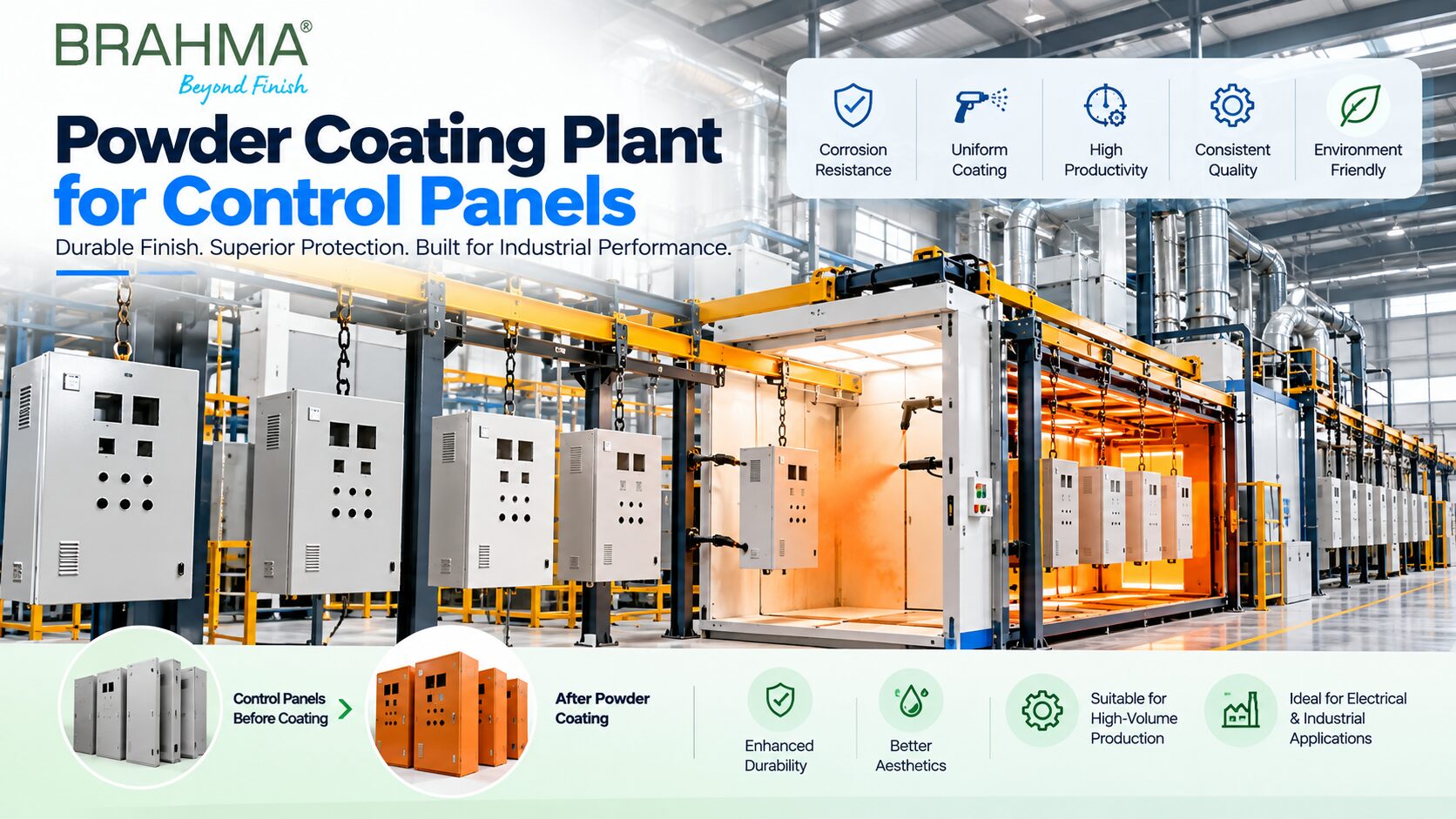
A powder coating plant for control panels should be designed around the actual enclosure sizes, sheet-metal geometry, production volume, colour requirements, substrate, factory space and level of automation required.
There is no single plant configuration that suits every control-panel manufacturer.
A company producing custom electrical enclosures in small batches may benefit from a flexible manual booth and batch curing oven. A manufacturer producing hundreds of repeatable cabinet bodies and doors every shift may achieve better flow with a conveyorised pretreatment, automatic powder application and continuous curing system.
The decision should therefore begin with:
panel dimensions → product mix → parts per shift → pretreatment requirement → colour changes → handling method → factory layout → equipment selection
Manufacturers evaluating a complete system can review Brahma Fabricon’s powder coating plant solutions and its powder coating project portfolio, which includes multiple control-panel coating projects.
Powder Coating Plant for Control Panels: Quick Selection Guide
| Production Requirement | System to Consider |
|---|---|
| Low-volume custom panels | Manual batch plant |
| Many different panel sizes | Batch or flexible semi-automatic system |
| Frequent colour changes | Manual/easy-clean batch system or appropriately designed fast-colour-change booth |
| Medium repeat production | Semi-automatic or indexing conveyor system |
| High-volume standardized cabinets | Conveyorised powder coating plant |
| Repetitive single/few colours | Automatic application with powder recovery |
| Very large assembled sheet-metal enclosures | Batch or engineered conveyor system based on size and weight |
| Doors, side panels and flat sheet components | Well suited to conveyorised automatic application at sufficient volume |
| Deep cabinet bodies and recessed geometry | Automatic application with manual touch-up or flexible manual spraying |
This table is a starting point. Final plant selection should be based on actual component drawings, production schedules and factory conditions.
What Is a Powder Coating Plant for Control Panels?
A powder coating plant for control panels is an industrial finishing system designed to clean, prepare, powder coat and cure sheet-metal electrical enclosures and related components.
Typical products can include:
- electrical control-panel cabinets;
- switchgear enclosures;
- PLC cabinets;
- MCC panels;
- distribution-board enclosures;
- electrical boxes;
- machine-control cabinets;
- server and telecom cabinets;
- doors and removable covers;
- gland plates;
- sheet-metal frames and brackets.
The coating plant itself can combine pretreatment, drying, electrostatic powder application, powder recovery, curing, cooling and material handling.
Why Control Panels Need a Purpose-Designed Powder Coating Process
At first glance, control panels appear simple because much of the enclosure consists of flat sheet metal.
In practice, a cabinet can contain:
- external corners;
- internal corners;
- door returns;
- folded channels;
- deep recesses;
- ventilation openings;
- welded sections;
- hinge areas;
- threaded studs;
- gland openings;
- electrical bonding/contact locations.
These features affect how the part should be hung, cleaned, sprayed, masked and cured.
The Powder Coating Institute identifies cavities, recesses and similar geometry as areas where the Faraday cage effect can inhibit electrostatic powder application.
Control-panel coating therefore requires more consideration than simply spraying the largest flat face.
Coat the Enclosure Before Electrical Assembly
In normal control-panel manufacturing, the metal enclosure components should generally pass through the powder coating and curing process before heat-sensitive electrical equipment, wiring, electronic devices, labels, seals and other final components are installed.
A powder curing oven is an industrial thermal process. Finished electrical assemblies should not be put through the cure cycle unless every relevant component and the complete assembly have specifically been qualified for that temperature and process.
A typical manufacturing sequence is therefore:
sheet cutting → punching → bending → welding → deburring → enclosure inspection → pretreatment → drying → powder coating → curing → cooling → inspection → final assembly
Integrating coating into the fabrication workflow helps avoid unnecessary handling and contamination between manufacturing stages.
Batch vs Conveyorised Powder Coating Plant for Control Panels
This is usually the most important plant-selection decision.
| Factor | Batch System | Conveyorised System |
|---|---|---|
| Production volume | Low to medium | Medium to high |
| Panel variety | Excellent flexibility | Best with repeat product families |
| Very large cabinets | Often easier to accommodate | Requires conveyor and openings engineered for size/weight |
| Colour changes | Flexible | Depends strongly on booth/recovery design |
| Material movement | Trolley, rack or manual handling | Continuous conveyor |
| Powder application | Usually manual or semi-automatic | Manual, automatic or hybrid |
| Curing | Batch oven | Continuous conveyorised oven |
| Process speed | Batch dependent | Controlled by line speed |
| Automation potential | Low to medium | Medium to high |
| Capital requirement | Generally lower | Generally higher |
| Best use case | Custom panel builders and mixed production | Repeat high-volume enclosure manufacturing |
When Should You Choose a Batch Powder Coating Plant?
A batch system is worth considering when the factory produces different enclosure sizes, varying colours or relatively small quantities.
A typical control-panel batch plant may include:
dip/spray pretreatment → drying → manual powder booth → batch oven → cooling and inspection
Batch Systems Work Well for Mixed Panel Sizes
Control-panel manufacturers often receive projects containing several enclosure dimensions rather than thousands of identical cabinets.
A batch oven can accommodate racks containing:
- cabinet bodies;
- doors;
- side panels;
- small electrical boxes;
- frames and brackets.
Production scheduling can be organized by colour, component size or customer order.
Batch Systems Can Simplify Colour Changes
If each project requires a different colour or texture, manual application can be more flexible than running frequent colour changes through a complex automatic recovery system.
This does not automatically make batch production cheaper. Labour, handling, production capacity and oven utilization still need to be evaluated.
Batch Plants Can Handle Occasional Large Cabinets
Where product dimensions vary widely, a correctly sized batch oven and manual booth can give the manufacturer greater flexibility than a conveyor line designed around a narrower component envelope.
When Should You Choose a Conveyorised Powder Coating Plant?
A conveyorised powder coating plant for control panels becomes attractive when production is repetitive enough to justify continuous material movement.
A typical line may follow:
loading → spray pretreatment → dry-off oven → automatic/manual powder booth → curing oven → cooling → unloading
For high-volume requirements, Brahma Fabricon’s conveyorised powder coating plants can integrate these stages around a controlled material-handling system.
Advantages for Repetitive Panel Production
A continuous conveyor can help provide:
- repeatable production flow;
- controlled dwell time;
- lower manual material handling;
- predictable oven residence time;
- integration with automatic guns;
- consistent loading schedules;
- better capacity planning.
Real enclosure manufacturers use continuous conveyor coating lines for cabinet, switchgear and related sheet-metal production where volumes justify the investment.
Should Control Panel Manufacturers Consider a Hybrid System?
Yes. The decision does not have to be limited to completely manual or completely automatic production.
A hybrid line can combine:
- conveyorised material handling;
- automatic guns for broad external surfaces;
- manual touch-up for difficult recesses;
- continuous curing;
- controlled powder recovery.
This configuration can be particularly useful for electrical cabinets because the broad flat faces are automation-friendly while internal corners, returns and recessed areas may still benefit from skilled manual application.
Step 1: Define the Control Panel Product Family
Before requesting equipment quotations, create a product matrix.
| Input | Record |
|---|---|
| Minimum cabinet size | L × W × H |
| Typical cabinet size | L × W × H |
| Maximum cabinet size | L × W × H |
| Maximum weight | kg/component |
| Door dimensions | Largest door/panel |
| Material | CRCA/MS/GI/aluminium/etc. |
| Components per shift | Current + projected |
| Colours | Number and frequency |
| Coating specification | Powder type and required performance |
| Hanging orientation | Vertical/horizontal/special fixture |
Do not design the entire coating line only around the largest cabinet.
The maximum product determines whether the plant can physically handle it, but the typical product often determines the economics of daily production.
Step 2: Decide Whether to Coat Cabinets Assembled or as Separate Sheet-Metal Parts
Some manufacturers coat:
cabinet body + door separately
while others may process additional removable panels or frames independently.
The choice affects:
- hanger design;
- parts per hanger;
- gun access;
- pretreatment drainage;
- oven loading;
- assembly workflow.
Coating doors separately can provide straightforward access to both faces, while deep enclosure bodies require more attention to recessed coverage.
The correct approach should match the product design and final assembly process.
Step 3: Select Pretreatment for the Panel Material and Service Environment
Powder coating performance begins before the powder booth.
Fabrication oils, fingerprints, welding contamination, dust and other soils need to be removed adequately before conversion treatment and coating.
The Powder Coating Institute emphasizes that the cleaner and pretreatment should be selected according to factors including substrate, contamination and required coating performance.
Pretreatment for Mild-Steel Control Panels
Mild-steel and CRCA enclosures commonly require cleaning followed by a suitable conversion-treatment process.
Depending on the required corrosion performance and chemistry selected, the process may use iron phosphate, zinc phosphate or another validated conversion system.
Do not assume that a greater number of pretreatment stages automatically means better performance.
The correct stages should be selected according to:
- incoming contamination;
- steel condition;
- required corrosion resistance;
- customer specification;
- chemical supplier recommendations;
- wastewater requirements.
What About GI or Aluminium Panels?
Galvanized and aluminium substrates should not automatically receive the same chemistry used for mild steel.
Pretreatment should be selected for the actual substrate and required finish.
Brahma Fabricon’s pre-treatment plant systems include dip and spray configurations that can be engineered around the required component material and production method.
Dip vs Spray Pretreatment for Control Panels
| Factor | Dip Pretreatment | Spray Pretreatment |
|---|---|---|
| Production arrangement | Batch | Batch or continuous |
| Complex geometry | Full immersion can reach many surfaces | Coverage depends on spray access and nozzle design |
| High-volume conveyor line | Possible with transporter systems | Strong fit for continuous production |
| Factory footprint | Tank line and handling space | Tunnel length and pump/tank area |
| Automation | Manual or transporter | Easy to integrate with continuous conveyor |
The selection should be based on part geometry, production rate and process chemistry rather than using dip or spray simply because another panel manufacturer uses it.
Step 4: Design the Hanging and Fixture System
Hanging design has a direct effect on control-panel coating quality and line capacity.
A good fixture should:
- support the component safely;
- provide reliable electrical contact during electrostatic coating;
- expose surfaces to the spray guns;
- allow pretreatment drainage;
- avoid contact marks in critical visible areas;
- fit through every process opening.
Clean Hangers Matter
The Powder Coating Institute notes that powder buildup on hanger or conveyor contact points can degrade the electrical path to ground.
Fixture cleaning should therefore be included in preventive maintenance rather than waiting until coating problems appear.
Plan Hanger Density Carefully
Putting more components on each hanger can increase theoretical production, but excessive loading may reduce:
- spray access;
- pretreatment coverage;
- drainage;
- air circulation;
- coating consistency.
The highest hanger density is not always the most productive arrangement.
Step 5: Mask Threads, Contact Surfaces and Critical Areas
Not every surface on an electrical enclosure should automatically receive powder.
Depending on the engineering drawing and electrical design, masking may be required for:
- threaded studs;
- threaded holes;
- designated electrical bonding points;
- specified earth/contact surfaces;
- certain gasket interfaces;
- assembly interfaces;
- precision-fit locations.
Heat-resistant caps, plugs and masking materials can be used according to the required area and oven temperature.
These locations should be identified from the control-panel drawing before production rather than left to individual operator judgment.
Powder Coating Does Not Create the Enclosure’s IP Rating
Powder coating can contribute to surface protection, corrosion performance and appearance, but it does not by itself give an electrical enclosure an IP rating.
IEC 60529 defines degrees of protection provided by enclosures through the IP Code.
The completed enclosure’s protection depends on the relevant enclosure design, openings, joints, doors, seals, glands and other construction details.
This distinction matters because coating requirements should support the enclosure design rather than being treated as a substitute for it.
Step 6: Design the Powder Coating Booth Around Panel Geometry
Control-panel bodies combine large flat surfaces with corners and recessed areas.
The booth should therefore be sized around:
- maximum cabinet dimensions;
- hanging orientation;
- gun access;
- manual operator access;
- automatic reciprocator stroke;
- powder containment;
- recovery method;
- colour-change requirements.
Brahma Fabricon offers both conveyorised and manual powder coating booths, including configurations specifically intended for control-panel and enclosure work.
Why Faraday Areas Matter on Control Panels
Internal corners, folded returns, channels and deep recesses can be difficult to coat electrostatically because of the Faraday cage effect.
The Powder Coating Institute describes this as a condition where the external electric field does not effectively penetrate certain recesses or cavities.
Successful coverage can require coordinated adjustment of:
- gun voltage/current;
- powder flow;
- airflow;
- gun angle;
- gun distance;
- application sequence;
- manual touch-up.
Simply increasing powder output is not necessarily the solution.
Use Representative Cabinet Bodies During Commissioning
A flat steel test panel cannot demonstrate whether the coating system can reach a deep electrical cabinet corner.
During plant commissioning, trial actual enclosure bodies representing:
- deepest cabinet;
- largest cabinet;
- typical high-volume model;
- difficult recesses;
- door returns.
This gives much more useful information about real application performance.
Manual vs Automatic Powder Application for Control Panels
| Requirement | Manual Application | Automatic Application |
|---|---|---|
| Mixed product sizes | Excellent flexibility | Requires recipes/positioning |
| Flat repetitive panels | Suitable | Strong application |
| Complex cabinet recesses | Operator can target difficult areas | May require manual touch-up |
| High production | Labour dependent | Strong advantage |
| Consistency | Operator dependent | High when product presentation is repeatable |
| Frequent product changes | Flexible | Requires recipe/changeover planning |
Automatic Plus Manual Touch-Up Can Be a Strong Combination
For repetitive control-panel production, automatic guns can apply powder to large external surfaces while a manual operator addresses:
- internal corners;
- door returns;
- recesses;
- shielded areas;
- geometry not consistently visible to automatic guns.
This hybrid approach can balance automation with the geometric complexity of enclosure bodies.
Step 7: Select the Right Powder Recovery System
The best recovery arrangement depends strongly on the colour-production strategy.
Few Colours and Long Production Runs
If a panel manufacturer runs large batches in one or a small number of colours, reclaim can be economically useful.
Many Custom Colours
For frequent colour changes, priority may shift toward:
- easy cleaning;
- lower retained powder;
- fast changeover;
- reduced cross-contamination.
A recovery system that performs well for long mono-colour production may not be the best choice for a custom control-panel manufacturer changing colours several times per day.
Step 8: Select the Curing Oven Around the Actual Panel Load
The oven must be sized around more than external cabinet dimensions.
Important inputs include:
- largest component;
- sheet thickness;
- parts per batch or hanger;
- fixture/rack mass;
- powder cure schedule;
- production target;
- available utilities.
Brahma Fabricon’s powder curing ovens include batch and conveyorised configurations with gas or electric heating.
Batch Oven for Control Panels
A batch oven is often practical for custom panel manufacturers because different cabinet sizes can be processed in separate loads.
The oven should be specified around the largest loaded rack or trolley—not simply the largest individual cabinet.
Conveyorised Oven for Control Panels
For continuous production, the curing oven needs to work with:
conveyor speed + hanger pitch + component loading + required cure schedule
A useful planning relationship is:
Residence time = heated conveyor travel length ÷ conveyor speed
The final oven design still needs to account for workpiece heat-up, airflow and heat losses.
Gas vs Electric Oven for Control Panel Production
Both gas and electric ovens can cure control-panel powder successfully when designed correctly.
The decision should consider:
| Factor | What to Evaluate |
|---|---|
| Electricity | Available connected load and tariff |
| Gas | PNG/LPG availability and delivered cost |
| Operating hours | Intermittent vs continuous production |
| Thermal load | Parts plus racks/fixtures |
| Infrastructure | Electrical upgrade or fuel system requirements |
| Maintenance | Electrical heating vs burner/fuel systems |
For a detailed comparison, see our gas vs electric powder coating oven guide.
Part-Metal Temperature Matters More Than Oven-Air Temperature
A curing oven controller shows the process environment, but the coating cure depends on the thermal history of the actual workpiece.
Different enclosure parts can heat at different rates because of:
- sheet thickness;
- welded reinforcements;
- cabinet size;
- rack mass;
- loading density.
The cure process should therefore be validated against the powder manufacturer’s technical data and actual component temperature where required.
Step 9: Plan the Powder Coating Plant Layout
A good control panel powder coating plant layout should follow the manufacturing process rather than simply fitting machines into unused floor space.
A typical conveyorised layout follows:
loading → pretreatment → dry-off → powder application → curing → cooling → inspection → unloading
A typical batch layout may follow:
batch pretreatment → drying → staging → manual booth → batch oven → cooling → inspection
For detailed planning principles, see Brahma Fabricon’s powder coating plant layout guide.
Keep Fabrication Dust Away From the Powder Booth
Panel factories often contain laser cutting, grinding, welding and fabrication processes.
The powder application area should be protected from uncontrolled:
- grinding dust;
- welding contamination;
- metal chips;
- dirty incoming components;
- heavy forklift traffic.
This helps reduce contamination before curing.
Plan Loading and Unloading Around Sheet-Metal Flow
The coating line should integrate logically with fabrication upstream and assembly downstream.
Ideally:
fabricated enclosure → coating → inspection → hardware/electrical assembly
Avoid unnecessary crossing between raw fabricated parts and finished coated panels.
How Much Space Does a Control Panel Powder Coating Plant Need?
There is no standard footprint.
Required space depends on:
- panel dimensions;
- batch or conveyorised configuration;
- pretreatment stages;
- oven length;
- booth dimensions;
- cooling area;
- loading/unloading;
- colour-change access;
- maintenance clearances;
- ETP and utility equipment.
A useful factory-space calculation should include:
equipment footprint + operating space + maintenance access + material handling + utilities + staging
not merely the external dimensions of the machines.
How Is Conveyorised Control Panel Plant Capacity Calculated?
For early production planning:
Theoretical parts/hour = conveyor speed × 60 ÷ hanger pitch × parts per hanger
For example, if a line runs at a selected speed and two doors can safely be mounted on each hanger position, the theoretical production can be estimated from the hanger spacing.
But true capacity still depends on whether:
- loading can keep up;
- pretreatment has sufficient contact time;
- automatic guns can coat the available surface;
- the curing process is satisfied;
- unloading can keep up.
The slowest effective process stage controls real line output.
Do Not Quote Capacity Only as Cabinets per Hour
A control-panel factory may produce:
- one cabinet body;
- one door;
- multiple removable covers;
- side panels;
- small brackets;
- gland plates.
For this reason, a capacity statement such as “100 panels per hour” can be misleading.
Define clearly whether production means:
finished cabinets, hanging pieces, square metres coated or complete cabinet sets.
Suppliers should calculate capacity using the actual product mix.
Equipment Required for a Control Panel Powder Coating Plant
| Equipment | Control-Panel Selection Consideration |
|---|---|
| Pretreatment system | Substrate, contamination, corrosion requirement and production method |
| Dry-off oven | Complete drying of folds, corners and retained water |
| Powder booth | Largest enclosure, manual access, gun arrangement and colour changes |
| Powder guns | Manual, automatic or hybrid according to volume and geometry |
| Reciprocator | Stroke matched to hanging component height |
| Recovery system | Mono-colour production vs frequent colour changes |
| Curing oven | Part load, cure requirement and batch/continuous production |
| Conveyor | Part weight, hanger pitch, product dimensions and throughput |
| Fixtures/hooks | Grounding, drainage and spray access |
| Masking | Threads, contacts and specified bare surfaces |
| PLC/HMI | Line speed, temperatures, alarms and automation |
| Compressed-air preparation | Stable clean air for powder application |
| ETP/wastewater system | Required where wet pretreatment produces process wastewater |
| QC equipment | Film thickness, cure and specified quality tests |
Manufacturers still comparing individual components can use Brahma Fabricon’s powder coating equipment buying guide alongside this application-specific guide.
Quality Control for Powder-Coated Control Panels
The quality plan should be based on the enclosure specification, powder supplier requirements and customer standards.
Visual Inspection
Inspect for:
- bare areas;
- thin internal corners;
- dust contamination;
- pinholes;
- surface inclusions;
- uneven colour;
- excessive film build;
- handling damage.
Film Thickness
Where specified, measure coating thickness at representative surfaces rather than only one easy external face.
ISO 2808:2019 describes methods for measuring coating film thickness and remains current following its 2026 review.
Cure Verification
Confirm that representative products receive the cure schedule specified by the selected powder manufacturer.
Cross-Cut Testing Where Specified
If the customer quality plan calls for a cross-cut test, ISO 2409:2020 describes a method for assessing coating resistance to separation after a lattice pattern is cut through the coating.
It is important to describe the test correctly: ISO itself notes that the cross-cut procedure is not a direct measurement of adhesion.
Common Control Panel Powder Coating Problems
| Problem | First Areas to Investigate |
|---|---|
| Thin coating inside corners | Faraday effect, gun settings and application angle |
| Heavy edges | Gun position, electrostatic settings and film build |
| Powder not depositing consistently | Hanger/workpiece grounding and contamination |
| Rust appearing under coating | Cleaning, pretreatment, rinsing or damaged film |
| Pinholes | Surface contamination, trapped moisture or substrate condition |
| Threads filled with powder | Masking process |
| Colour contamination | Booth, hoses, recovery and cleaning procedure |
| Under-cure | Actual part temperature, line speed and oven profile |
| Handling damage | Cooling, unloading and downstream material handling |
How to Choose Between Batch and Conveyorised Systems
Choose Batch Production When
- panel sizes change frequently;
- daily production is modest;
- custom orders dominate;
- colour changes are frequent;
- very large panels appear occasionally;
- flexibility matters more than maximum throughput.
Consider Conveyorised Production When
- panel families are repeatable;
- daily production is consistently high;
- hanger loading can be standardized;
- production colours are predictable;
- continuous pretreatment and curing are practical;
- automation can reduce manual application work.
Consider a Hybrid System When
- volume justifies continuous handling;
- flat surfaces can be sprayed automatically;
- enclosure recesses still need manual attention;
- the product mix requires more flexibility than a fully automatic line.
What Determines the Cost of a Powder Coating Plant for Control Panels?
Plant cost depends on the technical scope rather than one standard price.
The main factors are:
- maximum component size;
- production capacity;
- batch vs conveyorised configuration;
- pretreatment stages;
- dip vs spray process;
- manual vs automatic application;
- number of automatic guns;
- reciprocators;
- powder recovery system;
- number of colours;
- oven size and heating source;
- conveyor length and load;
- automation and controls;
- ETP requirements;
- installation and commissioning scope.
When comparing quotations, compare the complete technical specification rather than only the final project price.
Information to Send for a Control Panel Powder Coating Plant Quotation
| Requirement | Information to Provide |
|---|---|
| Panel drawings | Typical and largest models |
| Dimensions | Minimum, typical and maximum L × W × H |
| Weight | Maximum individual component weight |
| Material | CRCA/MS/GI/aluminium/etc. |
| Production | Cabinets/parts per hour or shift |
| Product mix | Bodies, doors, panels and other components |
| Colours | Number of colours and change frequency |
| Powder specification | Product type and cure schedule |
| Quality requirement | Film/corrosion/customer specifications |
| Factory layout | Available dimensions and clear height |
| Utilities | Electricity, gas, compressed air and water |
| Pretreatment | Existing or required process |
| Future expansion | Expected production growth |
Photographs of the components and factory area can also help during early concept development.
Questions to Ask a Powder Coating Plant Manufacturer
- Which panel dimensions were used to size the plant?
- What hanging arrangement is proposed for bodies and doors?
- How was practical production capacity calculated?
- Why is batch, conveyorised or hybrid production being recommended?
- Which pretreatment chemistry and process configuration is assumed?
- How will water drain from folded cabinet sections?
- How will difficult Faraday areas be coated?
- Are automatic guns supported by manual touch-up?
- How quickly can the proposed booth be cleaned between colours?
- How is workpiece grounding maintained?
- What masking is required?
- How was curing-oven capacity calculated?
- How will actual part-metal temperature be verified?
- What plant utilities are required?
- What maintenance clearances are included in the layout?
- What installation and commissioning work is included?
- What performance criteria will be demonstrated before handover?
Common Buying Mistakes
Selecting a Plant Only by Cabinet Size
Two factories producing the same cabinet dimensions can need completely different plants if one manufactures 20 units per shift and another manufactures 500.
Choosing a Conveyor Before Calculating the Product Mix
Hanger pitch and parts per hanger directly affect line capacity and spray access.
Automatically Asking for Seven-Stage Pretreatment
Pretreatment should be designed around the substrate, contamination and required coating performance—not a preferred stage count.
Ignoring Recessed Areas
An automatic line that performs well on flat doors may still need a different strategy for deep cabinet bodies.
Forgetting Masking During Cycle-Time Calculations
If every cabinet requires several plugs, caps or manually masked areas, masking can become an important production operation.
Designing Capacity Around Conveyor Speed Alone
Pretreatment, application, curing, loading and unloading all need to support the planned production rate.
Ignoring Colour-Change Frequency
A booth optimized for long single-colour runs may create avoidable downtime in a custom panel factory.
Using Oven-Air Temperature as Proof of Cure
The actual workpiece must satisfy the powder manufacturer’s cure requirement.
Frequently Asked Questions About Powder Coating Plants for Control Panels
Which powder coating plant is best for control panels?
The best system depends on panel dimensions, product mix, production volume, colour changes and factory space. Batch plants provide flexibility for custom and low-volume work, while conveyorised lines are generally better suited to repetitive medium- and high-volume enclosure production.
Should I choose a batch or conveyorised system for electrical panels?
Choose a batch system when production is varied, volumes are lower or frequent colour changes are required. Consider a conveyorised system when cabinet families are repeatable and production is high enough to benefit from continuous material movement and automation.
Can control panel bodies be coated automatically?
Yes. Automatic guns can coat repeatable cabinet bodies and doors, particularly their broad external surfaces. Deep corners and recesses may still need optimized electrostatic settings, gun positioning or manual touch-up.
Why are internal corners difficult to powder coat?
Internal corners and recesses can experience the Faraday cage effect, where the electrostatic field favors deposition around the opening instead of deep inside the recess. Gun settings, airflow, angle and application technique may need to be adjusted.
Which pretreatment is suitable for control panels?
The pretreatment should be chosen according to the panel substrate, contamination and required corrosion performance. Mild steel, galvanized steel and aluminium may need different chemistry and process conditions.
Is dip or spray pretreatment better for control panels?
Neither is universally better. Dip processing can suit batch and complex components, while spray pretreatment integrates particularly well with continuous conveyorised production. The correct choice depends on geometry, throughput and the specified chemical process.
Should threaded holes be masked before powder coating?
Threads and other critical assembly areas may require masking when the engineering drawing specifies that they must remain coating-free. Define these areas before production and use masking compatible with the pretreatment and curing processes.
Does powder coating determine the IP rating of an electrical enclosure?
No. Powder coating can support surface durability and corrosion protection, but an IP rating relates to the enclosure’s degree of protection and depends on the completed enclosure design, openings, seals, joints and other relevant construction details.
What type of powder curing oven is suitable for control panels?
A batch oven is often suitable for mixed or custom production, while a conveyorised curing oven suits repetitive continuous production. Gas or electric heating can be used depending on the thermal load, available utilities and operating economics.
How is control panel coating-line capacity calculated?
For a conveyorised plant, theoretical capacity can be estimated using conveyor speed, hanger pitch and parts per hanger. Practical output must also account for loading, pretreatment, spraying, curing, colour changes and unloading.
How much factory space is required?
There is no fixed space requirement. The footprint depends on panel dimensions, plant configuration, pretreatment stages, booth, oven, conveyor route, maintenance access, utilities, cooling and loading/unloading areas.
Can Brahma Fabricon design a custom control panel powder coating plant?
Brahma Fabricon’s current product range includes manual and conveyorised powder coating systems for control panels and electrical enclosures, and its project portfolio shows multiple control-panel installations. The plant configuration can be discussed using your component dimensions, production requirement, factory layout and available utilities.
Conclusion
A powder coating plant for control panels should be selected around the way your factory actually manufactures enclosures.
For custom products, frequent colour changes and varying cabinet dimensions, a batch system can provide valuable flexibility.
For repeat production of cabinet bodies, doors and sheet-metal panels, a conveyorised system can integrate pretreatment, powder application and curing into a more predictable continuous flow.
Many control-panel manufacturers may benefit from a hybrid approach: automated material movement and broad-surface application combined with manual attention to difficult enclosure geometry.
The correct decision sequence is:
panel dimensions → material → production mix → pretreatment → hanging → masking → booth/application → curing → material handling → layout → capacity
Most importantly, evaluate the entire process rather than purchasing the booth, oven and conveyor independently. Poor grounding can undermine an advanced spray system; inadequate pretreatment can undermine an expensive powder; and an incorrectly sized oven can become the bottleneck of an otherwise fast coating line.
Brahma Fabricon designs custom powder coating plants, including batch and conveyorised coating systems for industrial applications such as electrical enclosures and control panels. You can also review Brahma Fabricon’s control panel project installations or contact Brahma Fabricon with your largest panel dimensions, production target, material, colour requirements and factory layout for a project-specific discussion.