
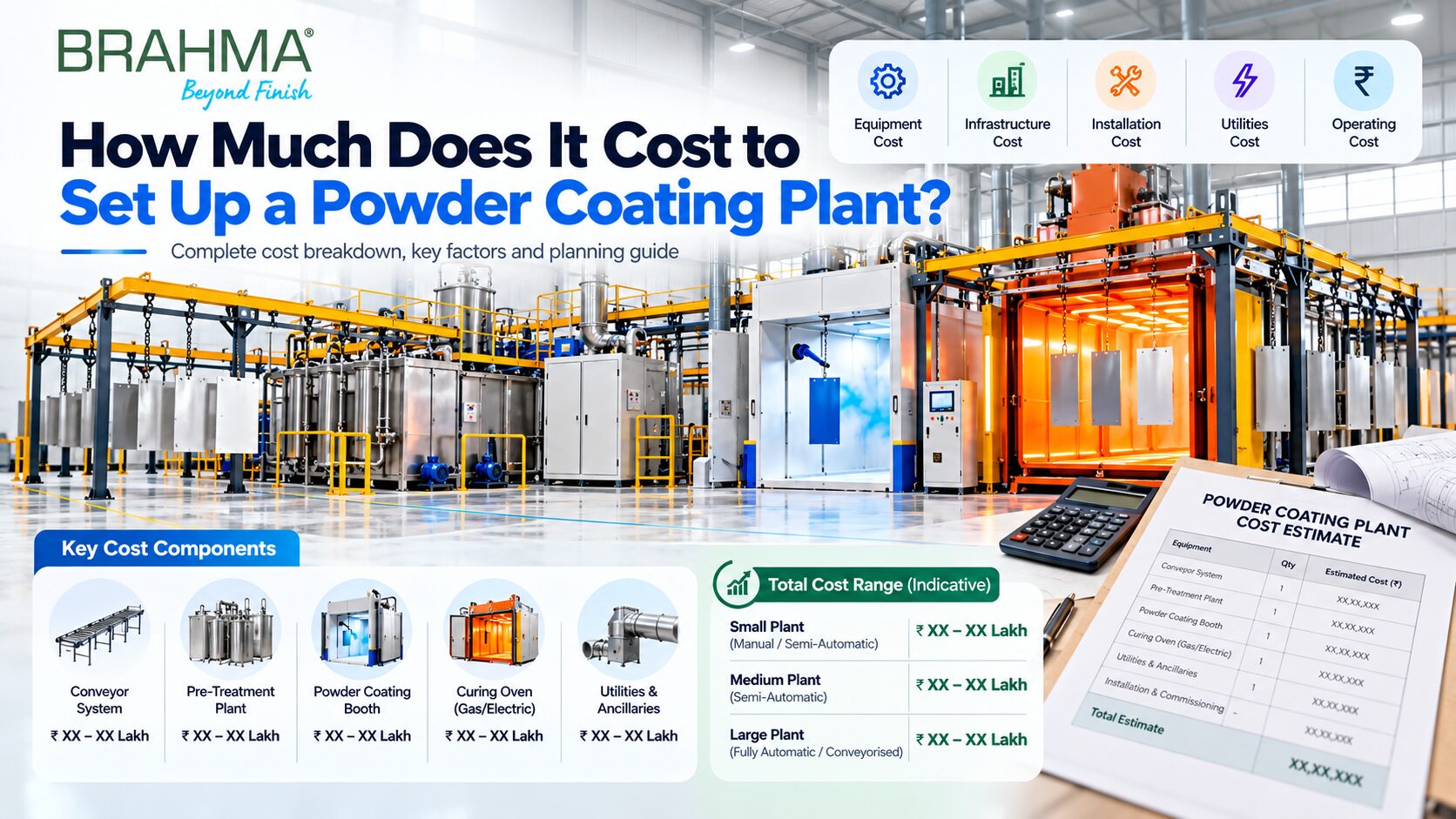
If you are planning a new finishing facility, one of the first questions is usually: how much does it cost to set up a powder coating plant?
In India, a basic manual powder coating setup can start at roughly ₹8–20 lakh, while semi-automatic plants may fall around ₹20–50 lakh. Larger fully automatic conveyorised systems can range from approximately ₹50 lakh to ₹2 crore or more, depending on production capacity, component size, pretreatment, automation and project scope.
These figures should be treated as indicative market ranges rather than fixed quotations.
The real project cost depends on much more than the powder coating booth and curing oven.
A complete setup may require:
pretreatment + drying + powder application + recovery + curing + material handling + compressed air + utilities + electrical infrastructure + wastewater treatment + installation + commissioning + working capital
That is why two powder coating plants capable of coating metal components can differ dramatically in price.
Manufacturers evaluating a complete system can explore Brahma Fabricon’s powder coating plant solutions and review its powder coating projects before developing a project-specific budget.
Powder Coating Plant Setup Cost at a Glance
| Plant Type | Indicative 2026 India Market Range | Typical Application |
|---|---|---|
| Basic manual batch plant | ₹8–20 lakh | Small fabricators, job shops, startups, low-volume production |
| Semi-automatic plant | ₹20–50 lakh | Growing manufacturers with repeat production |
| Automatic conveyorised plant | ₹50 lakh–₹2 crore+ | Medium- and high-volume industrial production |
| Highly customized/large automated line | Project-specific | Large OEM, automotive, appliance or specialized production |
The range is intentionally broad because the words “powder coating plant” can describe anything from a manual booth and batch oven to a fully integrated automatic conveyor line.
Why Is There No Single Powder Coating Plant Price?
A powder coating plant is usually engineered around the product being coated.
The supplier needs to know:
- component dimensions;
- component weight;
- material or substrate;
- parts per hour or shift;
- required pretreatment;
- powder specification;
- number of colours;
- factory layout;
- available electricity;
- gas or LPG availability;
- water and drainage;
- desired automation level.
Without this information, a quotation may be little more than a catalogue price.
A plant designed for 50 small brackets per shift will not cost the same as a plant designed for thousands of automotive components or large electrical cabinets.
The Biggest Cost Driver: Production Capacity
Production volume affects almost every major piece of equipment.
Higher production can require:
- larger pretreatment systems;
- longer spray tunnels;
- higher-capacity pumps;
- larger powder booths;
- more automatic guns;
- reciprocators;
- larger or longer curing ovens;
- continuous conveyors;
- PLC automation;
- higher electrical, gas and compressed-air capacity.
Before asking for a plant price, calculate:
- pieces per hour;
- pieces per shift;
- shifts per day;
- working days per month;
- expected production growth.
Do not buy a large automated line simply because it appears more advanced. Equipment should be right-sized to production requirements.
Manual vs Semi-Automatic vs Automatic Plant Cost
Manual Powder Coating Plant
A manual plant is generally the lowest-cost route into industrial powder coating.
A basic system may include:
- manual pretreatment or dip tanks;
- manual powder coating booth;
- one or more electrostatic powder guns;
- batch curing oven;
- air compressor;
- racks or trolleys.
Manual systems are best suited to:
- low production volume;
- custom parts;
- frequent product changes;
- multiple colours;
- startups and small manufacturers.
The lower investment should be weighed against greater dependence on labour, handling and operator skill.
Semi-Automatic Powder Coating Plant
A semi-automatic plant combines manual flexibility with selected automation.
It may include:
- conveyorised material handling;
- spray pretreatment;
- continuous or larger batch curing;
- automatic gun reciprocation;
- manual touch-up;
- powder recovery.
This can be a practical middle ground for manufacturers whose production has outgrown a basic batch setup but does not yet justify a fully automated line.
Fully Automatic Conveyorised Powder Coating Plant
A fully automatic line may integrate:
loading → pretreatment → dry-off → automatic powder application → recovery → curing → cooling → unloading
Investment rises because the system can include:
- long overhead conveyors;
- automatic guns;
- multiple reciprocators;
- part detection;
- powder management;
- cyclone recovery;
- PLC controls;
- larger continuous ovens;
- automated spray pretreatment.
For manufacturers comparing continuous systems specifically, see Brahma Fabricon’s conveyorised powder coating plants.
What Equipment Is Included in a Complete Powder Coating Plant?
The plant price makes more sense when it is broken into individual systems.
| Equipment | Purpose | Main Cost Drivers |
|---|---|---|
| Pretreatment system | Cleans and prepares metal | Stages, tank/tunnel size, heating, automation |
| Dry-off oven | Removes moisture after wet pretreatment | Size, heat source, production rate |
| Powder coating booth | Contains powder application and overspray | Dimensions, airflow, filtration, recovery |
| Powder guns | Electrostatically apply powder | Manual vs automatic, quantity, controller |
| Reciprocators | Automate gun movement | Stroke, number of axes, controls |
| Recovery system | Collects overspray | Cartridge, cyclone, colour-change design |
| Curing oven | Cures powder coating | Dimensions, thermal load, gas/electric heating |
| Conveyor | Moves parts through the line | Length, load, speed, conveyor type |
| PLC/control system | Coordinates process equipment | Automation, sensors, VFDs, monitoring |
| Compressed air | Supports powder transport and controls | Required flow and air quality |
| ETP/wastewater | Treats wet pretreatment wastewater where required | Chemistry, flow, discharge requirements |
1. Pretreatment Plant Cost
Pretreatment can represent a substantial portion of the project because it can require multiple tanks or spray stages, heating, pumps, chemical handling and wastewater infrastructure.
Common options include:
- manual dip tanks;
- multi-stage dip pretreatment;
- spray tunnel pretreatment;
- transporter-based systems;
- automated conveyorised pretreatment.
The right configuration depends on substrate, contamination, component geometry and corrosion-performance requirements.
More stages do not automatically mean a better process.
See Brahma Fabricon’s pre-treatment plant systems for the main configurations used in industrial finishing.
Do Not Forget Wastewater Cost
Wet cleaning and conversion processes can generate wastewater containing oils, suspended solids and chemicals depending on the selected treatment.
The project may therefore require:
- drainage;
- wastewater segregation;
- effluent treatment;
- sludge handling;
- chemical storage;
- water-treatment equipment.
These costs are easy to overlook if the quotation only lists pretreatment tanks or a spray tunnel.
2. Powder Coating Booth Cost
Booth pricing depends on much more than chamber dimensions.
Cost factors include:
- manual or automatic operation;
- workpiece dimensions;
- airflow requirement;
- filter cartridges;
- cyclone recovery;
- after-filter;
- number of colours;
- colour-change speed;
- automatic gun openings;
- operator stations.
A simple manual spray booth and an automatic quick-colour-change booth are fundamentally different investments.
Compare options through Brahma Fabricon’s powder coating booth range.
3. Powder Coating Gun and Automation Cost
The application system can range from one manual electrostatic gun to multiple automatic guns operating on reciprocators.
Automation cost depends on:
- number of guns;
- manual vs automatic equipment;
- reciprocators;
- gun controllers;
- part detection;
- recipe control;
- powder feed system;
- PLC integration.
The question should not be:
“How many guns can I afford?”
It should be:
“How many guns are required to coat our workpieces at the target conveyor speed?”
4. Powder Curing Oven Cost
The curing oven is another major investment area.
Its size and heating capacity depend on:
- maximum component dimensions;
- component weight;
- total batch mass;
- production rate;
- powder cure schedule;
- batch vs conveyor operation;
- gas or electric heating;
- insulation;
- air circulation.
Brahma Fabricon’s powder curing ovens include batch and conveyorised configurations.
Gas vs Electric Can Change Both Capex and Operating Cost
Electric heating can simplify some aspects of installation but may require substantial connected electrical capacity for a large oven.
Gas heating requires fuel infrastructure, burner controls and related safety equipment.
Neither option is universally cheaper.
Compare them using the actual production load, local energy tariff and annual operating hours. For a detailed comparison, see the gas vs electric powder coating oven guide.
5. Conveyor Cost
A conveyor can add significantly to project cost, especially on long automated lines.
Price is influenced by:
- total conveyor length;
- maximum workpiece load;
- hanger pitch;
- line speed;
- number of bends;
- track elevation;
- drive system;
- simple overhead vs power-and-free design.
A more complex conveyor is justified only when production requires the additional flexibility.
6. Factory and Civil Work Cost
The equipment price is not always the same as the project setup cost.
Factory modifications can include:
- equipment foundations;
- floor repairs;
- drainage channels;
- pretreatment pits;
- structural support;
- roof penetrations;
- exhaust stacks;
- equipment platforms;
- new partitions;
- loading/unloading areas.
A plant that fits on a supplier drawing can still require substantial civil work if the existing factory was not designed for a finishing line.
7. Electrical Infrastructure Cost
Before choosing equipment, confirm the available electrical load.
Electrical consumers can include:
- powder guns;
- reciprocators;
- fans;
- pumps;
- conveyor motors;
- PLC and controls;
- electric heaters;
- compressors;
- water-treatment equipment.
A large electric curing oven can materially increase connected-load requirements.
The real setup budget may therefore need to include:
- electrical panel upgrades;
- cabling;
- switchgear;
- transformer or sanctioned-load changes;
- earthing.
8. Compressed Air Cost
Powder coating application requires clean and stable compressed air.
A new plant may need:
- air compressor;
- receiver;
- air dryer;
- filters;
- distribution piping.
Do not assume an existing workshop compressor can automatically support an automatic powder line.
Check both:
pressure and available airflow at peak plant demand.
9. Powder, Chemicals and Initial Consumables
The plant cannot begin production with equipment alone.
Startup inventory may include:
- powder coating material;
- pretreatment chemicals;
- filter cartridges;
- gun nozzles;
- electrodes;
- hoses;
- masking plugs and caps;
- hooks;
- cleaning materials;
- quality-control consumables.
These are working-capital items rather than plant machinery, but they still need to be included in the startup budget.
10. Jigs, Hooks, Racks and Fixtures
Workpiece handling can become a significant hidden cost when the factory processes many different products.
Fixtures need to:
- carry the component safely;
- provide reliable electrical grounding;
- allow spray access;
- permit pretreatment drainage;
- fit the conveyor or trolley;
- withstand the cure temperature.
A factory with fifty product families may need far more fixture development than one coating a single repetitive component.
11. Installation and Commissioning Cost
Clarify whether the supplier’s price includes:
- transportation;
- unloading;
- equipment erection;
- travel and accommodation;
- electrical installation;
- piping;
- ducting;
- trial runs;
- oven profiling;
- operator training;
- final handover.
The words “turnkey plant” are only useful when the quotation clearly defines what is actually included.
For the project sequence from factory preparation to handover, see the powder coating plant installation process.
Equipment Price vs Complete Setup Cost
This distinction explains why online powder coating plant prices can appear inconsistent.
You may find an online listing for a machine costing only a few lakh rupees while another supplier quotes tens of lakhs for a complete powder coating plant.
They may not be selling the same thing.
| Equipment Listing May Include | Complete Turnkey Plant May Include |
|---|---|
| One booth | Pretreatment + booth + recovery |
| One oven | Dry-off + curing |
| One powder gun | Multiple guns/automation |
| Basic electrical panel | PLC, VFDs, sensors and interlocks |
| No conveyor | Integrated conveyor |
| No utilities | Defined utility interfaces |
| No commissioning | Installation and commissioning |
| No wastewater system | ETP/process integration where required |
Never compare quotations until the scope is normalized.
How Factory Layout Affects Setup Cost
A compact, logical factory can reduce:
- conveyor length;
- utility piping;
- electrical cabling;
- structural work;
- material movement.
An awkward building can require:
- additional conveyor bends;
- elevated sections;
- longer gas/water lines;
- additional ducting;
- custom structural supports.
Before ordering equipment, complete a proper powder coating plant layout around the actual building and product flow.
How Part Size Affects Plant Price
Large components increase cost across several systems at once.
A larger workpiece can require:
- bigger pretreatment tanks;
- wider spray tunnels;
- larger booth openings;
- larger batch ovens;
- stronger conveyors;
- more factory height;
- heavier fixtures.
This is why component drawings are one of the most important documents to send with a quotation request.
How Product Weight Affects Cost
Two components can have similar dimensions but very different weights.
Heavy parts affect:
- conveyor rating;
- hanger design;
- handling equipment;
- oven thermal load;
- heat-up time;
- production speed.
Always provide maximum weight along with maximum dimensions.
How Colour Changes Affect Plant Cost
A factory coating one colour for several days has different requirements from a job coater changing colour several times each shift.
Frequent colour changes can make:
- easy-clean booth design;
- powder segregation;
- quick-change recovery;
- multiple powder feed systems;
- production scheduling
more important than maximum reclaim efficiency alone.
Include the number of colours and typical change frequency in the quotation brief.
How Automation Changes the Budget
Automation can increase capital cost through:
- automatic guns;
- reciprocators;
- part detection;
- PLC controls;
- VFDs;
- conveyor integration;
- recipe management.
But automation can also improve consistency and throughput when production is sufficiently repetitive.
Automation should therefore be evaluated using:
cost per acceptable finished component
rather than simply comparing initial machine prices.
How Much Space Do You Need?
Space requirement depends on:
- plant type;
- component size;
- pretreatment;
- oven;
- conveyor route;
- cooling;
- loading and unloading;
- maintenance access;
- powder storage;
- chemical storage;
- ETP;
- finished-goods staging.
A small batch setup can operate in a much smaller area than a complete conveyorised line.
Do not calculate factory size from equipment footprints alone.
Use:
equipment + operating clearance + maintenance access + material handling + storage + utilities
What Does It Cost to Operate a Powder Coating Plant?
Capital cost is only half the investment decision.
Ongoing costs include:
- powder;
- pretreatment chemicals;
- electricity;
- gas or LPG;
- compressed air;
- water;
- labour;
- filters;
- replacement gun parts;
- conveyor maintenance;
- oven maintenance;
- ETP chemicals and waste handling;
- quality-control consumables.
Calculate Operating Cost per Accepted Part
A useful formula is:
Total monthly coating cost ÷ accepted coated output = coating cost per acceptable part
For manufacturers producing different-sized components, cost per square metre can also be useful.
Powder Cost: Do Not Look Only at Price per Kilogram
The cheapest powder per kilogram may not produce the lowest coating cost.
Consider:
- required film thickness;
- first-pass transfer;
- reclaim strategy;
- overspray;
- rejects;
- colour-change waste;
- coverage;
- required coating performance.
The Powder Coating Institute provides a coating cost comparison tool that includes material, manpower, energy and waste-related inputs, reinforcing the value of comparing complete process economics instead of coating purchase price alone.
Should You Buy a Batch Plant or Conveyorised Plant?
| Choose a Batch Plant When | Consider Conveyorised Production When |
|---|---|
| Production is relatively low | Production is consistently high |
| Products vary significantly | Product families are repetitive |
| Colour changes are frequent | Production colours are predictable |
| Large custom components are common | Hanger loading can be standardized |
| Capital budget is limited | Automation can be justified |
| Flexible scheduling matters | Continuous production flow matters |
The more expensive plant is not necessarily the better investment.
A fully automatic line operating at low utilization can be less economical than a correctly sized semi-automatic system.
Should You Build In-House or Outsource Powder Coating?
Setting up your own plant can make sense when outsourcing creates problems such as:
- high recurring coating expenditure;
- transport cost;
- long turnaround times;
- quality inconsistency;
- production delays;
- high rework;
- large predictable coating volume.
Outsourcing may still be more economical when:
- coating demand is very low;
- production is highly irregular;
- factory space is unavailable;
- capital is better used elsewhere;
- the required finish is highly specialized.
The comparison should use annual total cost rather than coating price alone.
Simple Powder Coating Plant ROI Calculation
If you are replacing outsourced coating, a basic investment calculation can begin with:
Annual outsourcing cost
minus:
annual in-house operating cost
equals:
estimated annual operating saving
Then:
Simple payback = total setup investment ÷ estimated annual saving
However, the calculation should also account for:
- maintenance;
- labour;
- finance cost;
- downtime;
- rejects;
- capacity utilization;
- working capital.
Avoid assuming the plant will operate at full capacity every day.
Example: Why Two Plants Can Have Very Different Budgets
Factory A: Custom Fabricator
Factory A produces small batches of electrical cabinets and machine parts in several colours.
Its practical configuration may be:
- dip pretreatment;
- manual booth;
- manual gun;
- batch oven;
- trolleys.
The priority is flexibility rather than maximum throughput.
Factory B: High-Volume Component Manufacturer
Factory B coats thousands of similar components per shift.
Its line may require:
- continuous spray pretreatment;
- dry-off oven;
- overhead conveyor;
- automatic guns;
- reciprocators;
- powder recovery;
- continuous curing oven;
- PLC control.
Both businesses have a “powder coating plant,” but the capital requirements are not comparable.
How to Prepare a Realistic Powder Coating Plant Budget
Break your project budget into these categories:
| Budget Category | Include |
|---|---|
| Core equipment | Pretreatment, booth, oven, guns, conveyor |
| Automation | PLC, reciprocators, sensors, drives |
| Utilities | Power, air, gas, water |
| Factory work | Civil, foundations, drainage, structures |
| Environmental systems | Wastewater/ETP and related requirements |
| Material handling | Hooks, racks, trolleys and lifting equipment |
| Installation | Erection, piping, wiring and ducting |
| Commissioning | Trials, profiling and training |
| Initial consumables | Powder, chemicals, filters and spares |
| Working capital | Labour, inventory and startup operation |
| Contingency | Project-specific unforeseen requirements |
This prevents a common mistake: securing enough money for the machines but not enough to make the plant production-ready.
What Should Be Included in a Powder Coating Plant Quotation?
A good quotation should clearly state:
- workpiece dimensions used for design;
- maximum component weight;
- production capacity basis;
- pretreatment stages;
- tank or tunnel dimensions;
- booth configuration;
- number and type of guns;
- recovery system;
- oven working dimensions;
- heating source;
- conveyor specification;
- connected electrical load;
- compressed-air requirement;
- water requirement;
- fuel requirement;
- controls;
- installation scope;
- commissioning scope;
- training;
- warranty;
- exclusions.
Questions to Ask Before Comparing Powder Coating Plant Prices
- Are both quotations based on the same maximum component size?
- Are they based on the same production capacity?
- Is pretreatment included?
- Does the quote include a dry-off oven?
- What type of powder booth and recovery system is included?
- How many powder guns are included?
- Is the curing oven gas or electric?
- What loaded mass was used for oven sizing?
- Is the conveyor included?
- What conveyor type and load rating are specified?
- Are PLC controls included?
- Is the air compressor included?
- Is ETP included?
- Are hooks, racks and fixtures included?
- Does the price include freight?
- Does it include installation?
- Does it include commissioning?
- Does it include operator training?
- Which site utilities must the customer provide?
- What items are specifically excluded?
Only after these questions are answered can two prices be compared fairly.
What Information Should You Send for an Accurate Quote?
| Requirement | Information to Provide |
|---|---|
| Component drawings | Photos/CAD where available |
| Maximum dimensions | Length × width × height |
| Maximum weight | kg per component |
| Typical components | Normal production mix |
| Substrate | MS, CRCA, GI, aluminium, etc. |
| Production | Parts/hour, shift or month |
| Colours | Number and change frequency |
| Powder specification | Cure schedule and performance requirements |
| Factory dimensions | Length, width and clear height |
| Electricity | Available connected load |
| Fuel | PNG/LPG/electric preference and availability |
| Compressed air | Existing compressor details |
| Water | Availability and quality |
| Drainage/ETP | Existing or proposed |
| Future production | Expected expansion |
The more accurate these inputs are, the more useful the quotation will be.
Frequently Asked Questions About Powder Coating Plant Setup Cost
How much does it cost to set up a powder coating plant in India?
A basic manual powder coating plant may cost roughly ₹8–20 lakh, while semi-automatic systems can fall around ₹20–50 lakh. Larger fully automatic conveyorised plants can cost approximately ₹50 lakh to ₹2 crore or more. These are broad market references; actual pricing depends on plant capacity, workpiece size, pretreatment, automation, oven, conveyor and installation scope.
What is the cheapest way to start powder coating?
For low production, a manual batch setup with appropriately sized pretreatment, manual powder application and a batch curing oven generally requires less capital than a complete conveyorised line. However, the system still needs proper ventilation, curing, compressed air, electrical infrastructure and safe material handling.
How much does a small powder coating plant cost?
Small plant cost varies considerably depending on whether the quotation includes pretreatment, booth, oven, gun, compressor and installation. Current Indian market guides commonly place basic complete manual setups in roughly the ₹8–20 lakh range, but a project-specific quotation is required.
How much does an automatic powder coating plant cost?
A fully automatic line generally requires substantially more investment because it adds conveyorised handling, automatic guns, reciprocators, powder recovery, larger ovens and control automation. Depending on scale and specification, complete automatic systems can range from tens of lakhs to ₹2 crore or more.
What is the most expensive part of a powder coating plant?
There is no universal single largest component. Pretreatment, curing ovens, conveyors and automated powder application can all represent major portions of the investment depending on the plant configuration.
Is a conveyorised powder coating plant more expensive?
Yes, it generally has a higher initial investment because it requires integrated material handling and often larger continuous process equipment. However, conveyorised production can become more economical per component when production volumes are sufficiently high and consistent.
Do I need pretreatment when starting a powder coating plant?
Proper surface preparation is fundamental to coating performance. The exact cleaning and conversion process depends on the substrate, contamination and required durability. A quotation that excludes pretreatment may not represent the complete production process you actually need.
Is gas or electric curing cheaper?
There is no universal answer. Compare actual electricity tariffs, fuel cost, production load, oven efficiency, operating hours and infrastructure costs before selecting the heat source.
How much factory space is required?
A small batch operation requires much less space than an automated conveyor line. Calculate the requirement from equipment dimensions plus loading, cooling, maintenance, storage, material handling and utilities rather than relying on one standard square-foot figure.
What hidden costs should I budget for?
Commonly overlooked items include civil modifications, electrical upgrades, air compressor systems, gas connections, drainage, ETP, hooks and fixtures, initial powder and chemicals, installation, freight, training and working capital.
How do I compare two powder coating plant quotations?
First confirm that both suppliers are quoting the same product dimensions, loaded weight, throughput, pretreatment, booth, guns, recovery, oven, conveyor, controls, utilities and installation scope. A lower quotation may simply exclude major items.
Can I expand a small powder coating plant later?
Often yes, but future expansion should be considered during the initial factory layout and utility planning. Space for a larger oven, conveyor extension, additional booth equipment or higher electrical and compressed-air demand can make later expansion easier.
Conclusion
So, how much does it cost to set up a powder coating plant?
For an Indian project in 2026, a useful early planning range is roughly:
- ₹8–20 lakh for a basic manual setup;
- ₹20–50 lakh for many semi-automatic configurations;
- ₹50 lakh to ₹2 crore+ for larger fully automatic conveyorised systems.
But the number that matters is not the cheapest equipment quote.
The meaningful figure is:
the total cost of creating a production-ready plant capable of coating your actual components at the required quality and output.
That means budgeting for:
equipment + factory work + utilities + pretreatment + environmental systems + installation + commissioning + fixtures + startup materials + working capital
Start with your component drawings and production target. Then select the process, calculate the required capacity and develop the layout before comparing equipment prices.
Brahma Fabricon designs custom powder coating plants for manual, semi-automatic and conveyorised industrial production. You can review Brahma Fabricon’s powder coating projects or contact Brahma Fabricon with your component dimensions, weight, production target, factory space and available utilities for a project-specific quotation.