
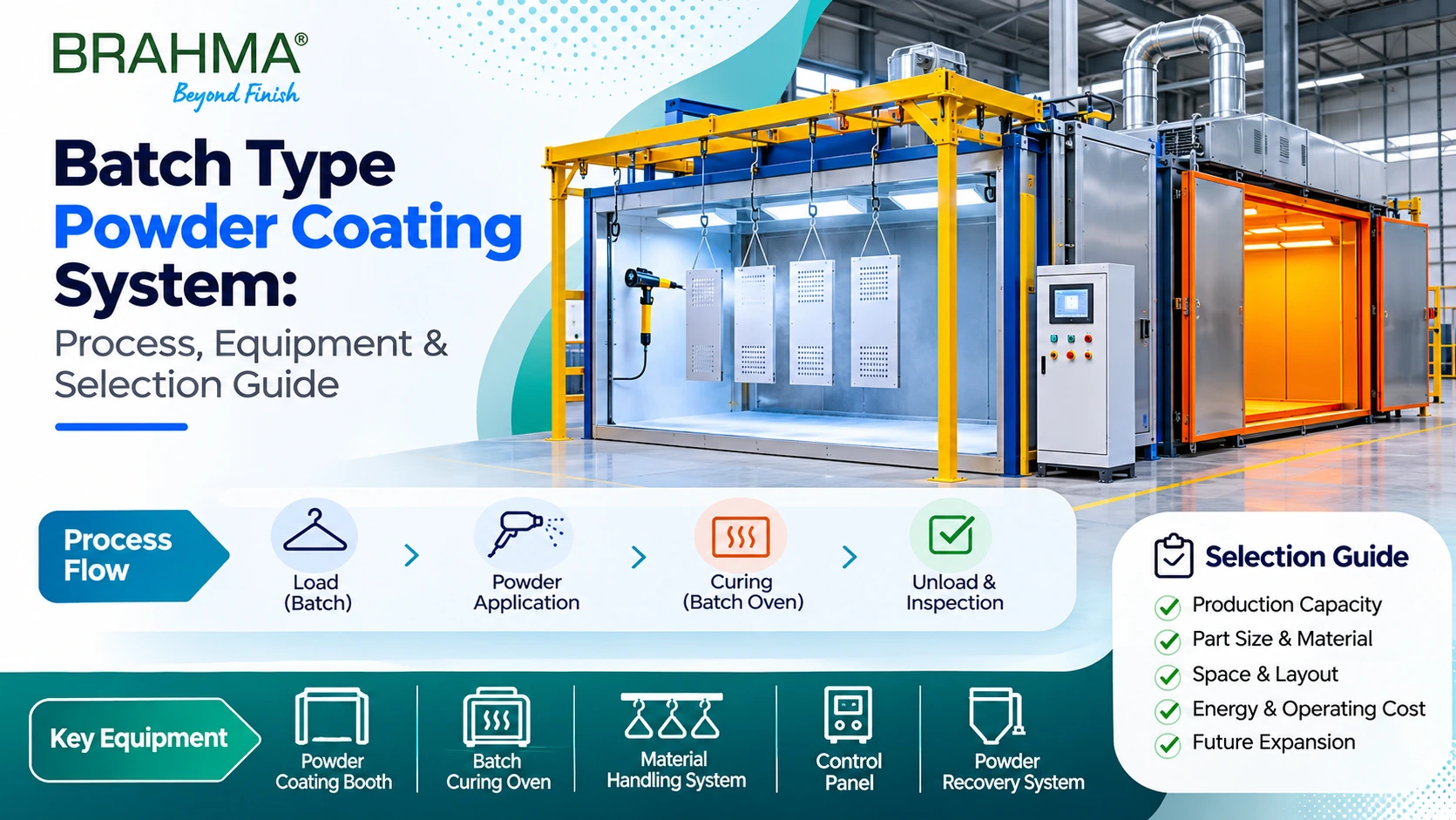
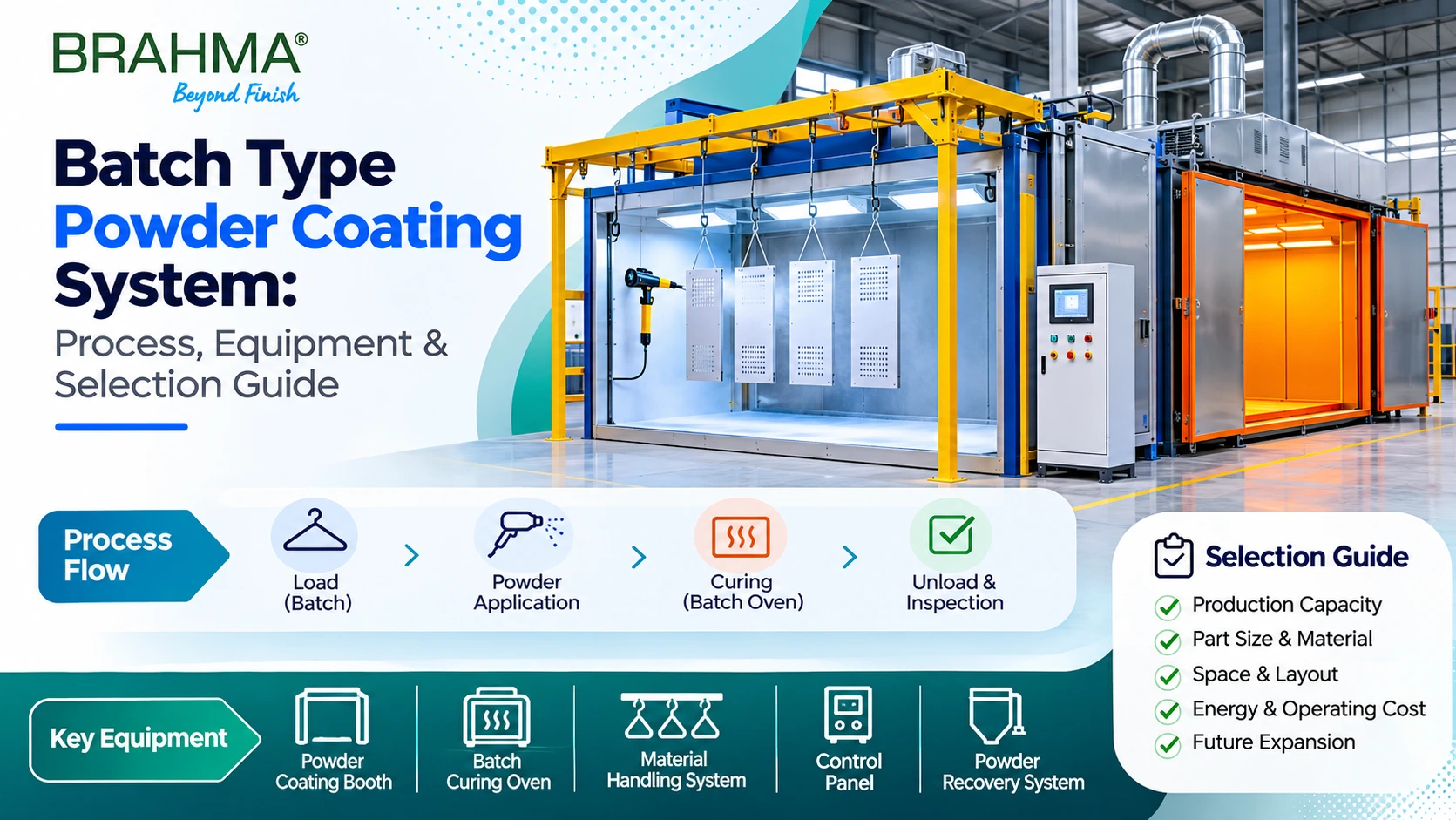
A batch type powder coating system is an industrial finishing setup in which components are prepared, coated and cured in groups or batches rather than moving continuously through an automated conveyor line.
Batch systems are widely used where manufacturers handle different component sizes, changing production schedules, multiple colours, large fabricated parts or relatively low-to-medium production volumes.
A typical batch process follows:
Loading → Pre-treatment → Drying → Powder Application → Batch Curing → Cooling → Inspection
Unlike a continuous conveyorised plant, components are normally moved between process stages using trolleys, racks, overhead rails, cranes or other suitable material-handling equipment.
The correct system should be designed around the parts being coated, required production capacity, coating specification and available factory space.
What Is a Batch Type Powder Coating System?
In a batch powder coating plant, a defined group of components passes through each production stage before the next batch is processed.
The plant can include:
- dip pre-treatment tanks;
- wash or cleaning system;
- dry-off arrangement;
- manual powder coating booth;
- electrostatic powder coating guns;
- powder recovery system;
- batch curing oven;
- racks and trolleys;
- compressed-air system;
- control panel.
Batch equipment is particularly useful when the parts being coated vary substantially in shape, size or colour.
It can also provide a practical starting point for manufacturers bringing powder coating in-house without immediately installing a complete continuous conveyorised line.
How Does a Batch Powder Coating System Work?
The exact process varies according to the metal substrate and required finish, but the main stages generally remain similar.
Step 1: Component Loading and Inspection
Before processing begins, components are loaded onto racks, trolleys, fixtures or hooks.
At this stage, operators should check:
- component dimensions;
- component weight;
- surface contamination;
- oil and grease;
- rust or scale;
- masking requirements;
- hanging points.
Batch size should be selected according to the capacity of the pretreatment area, booth and curing oven.
Loading too many parts onto a trolley can restrict spray access, reduce drainage and create inconsistent heating.
Step 2: Metal Pre-Treatment
Good powder coating begins with proper surface preparation.
The component may pass through chemical cleaning stages such as:
Degreasing → Rinsing → Derusting if required → Rinsing → Conversion Treatment → Final Rinse
The actual process depends on:
- mild steel, aluminium or galvanized steel;
- incoming contamination;
- corrosion-resistance requirement;
- powder coating specification.
For batch operations, dip or immersion pretreatment is often practical because complete racks of components can be lowered into tanks.
Brahma Fabricon offers dip, spray and transporter-based pre-treatment systems for industrial powder coating applications.
Step 3: Drying
Components should be adequately dried after wet pretreatment.
Moisture can remain in:
- corners;
- channels;
- seams;
- holes;
- welded sections;
- folded components.
If parts enter the powder coating booth while still wet, coating quality can suffer.
The drying system should therefore be matched to component geometry and batch size.
Step 4: Powder Application
Prepared components are moved into the powder coating booth.
An electrostatic powder gun charges the powder particles, which are attracted to the properly grounded metal component.
Manual powder application is common in batch plants because operators can adjust their spraying technique for different components.
This flexibility is particularly useful for:
- custom fabricated products;
- electrical enclosures;
- machine parts;
- furniture;
- large cabinets;
- heavy fabrication;
- low-volume industrial components.
Step 5: Powder Recovery
Not all sprayed powder deposits on the component during the first application.
A properly designed booth collects overspray using a suitable filtration or recovery arrangement.
Common options include:
- cartridge-filter recovery;
- cyclone-based recovery;
- non-reclaim collection where appropriate.
Recovery-system selection depends on powder consumption, production volume and colour-change frequency.
Manufacturers changing colours frequently may place greater emphasis on easy booth cleaning and reduced cross-contamination than on maximizing reclaim.
Step 6: Batch Curing
After powder application, the rack or trolley is moved into a batch curing oven.
During curing, the powder melts, flows and develops its final coating properties according to the powder manufacturer’s specified cure schedule.
The oven should be designed around:
- maximum component dimensions;
- loaded trolley dimensions;
- total component mass;
- rack or fixture mass;
- powder cure requirement;
- batch quantity;
- required production cycle.
A common mistake is to select an oven only from its internal dimensions.
The thermal load of the actual batch is equally important.
Part Temperature Matters During Curing
The oven-air temperature alone does not confirm that the coating has cured correctly.
The component itself must achieve the powder manufacturer’s specified metal-temperature and time requirement.
Heavy fabricated components may heat considerably more slowly than thin sheet-metal parts.
For this reason, oven selection should consider both part dimensions and thermal mass.
Equipment Required for a Batch Type Powder Coating System
- Pre-Treatment Tanks
Dip tanks can be used for:
- degreasing;
- rinsing;
- derusting;
- phosphating;
- conversion coating.
Tank size should accommodate the largest loaded rack while providing adequate clearance for safe movement.
- Material-Handling System
Depending on component size and weight, handling can use:
- manual racks;
- trolleys;
- overhead rails;
- hoists;
- cranes;
- transporter systems.
Handling should minimize unnecessary touching of cleaned components.
- Powder Coating Booth
The booth contains powder application and controls overspray.
Its size should allow adequate clearance around the component for:
- manual gun movement;
- powder containment;
- operator access;
- cleaning;
- maintenance.
- Powder Coating Gun
Manual electrostatic guns are commonly used in batch systems.
The application equipment should provide suitable control over:
- electrostatic settings;
- powder output;
- airflow;
- application pattern.
- Powder Recovery System
Cartridge filters or other recovery equipment collect overspray and help maintain booth airflow.
Filter access should be considered during plant layout so routine maintenance does not become difficult.
- Batch Curing Oven
The curing oven is one of the most important components of the system.
Batch ovens can use:
- gas heating;
- electric heating;
- another engineered process-heating system.
Heating selection should consider local utility availability, operating hours, required thermal load and total operating cost.
- Compressed-Air System
Clean, dry compressed air is required for powder transport and electrostatic application.
Oil or moisture contamination in compressed air can affect powder handling and coating quality.
Benefits of a Batch Type Powder Coating System
Greater Product Flexibility
Batch plants can handle a wide variety of components without requiring every product to conform to one conveyor envelope.
This makes them particularly useful for job coaters and manufacturers producing several product families.
Suitable for Frequent Colour Changes
Production can be grouped according to colour.
For example:
Batch 1 – White → Clean Booth → Batch 2 – Grey → Clean Booth → Batch 3 – Black
This can be easier to manage than frequent changes on a complex continuous line.
Lower Initial Investment Than Many Automated Lines
A batch system usually requires less material-handling automation than a fully conveyorised powder coating plant.
This can make batch production practical for smaller manufacturers or companies establishing an in-house finishing department.
The final investment still depends on component size, pretreatment requirements, booth, oven and handling equipment.
Flexible for Large Components
Large machine bodies, fabricated cabinets and bulky products may be difficult to accommodate on a conventional continuous overhead conveyor.
A purpose-designed batch system can allow large products to be processed using trolleys, rails or other handling arrangements.
Easier Production Scheduling for Mixed Orders
Different customers may require:
- different colours;
- different component sizes;
- different powder types;
- different production quantities.
Batch processing allows these jobs to be scheduled independently.
Limitations of Batch Powder Coating Systems
Batch systems are not the best solution for every factory.
Potential limitations include:
- greater manual material handling;
- more dependence on operator skill;
- lower throughput than suitable continuous systems;
- waiting between process stages;
- variable batch loading;
- greater labour input at higher volumes.
When thousands of similar components must be coated continuously, a conveyorised powder coating plant may become more appropriate.
Batch vs Conveyorised Powder Coating System
| Factor | Batch System | Conveyorised System |
| Production volume | Low to medium | Medium to high |
| Product variety | Excellent | Best with repeatable products |
| Large components | Highly flexible | Depends on conveyor design |
| Colour changes | Flexible | Depends on booth design |
| Material handling | Manual/trolley/rail | Continuous conveyor |
| Automation | Low to medium | Medium to high |
| Initial investment | Generally lower | Generally higher |
| Factory footprint | Can be compact | Usually larger |
| Production flow | Batch-based | Continuous |
| Labour dependence | Higher | Lower with automation |
| Best application | Mixed/custom production | Repetitive high-volume production |
Neither system is universally better.
The correct choice depends on the actual product mix and production requirement.
When Should You Choose a Batch Powder Coating Plant?
A batch system should be considered when:
- production volume is relatively low or moderate;
- components vary significantly in size;
- product designs change frequently;
- multiple colours are required;
- large components need coating;
- continuous conveyor operation cannot be justified;
- factory space is limited;
- flexibility is more important than maximum throughput.
When Should You Consider a Conveyorised Plant Instead?
A conveyorised system may be a better fit when:
- products are highly repetitive;
- daily production is consistently high;
- component dimensions are standardized;
- hanger loading can be repeated;
- colour changes are limited or predictable;
- automation can reduce meaningful labour requirements;
- continuous production is required.
Manufacturers evaluating higher-volume production can compare Brahma Fabricon’s conveyorised powder coating plant solutions with batch configurations before finalizing the plant concept.
Batch Powder Coating Plant Layout
A simple batch plant layout may follow:
Incoming Parts → Pretreatment → Drying → Staging → Powder Booth → Batch Oven → Cooling → Inspection
The layout should minimize unnecessary movement.
Important planning considerations include:
- trolley travel;
- operator access;
- loading and unloading;
- booth maintenance;
- oven-door clearance;
- powder storage;
- chemical storage;
- compressed air;
- electrical utilities;
- wastewater handling.
The shortest equipment arrangement is not necessarily the best layout. Material should move logically through the factory without clean components crossing dirty fabrication areas.
How to Size a Batch Curing Oven
Start with the largest production batch rather than the largest individual part.
Provide:
- maximum component length;
- width;
- height;
- component weight;
- number of parts per batch;
- rack dimensions;
- rack weight;
- powder cure schedule.
The oven must have enough internal space for airflow around the loaded batch.
If components are packed too closely, air circulation and heating uniformity can suffer.
How to Calculate Batch Production Capacity
Batch capacity should consider the full production cycle.
For example:
Loading + Pretreatment + Drying + Spraying + Curing + Cooling + Unloading
The oven alone should not define plant output.
If a curing oven can process a batch quickly but pretreatment or manual spraying cannot keep up, the overall plant capacity will still be limited.
When comparing suppliers, ask how the quoted parts-per-shift figure was calculated.
Industries That Use Batch Powder Coating Systems
Batch systems can be suitable for:
- electrical control panels;
- machine enclosures;
- CNC machine bodies;
- fabricated sheet metal;
- metal furniture;
- industrial cylinders;
- automotive components;
- agricultural equipment;
- gates and fabricated structures;
- general engineering components.
The suitability depends on actual component dimensions and production requirements.
Common Mistakes When Buying a Batch Powder Coating System
Avoid:
- purchasing an oven before calculating batch load;
- choosing pretreatment only by number of tanks;
- undersizing the booth;
- ignoring trolley and fixture dimensions;
- failing to plan colour changes;
- ignoring compressed-air quality;
- leaving insufficient maintenance space;
- designing around maximum part size but ignoring typical production;
- comparing quotations with different scopes;
- assuming a batch plant has unlimited flexibility.
The plant should be designed as one integrated process.
Batch Type Powder Coating System Selection Checklist
Before requesting a quotation, confirm:
- Maximum component dimensions
- Typical component dimensions
- Maximum component weight
- Components per batch
- Batches per shift
- Metal substrate
- Pretreatment requirement
- Number of colours
- Colour-change frequency
- Powder specification
- Batch oven load
- Gas or electrical availability
- Compressed-air availability
- Factory dimensions
- Trolley or rack requirements
- Wastewater-management requirements
- Installation and commissioning scope
Frequently Asked Questions About Batch Type Powder Coating Systems
What is a batch type powder coating system?
A batch type powder coating system processes groups of components through surface preparation, powder application and curing rather than moving products continuously through an automated conveyor line.
What equipment is required for a batch powder coating plant?
Typical equipment includes pretreatment tanks, material-handling racks or trolleys, a powder coating booth, electrostatic powder gun, recovery system, batch curing oven and compressed-air system.
Is a batch powder coating system suitable for large parts?
Yes. Batch systems can be particularly useful for large or varied components when the booth, oven and handling system are designed around their dimensions and weight.
Is a batch system cheaper than a conveyorised powder coating plant?
A batch plant generally requires less conveyor automation and can have a lower initial investment. Actual project cost depends on component dimensions, pretreatment, oven size, booth, utilities and handling requirements.
Can a batch powder coating system handle multiple colours?
Yes. Batch systems can provide good flexibility for manufacturers handling several colours, although proper booth and application-equipment cleaning is still necessary between colour changes.
How is batch powder coating plant capacity calculated?
Capacity should consider batch quantity and the complete production cycle, including loading, pretreatment, drying, powder application, curing, cooling and unloading.
Which is better: batch or conveyorised powder coating?
Neither is inherently better. Batch systems are generally more flexible for varied products and moderate volumes, while conveyorised systems are typically better suited to repetitive high-volume production.
Conclusion
A batch type powder coating system can be a practical choice for manufacturers that need flexibility, process different product sizes, handle frequent colour changes or operate at low-to-medium production volumes.
The correct plant should be selected in this sequence:
component → production volume → pretreatment → handling → booth → curing oven → utilities → layout
The largest component determines whether the equipment can physically handle the product, but typical batch size and daily production determine whether the system will be economically practical.
Brahma Fabricon manufactures batch and conveyorised powder coating plants, pretreatment systems, powder coating booths and curing ovens for industrial applications. Manufacturers planning a batch system can explore Brahma Fabricon’s powder coating plant solutions or contact Brahma Fabricon with component dimensions, batch quantity, production targets and factory layout for a project-specific configuration.