
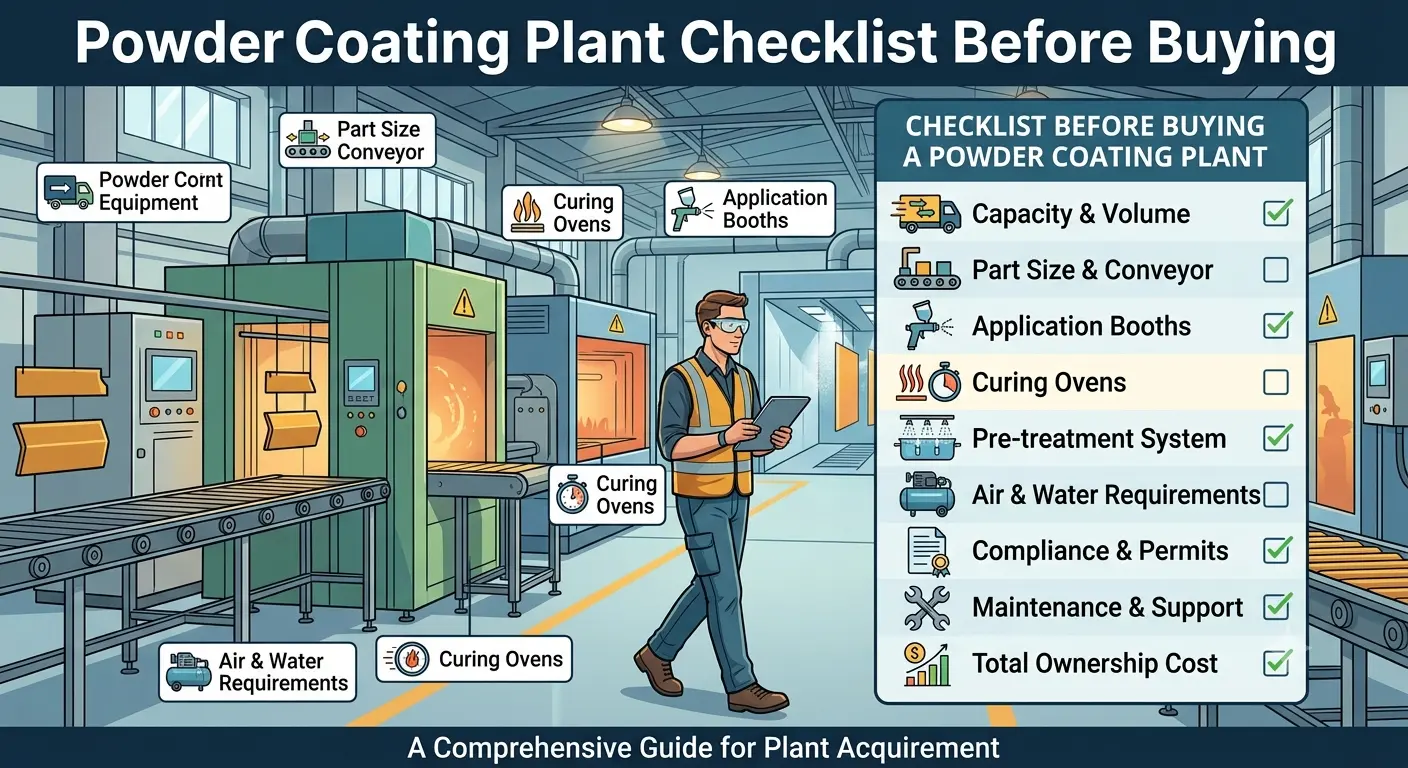
Buying a powder coating plant is a long-term investment that affects production quality, operating costs, efficiency, and profitability. Before purchasing, manufacturers should evaluate production capacity, pretreatment systems, powder recovery, automation, energy efficiency, conveyor systems, after-sales support, maintenance requirements, and total cost of ownership (TCO) rather than focusing only on the equipment price.
Quick Buying Checklist:
Before selecting a powder coating plant, verify:
✅ Production capacity
✅ Product dimensions & weight
✅ Type of metal being coated
✅ Pretreatment system
✅ Powder coating booth
✅ Powder recovery efficiency
✅ Curing oven performance
✅ Conveyor system
✅ Automation level
✅ Energy consumption
✅ Environmental compliance
✅ Maintenance requirements
✅ Spare parts availability
✅ Installation & commissioning
✅ Operator training
✅ After-sales support
✅ Warranty
✅ Future expansion capability
✅ Total Cost of Ownership (TCO)
✅ Customer references & case studies
Why Choosing the Right Powder Coating Plant Matters
A powder coating plant is not just another piece of equipment—it’s a critical production asset that influences product quality, operational efficiency, customer satisfaction, and long-term profitability.
Many buyers make the mistake of comparing only the purchase price. However, the real value lies in:
- Lower operating costs
- Reliable production
- High powder recovery
- Reduced maintenance
- Energy efficiency
- Better coating quality
- Scalability for future growth
A well-engineered system can deliver consistent returns for many years.
Step 1: Define Your Production Requirements
Before contacting suppliers, clearly identify your manufacturing needs.
Products to Be Coated
Examples include:
- Metal furniture
- Automotive components
- Aluminium extrusions
- Electrical enclosures
- Heavy fabrication
- Agricultural equipment
- Industrial machinery
Production Volume
Estimate:
- Components per shift
- Daily output
- Monthly production
- Future growth plans
Your production volume determines the required plant capacity and automation level.
Product Size and Weight
Measure the:
- Maximum length
- Width
- Height
- Weight
These dimensions influence conveyor design, booth size, and curing oven capacity.
Step 2: Evaluate Every Plant Component
A complete powder coating plant consists of multiple integrated systems.
Pretreatment System
Surface preparation determines coating performance.
Verify:
- Number of stages
- Chemical process
- Water quality management
- Drying efficiency
Powder Coating Booth
Ask about:
- Booth type
- Powder recovery method
- Airflow design
- Filter technology
- Cleaning time during color changes
Powder Recovery System
Higher recovery efficiency reduces operating costs.
Compare:
- Cartridge filter systems
- Cyclone recovery systems
- Recovery efficiency
- Powder reuse capability
Electrostatic Spray Equipment
Evaluate:
- Spray gun quality
- Automatic or manual operation
- Transfer efficiency
- Ease of maintenance
Curing Oven
The curing oven significantly impacts energy consumption.
Compare:
- Fuel type
- Temperature uniformity
- Insulation quality
- Heating efficiency
- Heat recovery features
Conveyor System
Select a conveyor based on:
- Production volume
- Product weight
- Available floor space
- Future expansion
Options include:
- Overhead conveyors
- Floor conveyors
- Power & free systems
- Monorail conveyors
Step 3: Compare Technical Specifications
Do not compare quotations based solely on price.
Instead, evaluate:
| Specification | Why It Matters |
|---|---|
| Plant Capacity | Meets production demand |
| Powder Recovery | Reduces material waste |
| Automation Level | Improves productivity |
| Oven Efficiency | Lowers fuel consumption |
| Conveyor Design | Supports smooth workflow |
| Filter Technology | Improves air quality |
| Control System | Simplifies operation |
| Safety Features | Protects personnel |
Request detailed technical documentation from every supplier.
Step 4: Understand Operating Costs
The purchase price represents only part of the investment.
Evaluate long-term expenses such as:
Energy Consumption
- Electricity
- LPG
- PNG
- Diesel
- Natural gas
Powder Consumption
Efficient recovery systems reduce material costs.
Maintenance
Compare:
- Filter replacement
- Spare parts
- Preventive servicing
- Annual maintenance costs
Labor
Automation can significantly reduce labor requirements and improve productivity.
Downtime
Reliable equipment minimizes production interruptions.
Step 5: Review Supplier Capabilities
A reliable supplier offers more than equipment.
Look for:
Engineering Experience
Experience with projects similar to yours.
Custom Design
Avoid one-size-fits-all solutions.
Your plant should match:
- Product size
- Production volume
- Factory layout
- Industry requirements
Installation & Commissioning
Confirm whether the supplier provides:
- Installation
- Testing
- Operator training
- Performance validation
After-Sales Service
Strong technical support reduces downtime.
Ask about:
- Spare parts availability
- Technical assistance
- Annual maintenance
- Emergency support
Step 6: Compare Multiple Quotations
When reviewing quotations, compare:
| Factor | Supplier A | Supplier B | Supplier C |
| Plant Capacity | |||
| Automation | |||
| Powder Recovery | |||
| Oven Type | |||
| Conveyor System | |||
| Installation | |||
| Training | |||
| Warranty | |||
| Support | |||
| Total Cost |
This comparison helps identify the best long-term value rather than the lowest upfront price.
10 Common Buying Mistakes
Avoid these costly errors:
1. Choosing the Lowest Price
The cheapest system often has higher operating costs.
2. Ignoring Total Cost of Ownership
Evaluate lifecycle costs, not just purchase price.
3. Underestimating Future Growth
Choose equipment that can be expanded.
4. Ignoring Energy Efficiency
Efficient ovens reduce operating expenses.
5. Overlooking Powder Recovery
Higher recovery saves thousands in powder costs annually.
6. Buying Without a Layout Study
Plant design should fit your available space and production flow.
7. Ignoring Environmental Compliance
Ensure wastewater management and emissions meet local regulations.
8. Skipping Customer References
Speak with existing customers whenever possible.
9. Not Evaluating After-Sales Service
Reliable technical support is critical for long-term success.
10. Buying Without ROI Analysis
Understand how the investment will improve productivity and reduce costs.
Final Powder Coating Plant Buying Checklist
Before signing a purchase order, confirm:
| Checklist Item | Status |
| Production Capacity Defined | ☐ |
| Product Dimensions Verified | ☐ |
| Pretreatment Process Selected | ☐ |
| Powder Booth Evaluated | ☐ |
| Recovery System Compared | ☐ |
| Conveyor System Finalized | ☐ |
| Oven Specifications Reviewed | ☐ |
| Automation Level Confirmed | ☐ |
| Utility Requirements Calculated | ☐ |
| Environmental Compliance Reviewed | ☐ |
| Installation Included | ☐ |
| Operator Training Included | ☐ |
| Warranty Confirmed | ☐ |
| Spare Parts Available | ☐ |
| Service Support Available | ☐ |
| ROI Analysis Completed | ☐ |
Why Manufacturers Choose Brahma Fabricon
Brahma Fabricon specializes in designing customized powder coating plants that balance performance, efficiency, and long-term value.
Our Solutions Include
- Automatic powder coating plants
- Conveyorized powder coating lines
- Pretreatment systems
- Powder coating booths
- Powder recovery systems
- Energy-efficient curing ovens
- Wastewater management integration
- Turnkey powder coating solutions
Why Work With Us?
- Customized engineering
- Industry-specific solutions
- Energy-efficient equipment
- High powder recovery systems
- Comprehensive installation and commissioning
- Operator training
- Reliable after-sales support
- Long-term technical partnership
Our engineering team works closely with customers to recommend solutions based on production requirements—not just equipment specifications.
Quick Answers:
What should I check before buying a powder coating plant?
Evaluate production capacity, product dimensions, pretreatment quality, powder recovery, conveyor type, curing oven efficiency, automation, operating costs, and supplier support.
Is the cheapest powder coating plant the best option?
Not necessarily. Lower-priced systems can have higher energy consumption, greater maintenance needs, and reduced productivity, increasing total ownership costs.
Why is pretreatment important?
Proper pretreatment improves coating adhesion, corrosion resistance, and finish durability, reducing defects and rework.
How do I compare suppliers?
Look beyond price. Compare engineering expertise, customization, lifecycle costs, after-sales support, references, and the ability to deliver turnkey solutions.
Frequently Asked Questions
1. What is the most important factor when buying a powder coating plant?
The plant should match your production requirements while offering efficient operation and reliable long-term performance.
2. How do I estimate the right plant capacity?
Calculate current production, future expansion, product sizes, and shift requirements.
3. Which conveyor system is best?
The ideal conveyor depends on product weight, size, production volume, and factory layout.
4. Why is powder recovery important?
Higher recovery efficiency reduces powder waste and lowers operating costs.
5. Should I choose an automatic or manual plant?
Automatic systems are generally better for medium- and high-volume production, while manual systems may suit lower production volumes.
6. What affects the total cost of ownership?
Energy, maintenance, spare parts, powder consumption, labor, downtime, and equipment lifespan all contribute.
7. How important is after-sales support?
Excellent after-sales support minimizes downtime and helps maintain consistent production.
8. Can a powder coating plant be upgraded later?
Many systems can be expanded with additional automation, conveyor extensions, or enhanced recovery systems.
9. How long does a powder coating plant typically last?
With proper maintenance, a high-quality industrial powder coating plant can operate efficiently for many years.
10. Can Brahma Fabricon help evaluate my project?
Yes. Our engineering team provides plant selection guidance, layout recommendations, ROI analysis, and customized quotations.
Conclusion
Purchasing a powder coating plant is a strategic investment that should be based on long-term performance rather than the lowest initial price. By carefully evaluating production requirements, equipment specifications, operating costs, supplier capabilities, and total cost of ownership, manufacturers can select a system that delivers superior coating quality, higher productivity, and long-term profitability. A structured buying checklist minimizes risk and ensures your investment supports future business growth.
Get Expert Help Before You Invest
Choosing the right powder coating plant doesn’t have to be complicated.
Brahma Fabricon offers:
- Free project consultation
- Plant layout planning
- Production capacity analysis
- ROI and TCO evaluation
- Customized powder coating plant design
- Turnkey installation and commissioning
- Detailed technical quotations
Contact our engineering team today for a personalized recommendation and ensure your next powder coating plant is the right investment for your business.