
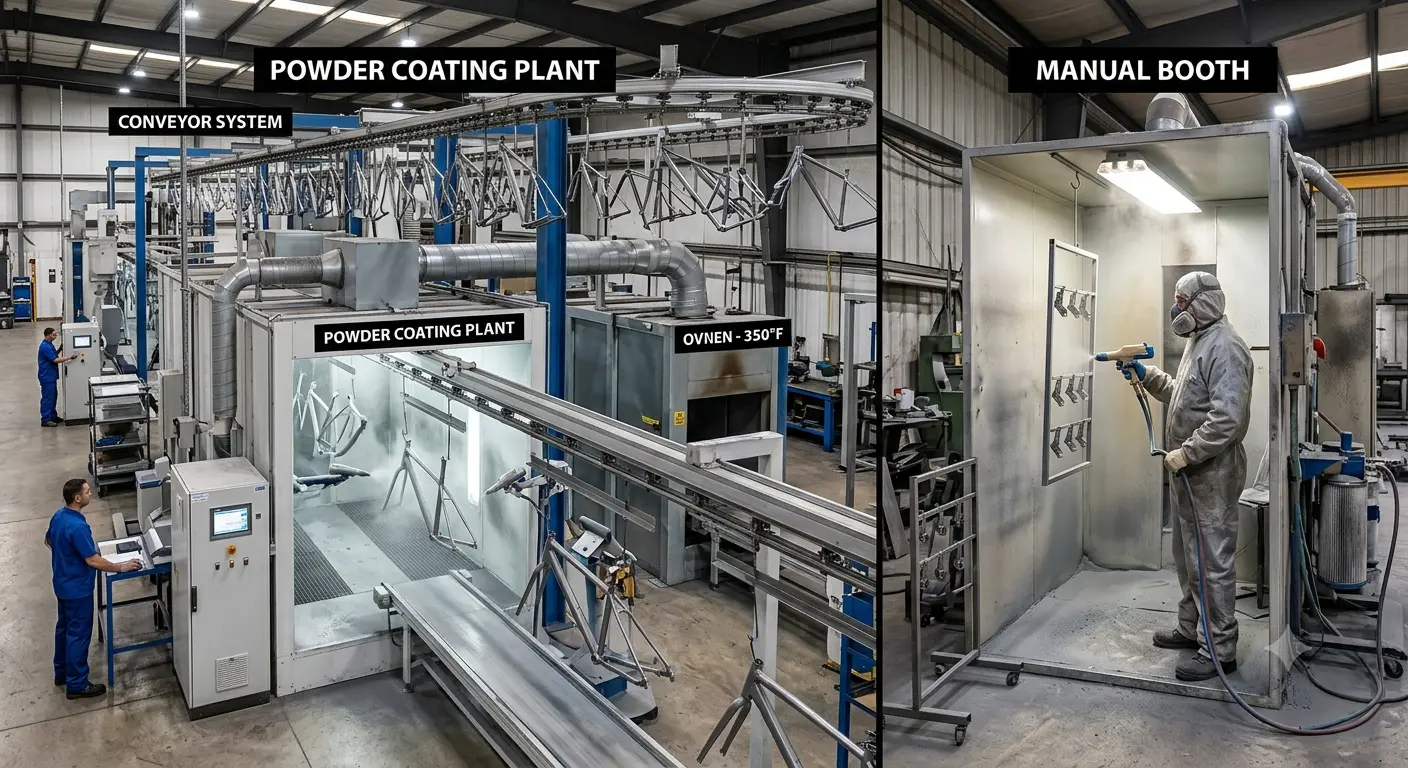
A powder coating plant is generally better for medium- to high-volume manufacturers that need consistent quality, higher productivity, automated material handling, and lower long-term operating costs. A manual powder coating booth is more suitable for small production volumes, frequent product changes, prototypes, and businesses with limited initial investment capacity. The right choice depends on production volume, product size, labor costs, quality requirements, and expected growth.
Quick Answer: Plant or Manual Booth?
| Requirement | Manual Booth | Powder Coating Plant |
|---|---|---|
| Low production volume | ✅ Excellent | ⚠️ May be excessive |
| High production volume | ❌ Limited | ✅ Excellent |
| Initial investment | ✅ Lower | ❌ Higher |
| Automation | Limited | High |
| Production consistency | Moderate | High |
| Labor requirement | Higher | Lower |
| Powder recovery | Basic–moderate | Advanced |
| Pretreatment integration | Limited | Excellent |
| Curing process | Separate/manual | Integrated |
| Conveyorized production | Usually no | Yes |
| Future scalability | Limited | Excellent |
| Long-term productivity | Moderate | High |
Simple rule: If you are coating a relatively small number of parts and flexibility matters most, start with a manual booth. If coating is becoming a production bottleneck, a complete powder coating plant is usually the stronger long-term investment.
The decision becomes clearer when comparing different production configurations. Our guide to conveyorised vs. batch vs. manual powder coating plants explains how each system differs in capacity, flexibility, and investment.
What Is a Powder Coating Plant?
A powder coating plant is an integrated finishing system designed to take metal components through multiple stages of surface preparation, powder application, curing, cooling, and inspection.
A typical production line can include:
Loading → Pretreatment → Rinsing → Drying → Powder Coating → Curing → Cooling → Unloading
Depending on production requirements, the system can include:
- Pretreatment plant
- Powder coating booth
- Automatic spray guns
- Powder recovery system
- Conveyor system
- Curing oven
- Cooling zone
- Control panel
- Chemical dosing
- Wastewater management
The objective is to create a repeatable production process rather than treating each component as an individual manual job.
What Is a Manual Powder Coating Booth?
A manual powder coating booth is a standalone spray enclosure where an operator applies powder using a handheld electrostatic spray gun.
A typical manual setup may include:
- Powder coating booth
- Manual spray gun
- Powder pump
- Basic recovery system
- Curing oven
The operator generally loads and unloads components manually and controls the spray application.
This configuration is attractive to smaller businesses because it requires less capital and can provide greater flexibility for low-volume or highly varied production.
Powder Coating Plant vs Manual Booth: Detailed Comparison
1. Initial Investment
The biggest difference is upfront investment.
A manual booth generally requires fewer integrated systems, making it less expensive to establish.
A complete plant may include:
- Pretreatment
- Conveyor
- Automatic spraying
- Recovery
- Curing
- Controls
- Loading and unloading systems
Therefore, a full system requires a significantly larger initial investment.
However, comparing purchase price alone can be misleading.
The more useful metric is total cost of ownership (TCO).
2. Production Capacity
Manual Booth
Manual coating depends heavily on operator speed and availability.
Capacity can be affected by:
- Operator skill
- Part complexity
- Product changeovers
- Manual loading
- Manual unloading
- Curing capacity
Powder Coating Plant
An integrated plant can continuously move components through the production process.
This makes it more suitable for:
- Large production volumes
- Multiple shifts
- Repeatable products
- OEM manufacturing
- Industrial production
Winner for high-volume production: Powder coating plant
3. Coating Quality and Consistency
Manual coating depends heavily on operator technique.
Two operators may apply slightly different:
- Spray distances
- Gun movements
- Powder thickness
- Application patterns
Automated systems can provide more consistent application by controlling spray parameters and product movement.
However, automation does not eliminate the need for proper pretreatment, powder quality, curing control, and maintenance.
Winner for repeatability: Automated powder coating plant
4. Labor Requirements
A manual booth requires operators to perform much of the handling and coating work.
A conveyorized plant automates significant portions of:
- Product transportation
- Powder application
- Recovery
- Curing workflow
The plant still requires trained personnel for loading, unloading, monitoring, quality control, and maintenance.
Winner for labor efficiency: Powder coating plant
5. Powder Recovery
Powder recovery has a direct effect on material costs.
A manual booth may use a relatively simple recovery arrangement.
An industrial plant can incorporate engineered recovery systems such as:
- Cartridge filter recovery
- Cyclone recovery
- Multi-stage recovery
- Automatic powder recycling
The appropriate recovery technology depends on production requirements and color-change frequency.
6. Pretreatment
This is one of the most important differences.
A manual booth does not necessarily include an integrated pretreatment system.
A complete plant can incorporate:
- Degreasing
- Water rinsing
- Phosphating/conversion coating
- Passivation
- Drying
Proper surface preparation improves:
- Adhesion
- Corrosion resistance
- Finish durability
- First-pass quality
For industrial production, integrated pretreatment can be a major advantage.
7. Curing
Powder must be cured according to the powder manufacturer’s specified time and temperature profile.
A manual operation may use a standalone batch oven.
A conveyorized plant can use a continuous curing oven integrated into the production line.
This can improve production flow where volumes justify continuous operation.
8. Flexibility
This is where manual booths have a significant advantage.
A manual booth can be useful when you regularly process:
- Different component sizes
- Small batches
- Prototype parts
- Repair jobs
- Custom orders
- Frequent color changes
Automated lines are generally more efficient when products and production volumes are relatively predictable.
Winner for highly variable, low-volume production: Manual booth
Cost Comparison
There is no universal price for either system because the final investment depends on capacity, dimensions, automation, materials, utilities, and plant configuration.
| Cost Factor | Manual Booth | Complete Plant |
| Booth | Lower | Higher |
| Spray Equipment | Lower | Higher |
| Pretreatment | Usually separate | Integrated option |
| Conveyor | Usually not required | Required/integrated |
| Curing Oven | Batch | Continuous or batch |
| Recovery | Basic/moderate | Engineered/high-efficiency |
| Automation | Low | Medium to high |
| Installation | Lower | Higher |
| Civil/Utility Work | Lower | Higher |
| Operator Labor | Higher | Lower per unit at scale |
| Maintenance | Simpler | More comprehensive |
Important
Avoid asking only:
“How much does the plant cost?”
Instead ask:
“What will this system cost me to operate per coated component over five to ten years?”
That is a much better purchasing question.
Initial equipment price is only one part of the investment. Manufacturers should also evaluate conveyorised powder coating plant cost, operating expenses, maintenance, and productivity.
ROI Analysis: Manual Booth vs Powder Coating Plant
ROI depends heavily on your production profile.
Consider five major variables:
- Annual production volume
- Labor cost
- Powder consumption
- Energy consumption
- Rejection and rework rate
A simplified ROI framework is:
Annual Benefit = Labor Savings + Material Savings + Productivity Gains + Reduced Rework − Additional Operating Costs
The investment becomes increasingly attractive as production volume increases.
Labor, powder consumption, energy, maintenance, and downtime can significantly change the economics of a coating operation. See our guide to hidden costs of powder coating systems for a detailed total-cost-of-ownership analysis.
Example ROI Scenario
Consider a manufacturer that is gradually increasing production.
Manual Booth
The company may benefit from:
- Low initial investment
- Flexible production
- Lower technical complexity
But it may also experience:
- Higher labor requirements
- Slower throughput
- Greater operator dependency
- More manual handling
Automated Plant
The initial investment is higher, but the manufacturer may gain:
- Higher throughput
- Better repeatability
- Reduced handling
- Lower labor requirement per unit
- Improved process integration
- Better scalability
The actual payback period must be calculated using your production data rather than a generic industry estimate.
When Should You Choose a Manual Booth?
A manual powder coating booth may be the better choice if:
You Have Low Production Volume
If you coat relatively few components per day, a complete automated line may not be economically justified.
Your Products Change Frequently
Manual systems offer greater flexibility for different component sizes and small batches.
You Are Testing the Market
A manual system can provide an entry point before committing to a larger production line.
Capital Is Limited
The lower initial investment can be important for startups and small manufacturers.
You Need Repair or Job-Shop Capability
Manual booths are particularly useful for customized coating work.
When Should You Invest in a Powder Coating Plant?
A complete plant becomes more attractive when:
Production Volume Is Increasing
If manual coating has become a bottleneck, automation can increase throughput.
Labor Is Becoming Expensive
Reducing manual handling can improve unit economics.
Quality Must Be Highly Consistent
Automated process control can reduce operator-to-operator variation.
You Need Continuous Production
Conveyorized systems are designed for continuous workflows.
You Are Serving OEM Customers
OEM production often requires repeatable quality and documented processes.
You Expect Future Growth
A properly designed plant can provide capacity for future expansion.
Hidden Costs of Staying With a Manual Booth
The lower purchase price of a manual booth does not necessarily mean lower long-term costs.
Consider:
Labor Cost
More manual coating and handling increases labor dependency.
Production Bottlenecks
Manual handling can restrict throughput.
Rework
Inconsistent coating can increase rework requirements.
Material Waste
Overspray and inefficient recovery can increase powder consumption.
Scaling Costs
When demand increases, you may need additional booths, ovens, operators, and handling equipment.
Hidden Costs of Buying an Oversized Plant
Automation is not automatically better.
An oversized plant can create:
- Excess capital expenditure
- Unused capacity
- Higher maintenance requirements
- Greater energy consumption
- More complex operation
The goal should be right-sized automation, not maximum automation.
Upgrade Path: Manual Booth to Automated Plant
Manufacturers do not always need to jump directly from a manual booth to a fully automated line.
A staged approach can include:
Stage 1
Manual booth + batch curing oven
Stage 2
Improved powder recovery
Stage 3
Automated or assisted spraying
Stage 4
Conveyorized material handling
Stage 5
Integrated pretreatment
Stage 6
Continuous curing oven
This approach allows businesses to scale investment alongside production growth.
Decision Matrix
| Business Situation | Recommended Option |
| Startup with low volume | Manual Booth |
| Small fabrication workshop | Manual Booth |
| Custom coating jobs | Manual Booth |
| Frequent color/product changes | Manual Booth |
| Growing manufacturer | Hybrid / Semi-automatic |
| Medium-volume production | Conveyorized system |
| High-volume OEM production | Automated Plant |
| Large-scale metal furniture production | Automated Plant |
| Aluminium extrusion production | Automated Plant |
| Continuous multi-shift production | Automated Plant |
7 Questions to Ask Before Buying
Before selecting either system, answer:
1. How many components do we coat per shift?
This determines required capacity.
2. What are the maximum product dimensions?
This affects booth, conveyor, and oven sizing.
3. How much does labor cost?
Higher labor costs can accelerate automation ROI.
4. How many colors do we run?
Frequent color changes affect booth and recovery-system selection.
5. What quality level do customers expect?
OEM and architectural applications may require tighter process control.
6. What is our five-year production forecast?
Do not size equipment only for today’s production.
7. What is the total cost of ownership?
Compare energy, labor, powder, maintenance, downtime, and productivity.
Why Choose Brahma Fabricon?
Brahma Fabricon designs powder coating solutions around actual production requirements rather than simply selling individual equipment.
Solutions can include:
- Manual powder coating booths
- Automatic powder coating plants
- Conveyorized powder coating lines
- Pretreatment systems
- Powder recovery systems
- Curing ovens
- Overhead conveyor systems
- Floor conveyor systems
- Turnkey finishing plants
The right recommendation depends on your product dimensions, production volume, coating requirements, available space, and future growth plans.
For manufacturers uncertain whether they need a booth or a complete plant, a technical design consultation can help determine the most economical configuration.
Quick Answers
Is a powder coating plant better than a manual booth?
A manual booth can be a practical option for smaller manufacturers with lower production volumes. If you’re starting a coating operation or evaluating capacity requirements, see our guide to powder coating plants for small businesses.
Is an automated powder coating plant worth the investment?
It can be when higher throughput, labor efficiency, consistent quality, and future production growth justify the additional capital investment.
Which is cheaper: a powder coating booth or plant?
A manual booth generally has a lower initial investment. However, total cost should include labor, energy, powder consumption, maintenance, downtime, and productivity.
When should a company automate powder coating?
Automation becomes more attractive when manual coating creates production bottlenecks, quality variation, high labor costs, or insufficient capacity.
Frequently Asked Questions
1. What is the difference between a powder coating plant and a manual booth?
A manual booth is primarily a standalone powder application area, while a powder coating plant integrates multiple stages such as pretreatment, coating, curing, conveying, and recovery.
2. Is a manual powder coating booth suitable for small businesses?
Yes. Manual booths can be suitable for small production volumes, custom work, prototypes, and businesses with frequent product changes.
3. Is an automated powder coating plant suitable for high production?
Yes. Conveyorized and automated plants are designed to support higher production volumes and repeatable workflows.
4. Does automation reduce powder consumption?
An appropriately designed recovery and application system can improve powder utilization, although actual savings depend on the application, powder, equipment settings, and operating practices.
5. Which option requires more labor?
Manual booths generally require more operator involvement in spraying and material handling.
6. Which system provides better coating consistency?
Automated systems can provide greater repeatability when properly designed, operated, and maintained.
7. Can I upgrade a manual booth later?
In some cases, yes. However, the feasibility depends on the existing booth, oven, layout, utilities, and production requirements.
8. What affects powder coating plant ROI?
Production volume, labor costs, powder utilization, energy consumption, downtime, quality requirements, and capital investment all affect ROI.
9. Should a startup buy an automated powder coating plant?
Not necessarily. Startups should evaluate current and projected production before investing in high-capacity automation.
10. Can Brahma Fabricon recommend the right system?
Yes. Brahma Fabricon can evaluate production requirements and recommend a manual, semi-automatic, or fully automated powder coating configuration.
Conclusion
The choice between a powder coating plant and a manual booth should be based on production economics rather than the idea that automation is always better.
A manual booth can be the right choice for small manufacturers, job shops, prototypes, custom orders, and highly variable production. A complete powder coating plant becomes more attractive when production volumes increase, consistent quality is essential, labor costs rise, and manufacturers need continuous production.
The best investment is the system that provides the right balance of capacity, quality, flexibility, operating cost, automation, and future scalability.
Before making a purchase, calculate the expected five-year total cost of ownership and compare it against the productivity and quality benefits of each option.
Not Sure Which System You Need?
Don’t invest in a larger powder coating system than your production requires—or choose a small booth that becomes a bottleneck six months later.
Brahma Fabricon can help you evaluate:
- Production volume
- Product dimensions
- Manual vs. automated spraying
- Pretreatment requirements
- Conveyor configuration
- Powder recovery
- Curing requirements
- Energy consumption
- ROI and total cost of ownership
Schedule a technical consultation with Brahma Fabricon to determine whether a manual booth, semi-automatic system, or complete powder coating plant is the right fit for your business.