
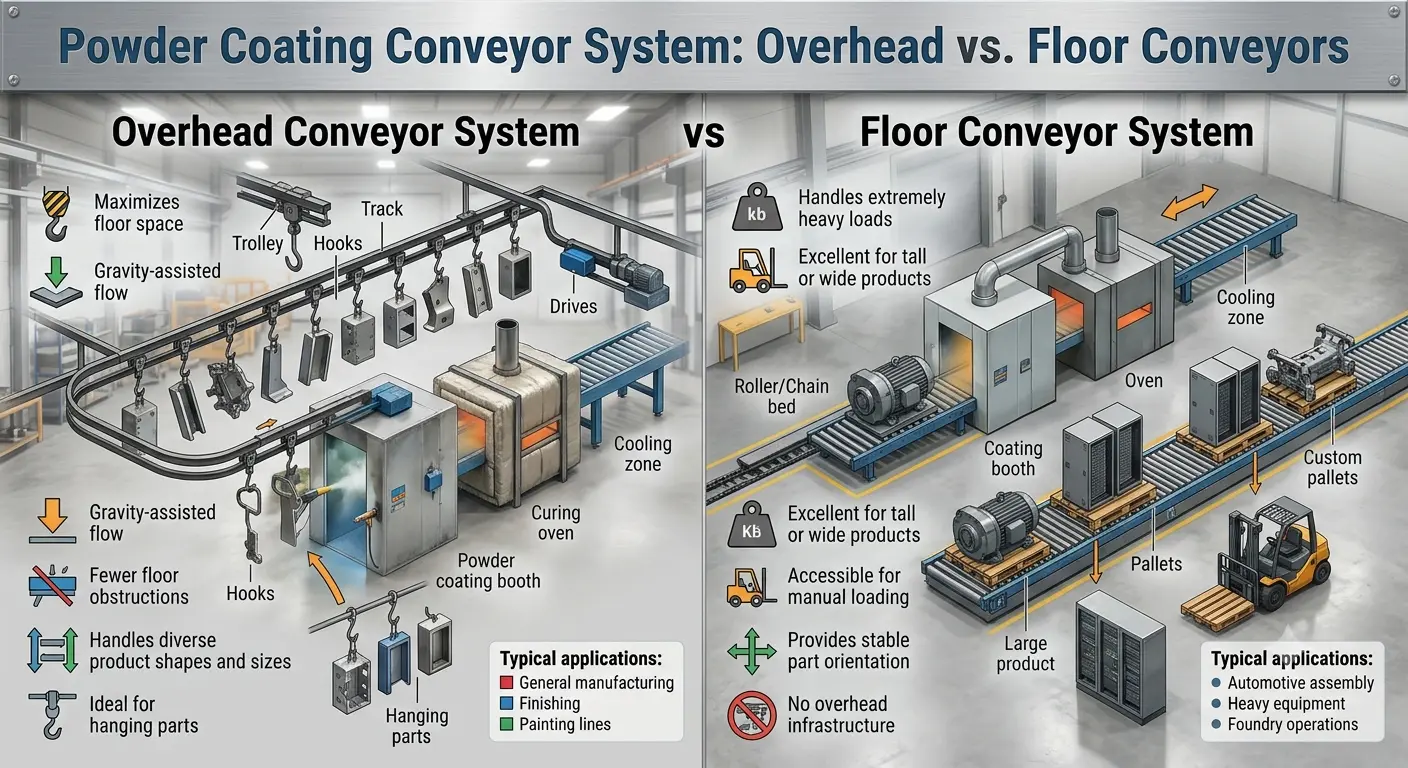
Powder coating conveyor systems are the backbone of modern powder coating plants, transporting components through pretreatment, drying, powder application, curing, cooling, and inspection. The two most common options-overhead conveyors and floor conveyors-offer different advantages depending on product size, production volume, available floor space, automation requirements, and budget. Choosing the right conveyor system improves productivity, coating consistency, and long-term operational efficiency.
Quick Answer
Choose an Overhead Conveyor if you need:
- High-volume production
- Continuous automated operation
- Better floor space utilization
- Multiple process stages
- Large production capacity
- Lower labor dependency
Choose a Floor Conveyor if you need:
- Heavy product handling
- Flexible production layouts
- Lower initial investment
- Easy maintenance access
- Small or medium production volumes
- Transport of oversized components
What Is a Powder Coating Conveyor System?
A conveyor system is the material handling backbone of a powder coating plant. It automatically transports workpieces through every production stage without unnecessary manual handling.
Typical process flow:
Loading → Pretreatment → Drying → Powder Coating Booth → Curing Oven → Cooling → Unloading → Inspection
By automating product movement, conveyor systems improve consistency, increase throughput, reduce labor requirements, and minimize handling damage.
Why Conveyor Systems Matter
An efficient conveyor system provides far more than transportation.
Key Benefits
- Continuous production flow
- Higher productivity
- Reduced manual handling
- Consistent coating quality
- Better worker safety
- Improved plant utilization
- Lower production costs
- Easy automation integration
For medium and large manufacturing facilities, conveyors are essential for achieving repeatable, high-quality finishing operations.
Types of Conveyor Systems Used in Powder Coating Plants
The most common conveyor systems include:
- Overhead Conveyors
- Floor Conveyors
- Power & Free Conveyors
- Chain Conveyors
- Monorail Conveyors
- Inverted Conveyors
- Skid Conveyors
Among these, overhead and floor conveyors are the most widely used across industrial powder coating applications.
Overhead Conveyor Systems
An overhead conveyor suspends products from a track mounted above the production floor.
The workpieces move automatically through each stage of the powder coating process.
Advantages
Maximizes Floor Space
Since the conveyor is installed overhead, valuable production floor area remains available for other operations.
Ideal for Continuous Production
Overhead systems are well suited for high-volume manufacturing with uninterrupted product flow.
Improved Automation
They integrate easily with:
- Automatic spray guns
- PLC controls
- Robotic loading
- Automated curing systems
Better Production Efficiency
Consistent movement through each process stage minimizes bottlenecks and improves throughput.
Limitations
- Higher initial investment
- Ceiling height requirements
- More complex installation
- Structural support requirements
Floor Conveyor Systems
Floor conveyors transport products on tracks or rollers installed at ground level.
They are often selected for heavy or oversized components.
Advantages
Handles Heavy Loads
Suitable for:
- Heavy fabrication
- Steel structures
- Industrial machinery
- Large fabricated assemblies
Easier Maintenance
Technicians can access conveyor components without working at height.
Flexible Layouts
Floor systems are often easier to modify as production requirements change.
Lower Initial Cost
In many applications, floor conveyors require less structural work than overhead systems.
Limitations
- Occupies production floor space
- More manual interaction may be required
- Can create workflow obstacles if layouts are not optimized
Overhead vs. Floor Conveyor Comparison
| Feature | Overhead Conveyor | Floor Conveyor |
| Floor Space Utilization | Excellent | Moderate |
| Heavy Load Handling | Good | Excellent |
| Automation Integration | Excellent | Good |
| Production Speed | High | Moderate to High |
| Installation Complexity | Higher | Lower |
| Maintenance Accessibility | Moderate | Excellent |
| Initial Investment | Higher | Lower to Moderate |
| Future Expansion | Excellent | Good |
Cost Comparison
The total investment depends on:
- Plant size
- Conveyor length
- Product weight
- Automation level
- Number of process stages
- Control systems
- Building layout
Rather than focusing only on the purchase price, manufacturers should compare the Total Cost of Ownership (TCO), including:
- Energy consumption
- Maintenance
- Spare parts
- Downtime
- Labor requirements
- Productivity gains
A higher initial investment in an automated conveyor often delivers lower operating costs over its lifetime.
Which Conveyor Is Best for Your Industry?
Metal Furniture Manufacturing
Recommended: Overhead Conveyor
Supports continuous production and high throughput.
Aluminium Extrusion Plants
Recommended: Overhead Conveyor
Ideal for long profiles and automated finishing lines.
Automotive Components
Recommended: Overhead Conveyor
Provides consistent movement through automated pretreatment and coating stages.
Heavy Fabrication
Recommended: Floor Conveyor
Handles oversized fabricated structures and heavy steel components efficiently.
Electrical Enclosures
Recommended: Overhead Conveyor
Improves productivity and coating consistency for medium-sized products.
Agricultural Equipment
Recommended: Floor Conveyor
Accommodates heavy frames and large fabricated assemblies.
Factors to Consider Before Choosing
Before selecting a conveyor system, evaluate:
Production Volume
Higher volumes generally justify greater automation.
Product Dimensions
Consider:
- Length
- Width
- Height
- Weight
Building Height
Overhead systems require sufficient ceiling clearance.
Floor Space
Floor conveyors consume production space, while overhead systems free up valuable work areas.
Future Expansion
Choose systems that can be extended as production grows.
Maintenance Resources
Consider the availability of trained maintenance personnel and spare parts.
ROI Analysis
A conveyor system should be evaluated based on long-term value rather than purchase price alone.
Productivity Gains
Automated movement reduces handling time and increases output.
Labor Savings
Continuous transport minimizes manual material handling.
Better Coating Quality
Uniform movement through pretreatment, powder application, and curing improves finish consistency.
Reduced Product Damage
Automated handling lowers the risk of scratches and dents during production.
Lower Operating Costs
Efficient conveyor design reduces production delays and supports smoother workflows.
Decision Matrix
| Requirement | Best Choice |
| High Production Volume | Overhead Conveyor |
| Heavy Components | Floor Conveyor |
| Limited Floor Space | Overhead Conveyor |
| Large Fabricated Structures | Floor Conveyor |
| Maximum Automation | Overhead Conveyor |
| Lower Initial Budget | Floor Conveyor |
| Future Expansion | Overhead Conveyor |
| Easy Maintenance Access | Floor Conveyor |
Why Manufacturers Choose Brahma Fabricon
Brahma Fabricon designs conveyor systems that integrate seamlessly with complete powder coating plants.
Our Solutions Include
- Overhead conveyor systems
- Floor conveyor systems
- Conveyorized powder coating plants
- Pretreatment systems
- Powder coating booths
- Curing ovens
- Powder recovery systems
- Turnkey finishing lines
Why Work With Us?
- Customized engineering
- Energy-efficient designs
- PLC-based automation
- Heavy-duty construction
- End-to-end project execution
- Installation and commissioning
- Preventive maintenance support
- Reliable after-sales service
Our engineering team helps manufacturers select the most suitable conveyor system based on production capacity, product dimensions, available space, and long-term operational goals.
Quick Answers
Which conveyor is best for powder coating?
There is no universal answer. Overhead conveyors are generally preferred for automated, high-volume production, while floor conveyors are often better for heavy or oversized products.
Are overhead conveyors more efficient?
For continuous manufacturing with limited floor space, overhead conveyors typically improve workflow and productivity.
When should I choose a floor conveyor?
Floor conveyors are often the preferred option for heavy fabrication, large machinery, and applications where easy maintenance access is a priority.
Frequently Asked Questions
What is a powder coating conveyor system?
It is a material handling system that transports components through pretreatment, powder coating, curing, cooling, and inspection stages.
What is the difference between an overhead and floor conveyor?
An overhead conveyor moves products above the floor on suspended tracks, while a floor conveyor transports products on ground-level tracks or rollers.
Which conveyor is better for high-volume production?
Overhead conveyors are commonly selected for continuous, automated, high-volume manufacturing.
Can floor conveyors handle heavier products?
Yes. Floor conveyors are well suited for oversized and heavy fabricated components.
Are conveyor systems customizable?
Yes. Modern systems can be designed around product dimensions, production volume, plant layout, and automation requirements.
Do conveyor systems reduce labor costs?
Automated transport reduces manual handling and improves production efficiency.
How do conveyors improve coating quality?
Consistent product movement supports uniform pretreatment, coating application, and curing.
Can conveyor systems be expanded later?
Many conveyor systems are modular and can be extended as production requirements grow.
Which industries use conveyorized powder coating plants?
Metal furniture, automotive, aluminum extrusion, heavy fabrication, agriculture, construction equipment, and electrical enclosure manufacturing.
Does Brahma Fabricon design custom conveyor systems?
Yes. Brahma Fabricon engineers customized overhead and floor conveyor systems integrated with complete powder coating plants.
Conclusion
The right conveyor system plays a critical role in the performance of a powder coating plant. Overhead conveyors maximize automation, improve floor space utilization, and support continuous production, making them ideal for high-volume manufacturing. Floor conveyors offer excellent load-handling capabilities, easier maintenance access, and greater flexibility for heavy or oversized components. By evaluating your production volume, product dimensions, facility layout, and long-term growth plans, you can select a conveyor solution that improves efficiency, coating quality, and return on investment.
Need Help Choosing the Right Conveyor System?
Whether you’re building a new powder coating facility or upgrading an existing production line, Brahma Fabricon can help you design the most efficient conveyor solution.
Our experts provide:
- Conveyor system design consultation
- Plant layout optimization
- Overhead and floor conveyor engineering
- Turnkey powder coating plant solutions
- Automation recommendations
- Production capacity planning
- Customized project quotations
Contact Brahma Fabricon today to schedule a technical consultation and receive a conveyor system recommendation tailored to your manufacturing requirements.