
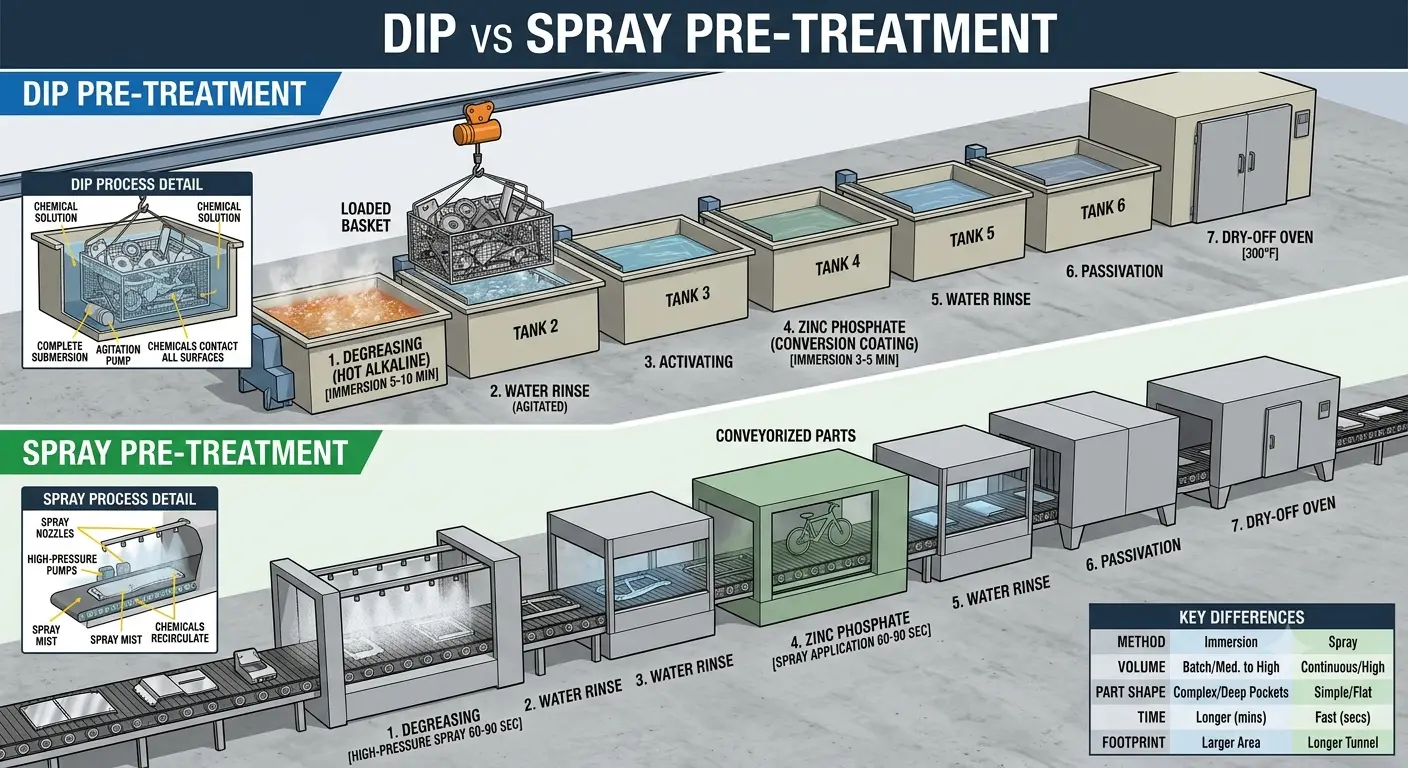
Dip vs spray pre-treatment depends on component geometry, production volume, contamination, material, and required coating performance. Dip or immersion treatment provides thorough chemical contact and can be advantageous for complex or difficult-to-reach components. Spray cleaning offers faster continuous processing and is often preferred for high-volume production. Neither method automatically guarantees better adhesion; surface preparation chemistry, cleaning quality, rinsing, conversion coating, drying, and process control determine the final result.
Dip vs Spray Pre-Treatment: Which Method Ensures Better Coating Adhesion?
Powder coating adhesion starts long before powder reaches the metal surface.
If oil, grease, oxides, dirt, or other contaminants remain on the substrate, even a high-quality powder coating system can experience adhesion failure, corrosion, blistering, or premature peeling.
That makes pre-treatment one of the most important stages in an industrial powder coating plant.
Two widely used approaches are dip pre-treatment, also called immersion treatment, and spray pre-treatment, where chemicals are applied through spray nozzles.
But which one provides better coating adhesion?
The answer isn’t simply “dip” or “spray.”
The better method depends on the metal substrate, component geometry, production volume, contamination level, chemical process, and required coating performance.
This guide compares both systems so manufacturers can make an informed equipment decision.
Quick Comparison: Dip vs Spray Pre-Treatment
| Factor | Dip / Immersion Treatment | Spray Pre-Treatment |
|---|---|---|
| Chemical contact | Excellent | Excellent when correctly designed |
| Complex components | Excellent | Good–Excellent |
| Hollow sections | Often advantageous | Requires proper nozzle coverage |
| High-volume production | Good | Excellent |
| Continuous production | Limited/Moderate | Excellent |
| Processing speed | Moderate | High |
| Chemical consumption | Can be higher depending on tank design | Often efficient with controlled spray |
| Floor space | Can be substantial | Can be optimized |
| Product flexibility | Excellent | Good |
| Automation | Moderate–High | High |
| Large batches | Excellent | Excellent |
| Conveyorized production | Possible | Highly suitable |
| Initial system complexity | Moderate | Moderate–High |
| Best application | Complex/varied parts | Continuous/high-volume lines |
Bottom line: Neither method inherently provides better adhesion. A properly engineered pretreatment process—regardless of whether it uses immersion or spray—creates the surface condition required for strong powder coating adhesion.
What Is Pre-Treatment in Powder Coating?
Pre-treatment is the process of cleaning and chemically preparing a metal surface before powder coating.
The objective is to remove contaminants and create a suitable surface for the coating system.
Typical contaminants include:
- Oil
- Grease
- Dirt
- Dust
- Oxides
- Mill scale
- Processing residues
- Fingerprints
- Manufacturing contaminants
A typical process may include:
Cleaning → Rinsing → Surface Conditioning → Conversion Treatment → Rinsing → Passivation → Drying
The exact sequence depends on the substrate and coating specification.
For a broader overview, see the pre-treatment systems for powder coating complete guide.
Why Pre-Treatment Determines Powder Coating Adhesion
Powder coating adhesion is influenced by several factors.
Surface cleanliness
Contaminants can create a barrier between the metal and coating.
Surface chemistry
The conversion layer can improve the interface between the substrate and coating.
Surface condition
Oxidation, corrosion, and manufacturing residues can negatively affect coating performance.
Rinsing
Poor rinsing can leave unwanted chemical residues.
Drying
Moisture remaining on the component can contribute to coating defects.
Process control
Chemical concentration, temperature, contact time, pH, spray pressure, and bath condition can all influence results.
Therefore, the question should not simply be:
“Which system has better adhesion?”
The more useful question is:
Which pretreatment process can consistently produce the required surface condition for your specific product?
What Is Dip Pre-Treatment?
Dip pre-treatment uses tanks containing cleaning and treatment chemicals.
Components are immersed in the tanks for a specified period.
A simplified process may look like:
Loading → Degreasing Tank → Rinse → Conversion Treatment → Rinse → Passivation → Drying → Powder Coating
The component is surrounded by the treatment solution during immersion.
Advantages of Dip or Immersion Treatment
1. Excellent Chemical Contact
Immersion allows treatment solution to contact surfaces from multiple directions.
This can be useful for components with complex geometry.
2. Suitable for Complex Components
Parts with difficult-to-reach areas may benefit from immersion.
3. Good Batch Flexibility
Dip systems can be practical for manufacturers processing different product types.
4. Suitable for Certain Hollow or Intricate Parts
Where solution access and drainage can be properly managed, immersion can treat areas that may be difficult to reach with external spray.
However, component design must allow proper drainage and rinsing.
5. Flexible Production
Different components can be processed in batches.
Limitations of Dip Pre-Treatment
Immersion systems also have considerations.
Tank Space
Multiple treatment stages require tank capacity and floor space.
Chemical Management
Bath concentration, contamination, temperature, and chemistry must be monitored.
Drag-Out
Components can carry treatment solution from one tank into another.
Drainage
Poorly designed components can retain chemicals.
Batch Handling
Manual loading and unloading may limit throughput.
What Is Spray Pre-Treatment?
Spray pre-treatment applies cleaning and treatment chemicals through spray nozzles.
Components typically move through enclosed stages while chemical solutions are sprayed onto their surfaces.
A typical process may include:
Loading → Spray Cleaning → Rinsing → Conversion Coating → Rinsing → Passivation → Drying → Powder Coating
This configuration is particularly common in conveyorized coating plants.
Advantages of Spray Pre-Treatment
1. High Production Throughput
Continuous spray stages can process components as they move through the line.
2. Excellent for Conveyorized Production
Spray systems integrate naturally with automated powder coating lines.
3. Controlled Chemical Application
Spray pressure, nozzle arrangement, temperature, and chemical concentration can be engineered for the application.
4. Suitable for High-Volume Manufacturing
Manufacturers processing large quantities of standardized components can benefit from continuous operation.
5. Reduced Manual Handling
Components can remain on the conveyor throughout the process.
Limitations of Spray Pre-Treatment
Spray systems require careful engineering.
Nozzle Coverage
Poor nozzle positioning can create untreated areas.
Product Orientation
Component orientation affects chemical access.
Complex Geometry
Deep recesses or shielded surfaces may require special nozzle arrangements.
Maintenance
Nozzles, pumps, filters, and spray systems require regular inspection.
Dip vs Spray Pre-Treatment: Adhesion Analysis
This is the most important part of the comparison.
Does immersion automatically provide better adhesion?
No.
Does spray cleaning produce weaker adhesion?
Not necessarily.
Adhesion depends on the quality of the complete pretreatment process.
A properly engineered spray system can provide excellent adhesion for high-volume industrial production.
Likewise, a poorly controlled immersion system can produce inconsistent coating performance.
The 6 Factors That Matter More Than the Method
1. Cleaning Quality
The first objective is removing oil, grease, dirt, and manufacturing contaminants.
If the substrate is not clean, subsequent treatment cannot perform correctly.
2. Conversion Coating
The conversion treatment creates a chemically suitable surface for the coating system.
The appropriate chemistry depends on the substrate.
Common substrates include:
- Mild steel
- Galvanized steel
- Aluminium
- Stainless steel
Each may require a different treatment approach.
3. Rinsing
Rinsing removes residual chemicals and contamination.
Insufficient rinsing can affect surface quality and downstream coating performance.
4. Chemical Concentration
The treatment chemistry must remain within the operating range specified for the process.
Too little chemical activity may result in inadequate cleaning.
Excessive concentration may create other process problems.
5. Temperature and Contact Time
Chemical reactions depend on process conditions.
Both dip and spray systems must provide appropriate:
- Temperature
- Contact time
- Chemical concentration
- Process agitation or spray action
6. Drying
After pretreatment, components must be properly dried before powder application.
Moisture can contribute to coating defects and inconsistent results.
Dip vs Spray: Which Is Better for Complex Components?
Dip treatment often has an advantage for complex geometry, provided the component can be completely immersed, properly treated, rinsed, and drained.
Examples include:
- Fabricated assemblies
- Complex brackets
- Frames
- Intricate components
- Components with difficult-to-reach surfaces
However, spray systems can also handle complex products when the line is engineered with appropriate nozzle positioning and product orientation.
Dip vs Spray: Which Is Better for High-Volume Production?
For high-volume manufacturing, spray pretreatment is often the preferred configuration because it integrates efficiently with continuous conveyorized production.
A typical high-volume workflow is:
Loading → Spray Pretreatment → Drying → Automatic Powder Coating → Curing → Cooling → Unloading
This minimizes batch handling and creates a continuous production flow.
Learn more about conveyorized powder coating plants.
Dip vs Spray: Chemical Consumption
Chemical consumption depends on many variables and should not be judged solely by the system type.
Important factors include:
- Bath volume
- Spray pressure
- Nozzle design
- Chemical concentration
- Drag-out
- Rinsing strategy
- Water management
- Production volume
- Component surface area
A properly engineered spray system can optimize chemical delivery, while a well-managed immersion system can also be highly effective.
The focus should be on chemical efficiency per square metre of treated surface, not simply litres consumed.
Dip vs Spray: Space Requirements
Space is an important consideration when designing a pretreatment plant.
Dip system
Requires space for:
- Treatment tanks
- Rinsing tanks
- Loading areas
- Drainage
- Chemical handling
- Maintenance access
Spray system
Requires space for:
- Spray chambers
- Pumps
- Nozzles
- Chemical circulation
- Exhaust
- Drying oven
- Conveyor
The final footprint depends on the number of stages and required production capacity.
Cost Comparison
There is no universal price difference because pretreatment plants are customized.
| Cost Factor | Dip Treatment | Spray Treatment |
| Tanks | High requirement | Lower tank requirement |
| Pumps | Moderate | Higher |
| Spray nozzles | Low/none | Required |
| Conveyor integration | Moderate | Excellent |
| Chemical management | High | High |
| Batch handling | Higher | Lower |
| Automation | Moderate | High |
| Maintenance | Tank/chemical focused | Pumps/nozzles/chemical focused |
| High-volume suitability | Good | Excellent |
| Complex parts | Excellent | Depends on design |
The most economical solution is determined by the complete plant lifecycle, not the initial equipment price.
Which Pre-Treatment Method Should You Choose?
Choose Dip Pre-Treatment When:
- Components have complex geometry
- Batch production is acceptable
- Product variety is high
- Components require comprehensive immersion
- Production volume is moderate
- Existing factory layout favors tanks
- Components can be properly drained after immersion
Choose Spray Pre-Treatment When:
- Production volume is high
- Components are relatively standardized
- Continuous production is required
- Conveyorized coating is planned
- Automated handling is important
- Faster processing is required
- Consistent process control is a priority
Industry-Wise Comparison
| Industry | Recommended Approach |
| Metal Furniture | Spray / Conveyorized |
| Aluminium Profiles | Spray / Application-specific |
| Automotive Components | Spray or engineered hybrid |
| Heavy Fabrication | Dip / Spray depending on geometry |
| Electrical Enclosures | Spray |
| Small Fabrication | Dip or batch |
| General Engineering | Application dependent |
| High-volume OEM | Spray / Conveyorized |
This is a starting point—not a universal rule.
The substrate, product geometry, production volume, and coating specification should determine the final system.
How Pretreatment Affects Powder Coating Adhesion
A well-designed pretreatment system supports several performance characteristics.
Better adhesion
A properly prepared surface allows the coating to bond effectively.
Improved corrosion resistance
Conversion treatment can improve the substrate’s resistance to corrosion beneath the coating.
Better coating durability
A stable substrate/coating interface helps the finish withstand service conditions.
Reduced coating failure
Proper cleaning and surface preparation can reduce problems such as:
- Peeling
- Blistering
- Flaking
- Undercutting
- Premature corrosion
How to Test Adhesion After Pretreatment
Manufacturers should validate coating performance rather than relying only on visual inspection.
Common coating quality checks can include:
- Dry film thickness measurement
- Cross-cut adhesion testing
- Gloss measurement
- Cure verification
- Visual inspection
- Corrosion testing where required
The specific test method should be selected according to the product specification and applicable standards.
For critical applications, establish documented acceptance criteria before production begins.
Common Pretreatment Mistakes
1. Choosing the System Based Only on Price
The cheapest pretreatment plant may not provide the required production performance.
2. Ignoring Product Geometry
Nozzle coverage and immersion/drainage must match the component design.
3. Poor Chemical Monitoring
Chemical concentration, temperature, pH, and contamination need regular monitoring.
4. Inadequate Rinsing
Residual chemicals can affect coating performance.
5. Poor Drying
Moisture before powder application can cause defects.
6. No Process Documentation
Operators should have clear operating ranges and inspection procedures.
7. Ignoring Wastewater Management
Pretreatment generates wastewater and chemical residues that require appropriate handling and compliance measures.
See the pre-treatment wastewater management guide for more information.
How to Select a Pretreatment System for Your Factory
Before requesting quotations, prepare the following information.
Product Information
- Material
- Maximum dimensions
- Minimum dimensions
- Weight
- Surface area
- Product geometry
Production Information
- Components per hour
- Components per shift
- Number of shifts
- Batch size
- Future production growth
Coating Requirements
- Powder type
- Film thickness
- Corrosion resistance
- Adhesion requirements
- Customer specifications
Factory Information
- Available floor area
- Conveyor layout
- Water availability
- Drainage
- Electrical supply
- Fuel availability
- Ventilation requirements
Providing this information allows a manufacturer to design a more accurate system.
Why Choose Brahma Fabricon?
Brahma Fabricon provides engineered pretreatment and powder coating solutions for industrial manufacturers.
The system can be designed around:
- Product geometry
- Substrate
- Production volume
- Required coating performance
- Factory layout
- Automation requirements
- Environmental considerations
Solutions can include:
- Dip pretreatment plants
- Spray pretreatment systems
- Conveyorized powder coating plants
- Powder coating booths
- Curing ovens
- Powder recovery systems
- Conveyor systems
- Turnkey coating plants
The objective is to select the process that provides the appropriate balance of adhesion, corrosion resistance, productivity, chemical efficiency, operating cost, and scalability.
For manufacturers uncertain about whether immersion or spray treatment is appropriate, a technical evaluation before equipment selection can prevent expensive redesigns later.
Dip vs Spray Pre-Treatment: Decision Matrix
| Your Requirement | Better Starting Point |
| Complex geometry | Dip |
| High-volume production | Spray |
| Continuous conveyor line | Spray |
| Small batches | Dip |
| Frequent product variation | Dip |
| Standardized components | Spray |
| Maximum automation | Spray |
| Difficult-to-reach surfaces | Dip |
| Large industrial production | Spray |
| Custom/job-shop production | Dip |
| Integrated automated plant | Spray |
| Application-specific requirements | Engineering evaluation |
Frequently Asked Questions
1. What is the difference between dip and spray pre-treatment?
Dip pretreatment immerses components in treatment tanks, while spray pretreatment applies cleaning and treatment chemicals through spray nozzles.
2. Is dip pretreatment better for powder coating adhesion?
Not automatically. Adhesion depends on cleaning, conversion coating, rinsing, drying, chemistry, and process control. Dip treatment can be advantageous for certain complex components.
3. Is spray pretreatment suitable for high-volume production?
Yes. Spray systems integrate particularly well with conveyorized and automated powder coating lines.
4. Which pretreatment method is cheaper?
There is no universal answer. Equipment cost depends on the number of stages, production capacity, automation, chemical systems, water management, and factory layout.
5. Which method is better for aluminium?
Both can be suitable. Aluminium requires application-specific chemistry and process control, so the substrate and required corrosion performance should be evaluated before selecting dip or spray treatment.
6. Can dip pretreatment be automated?
Yes. Immersion systems can use conveyors, hoists, automated transfer systems, dosing controls, and process monitoring.
7. Can spray pretreatment handle complex components?
Yes, but nozzle arrangement, spray pressure, component orientation, and coverage must be carefully engineered.
8. Does pretreatment improve powder coating durability?
Proper pretreatment can improve coating adhesion and corrosion performance, contributing to greater coating durability.
9. What causes poor powder coating adhesion?
Potential causes include inadequate cleaning, incorrect conversion treatment, poor rinsing, contamination, improper drying, incorrect powder curing, and unsuitable substrate preparation.
10. How do I choose between dip and spray pretreatment?
Evaluate product geometry, material, production volume, required coating performance, factory space, automation requirements, chemical management, and future capacity.
Conclusion
The dip vs spray pre-treatment decision should be based on process requirements rather than the assumption that one technology is universally superior.
Dip or immersion treatment can be an excellent solution for complex components, batch production, and applications where comprehensive chemical contact is important.
Spray cleaning and pretreatment are often better suited to continuous, automated, high-volume production where conveyorized processing and throughput are priorities.
Most importantly, coating adhesion comes from the quality of the complete pretreatment process—not simply whether the chemicals are applied by dipping or spraying.
The right system should provide controlled cleaning, conversion treatment, rinsing, drying, and process monitoring while matching the substrate and production requirements.
Need Help Selecting Dip or Spray Pre-Treatment?
Choosing the wrong pretreatment configuration can affect coating quality, operating costs, production capacity, and future expansion.
Brahma Fabricon can evaluate your:
- Metal substrate
- Product dimensions
- Component geometry
- Production volume
- Adhesion requirements
- Corrosion-resistance requirements
- Factory layout
- Automation needs
Request a technical consultation and quotation from Brahma Fabricon for a pretreatment system designed around your actual production process.