
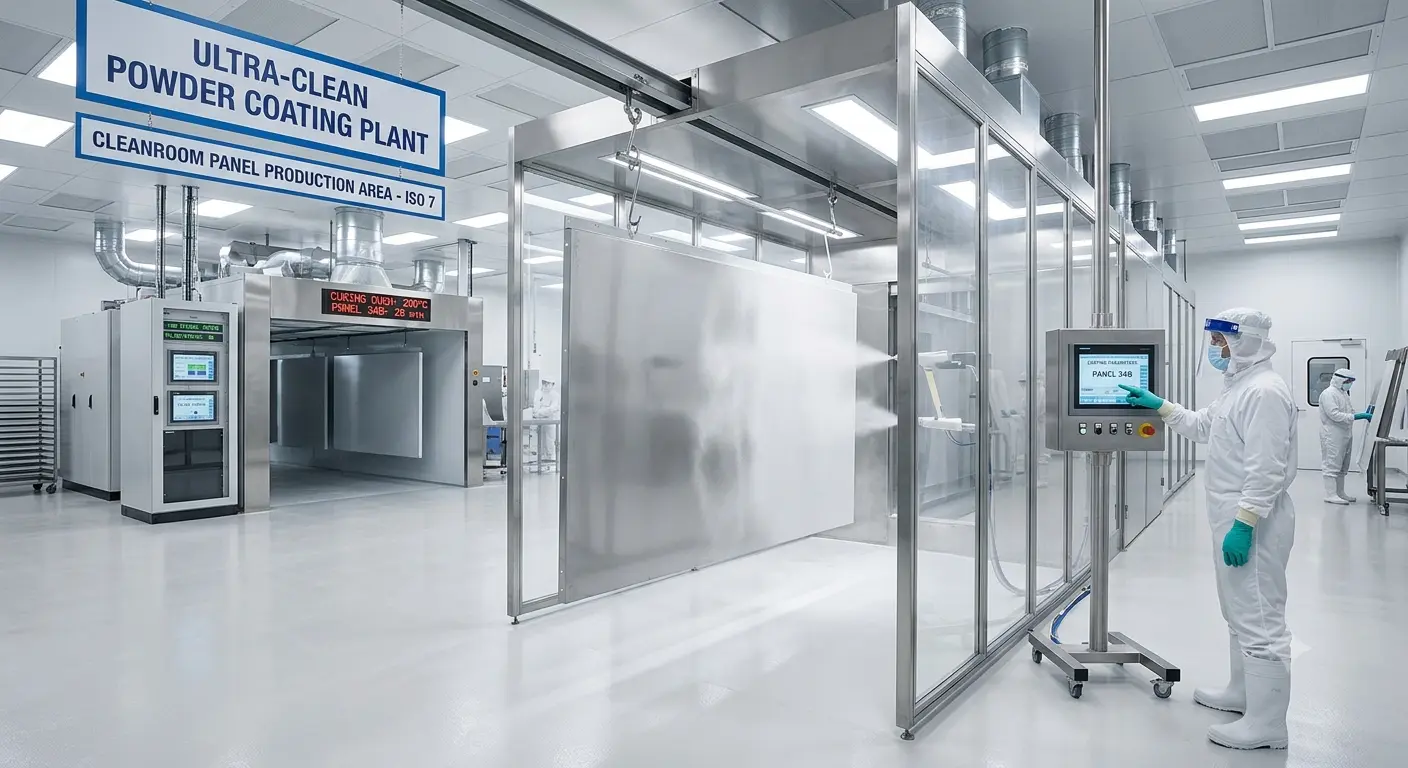
Cleanroom panel powder coating is an industrial finishing process used to protect metal cleanroom panels, partitions, doors, ceilings, cabinets, workstations, and modular furniture. The process combines substrate preparation, pretreatment, electrostatic powder application, and controlled curing to create a durable, smooth, and cleanable surface. For clean-space applications, coating chemistry, adhesion, chemical resistance, film thickness, and curing consistency are critical.
Cleanroom manufacturing demands a higher level of surface performance than many conventional metal-finishing applications.
Wall panels, ceiling panels, doors, partitions, storage cabinets, workstations, and modular furniture may be exposed to frequent cleaning, disinfectants, humidity, handling, and mechanical contact.
This makes the finishing process an important part of the overall product design.
A properly engineered cleanroom panel powder coating system can help manufacturers achieve consistent appearance, corrosion protection, durability, and repeatable production quality.
However, selecting the right powder is only one part of the process. Pretreatment, application, curing, recovery, material handling, and quality control all influence the final result.
This guide explains how powder coating is used for cleanroom panels and modular furniture, which technical specifications matter, and how manufacturers can plan an efficient coating production line.
Why Use Powder coating plant for cleanroom panels?
Powder coating can be an effective finishing solution for metal cleanroom panels and modular furniture because it can provide:
- Durable surface protection
- Smooth and cleanable finishes
- Good corrosion resistance
- Consistent color and appearance
- Strong adhesion with appropriate pretreatment
- Chemical resistance depending on powder formulation
- Repeatable automated application
- Efficient high-volume production
- Reduced solvent use compared with conventional solvent-based painting
The important point is that not every powder coating is suitable for every cleanroom application.
Manufacturers should select the coating based on the substrate, cleaning chemicals, required finish, service environment, performance requirements, and curing specifications.
What Is Cleanroom Panel Powder Coating?
Cleanroom panel powder coating refers to the application of a powder-based protective and decorative finish to metal components used in controlled environments.
Depending on the product design, components can include:
- Cleanroom wall panels
- Ceiling panels
- Partition panels
- Cleanroom doors
- Door frames
- Windows and frames
- Modular furniture
- Storage cabinets
- Workstations
- Shelving
- Equipment housings
- Utility panels
- Pass boxes
- Fabricated cleanroom components
Common substrates may include mild steel, galvanized steel, and aluminium.
The appropriate coating and pretreatment system should always be selected according to the substrate and final operating environment.
Why Do Cleanroom Panels Need Specialized Finishing?
Cleanrooms are designed to control contamination and maintain defined environmental conditions.
The surfaces used inside these environments therefore need to support easy maintenance and cleaning.
A suitable coating system should provide characteristics such as:
Smooth Surface
A smooth finish can make routine wiping and cleaning easier.
Good Adhesion
The coating should remain bonded to the substrate under expected operating and cleaning conditions.
Corrosion Protection
Metal panels may encounter humidity and repeated cleaning.
Chemical Resistance
Cleaning and disinfecting agents can affect coating performance.
Consistent Appearance
Large panels installed next to one another require consistent color, gloss, and finish.
Durability
Doors, furniture, cabinets, and workstations can experience repeated handling and mechanical contact.
Applications of Powder Coating in Cleanroom Manufacturing
Powder coating can be used for a wide range of cleanroom products.
Cleanroom Wall Panels
Wall panels require a durable finish capable of handling regular cleaning and maintenance.
A consistent coating can also improve the overall appearance of modular wall systems.
Ceiling Panels
Large ceiling panels require uniform application to maintain consistent color and gloss across the installation.
Cleanroom Doors
Doors experience frequent opening, closing, touching, and cleaning.
A durable powder-coated finish can help protect the underlying metal.
Modular Cleanroom Furniture
Applications include:
- Worktables
- Cabinets
- Storage units
- Trolleys
- Shelving
- Workstations
- Equipment stands
Pharmaceutical and Medical Environments
Cleanroom products may be manufactured for pharmaceutical facilities, medical-device manufacturing, laboratories, electronics production, and other controlled environments.
The coating specification should be determined according to the requirements of the individual application.
Powder Coating for Modular Furniture Manufacturing
Powder coating is particularly suitable for manufacturers producing standardized metal furniture components.
A typical production sequence can be:
Fabrication → Pretreatment → Drying → Powder Application → Curing → Cooling → Inspection
For high-volume manufacturing, these stages can be connected through a conveyorized system.
Manufacturers planning automated production can review the conveyorized powder coating plant guide to understand how pretreatment, powder application, curing, and material handling can be integrated.
Applications include:
- Modular office furniture
- Cleanroom furniture
- Laboratory furniture
- Industrial workstations
- Storage cabinets
- Metal shelving
- Equipment enclosures
Technical Requirements for Clean-Space Finishes
Selecting a coating for cleanroom applications requires more than choosing a color.
Manufacturers should evaluate several technical characteristics.
1. Surface Smoothness
A smooth coating can make surfaces easier to wipe and maintain.
Where frequent cleaning is required, excessive texture may not be desirable.
The required surface finish should be established according to the customer’s cleanroom specification.
2. Chemical Resistance
Cleanroom panels and furniture can come into contact with:
- Detergents
- Disinfectants
- Alcohol-based cleaners
- Sanitizing chemicals
- Process chemicals
Chemical resistance depends heavily on powder formulation.
Manufacturers should obtain technical data from the powder supplier for the actual chemicals and concentrations used in the facility.
3. Adhesion
Strong adhesion begins with correct surface preparation.
Important factors include:
- Cleaning
- Degreasing
- Surface conditioning
- Conversion treatment
- Rinsing
- Drying
- Powder selection
- Correct curing
Poor pretreatment can result in coating failure even when a high-quality powder is used.
4. Corrosion Resistance
The corrosion performance of a powder-coated cleanroom panel depends on the complete coating system:
Substrate + Pretreatment + Powder + Film Thickness + Cure
For this reason, manufacturers should not evaluate powder coating independently from pretreatment.
Our detailed guide to pre-treatment systems for powder coating explains how cleaning, conversion treatment, rinsing, and drying influence coating performance.
5. Film Thickness
Film thickness should be controlled according to the powder manufacturer’s technical specifications.
Too much coating can affect:
- Appearance
- Dimensional tolerances
- Surface finish
Too little coating may reduce the expected protective performance.
Cleanroom Panel Powder Coating Process
A typical process can include the following stages.
Stage 1: Component Preparation
The fabricated component is inspected and prepared.
Contaminants can include:
- Oil
- Grease
- Dirt
- Welding residues
- Fabrication debris
- Surface contamination
Stage 2: Pretreatment
The component passes through the selected chemical pretreatment process.
Stage 3: Rinsing
Rinsing removes residual process chemicals.
Stage 4: Drying
The component is dried before powder application.
Stage 5: Powder Application
Electrostatic spray equipment applies powder to the grounded component.
Stage 6: Curing
The coated component enters the curing oven.
Stage 7: Cooling
The component is cooled before handling.
Stage 8: Quality Inspection
The finished component is inspected for:
- Color
- Gloss
- Film thickness
- Adhesion
- Surface defects
- Cure
- Overall appearance
Pretreatment Requirements for Cleanroom Panels
Pretreatment is one of the most important stages in producing a reliable powder-coated finish.
Depending on the substrate, the process can include:
- Degreasing
- Cleaning
- Rinsing
- Surface conditioning
- Conversion coating
- Final rinsing
- Drying
The chemistry depends on whether the component is manufactured from steel, galvanized steel, aluminium, or another compatible substrate.
For example, aluminium and steel do not necessarily require the same pretreatment approach.
Dip vs Spray Pretreatment
Both immersion and spray systems can be appropriate depending on product geometry and production requirements.
| Factor | Spray Pretreatment | Dip Pretreatment |
|---|---|---|
| Continuous production | Excellent | Moderate |
| High-volume panels | Excellent | Good |
| Complex components | Good | Excellent |
| Automation | Excellent | Good–Excellent |
| Batch production | Good | Excellent |
| Standardized products | Excellent | Good |
| Product flexibility | Good | Excellent |
For manufacturers producing standardized panels at high volume, spray pretreatment can integrate effectively with a conveyorized line.
For complex components or batch production, immersion treatment may offer advantages.
For a deeper technical comparison, see dip vs spray pretreatment.
Powder Application for Cleanroom Panels
Powder can be applied using manual or automatic equipment.
Manual Powder Coating
Manual application can be suitable for:
- Low production volumes
- Product variations
- Small batches
- Prototyping
- Job-shop operations
Automatic Powder Coating
Automatic systems are more suitable for:
- High-volume production
- Standardized panel sizes
- Repetitive products
- Conveyorized production
- Consistent application requirements
Automatic spray guns and reciprocators can improve application consistency and production throughput.
Powder Coating Booth Requirements
The powder booth controls the application environment and manages overspray.
A cleanroom panel production line may require:
- Appropriate booth dimensions
- Automatic spray guns
- Manual touch-up equipment
- Powder recovery
- Filtration
- Controlled airflow
- Easy-clean internal surfaces
- Accessible maintenance areas
Booth selection becomes particularly important when the manufacturer produces multiple colors.
A booth designed for fast cleaning and efficient recovery can reduce production interruptions during color changes.
Before selecting equipment, manufacturers can compare different industrial powder coating booths based on production volume, product dimensions, powder type, recovery requirements, and color-change frequency.
Powder Recovery System
Powder recovery systems collect overspray from the application process.
Depending on the plant configuration, systems may use cartridge filtration, cyclone separation, or other recovery arrangements.
A suitable recovery system can help:
- Reduce powder waste
- Improve material utilization
- Maintain booth cleanliness
- Support production efficiency
However, recovered powder should be managed according to the powder manufacturer’s recommendations.
For strict appearance requirements, recovery and color-change procedures should be carefully controlled to prevent contamination.
Curing Oven Requirements
Curing is critical to final coating performance.
The curing process must provide the required combination of:
- Part temperature
- Time at temperature
- Oven temperature
- Air circulation
- Load configuration
Manufacturers should not evaluate curing based only on the oven’s displayed air temperature.
The powder manufacturer’s technical data sheet should be used to establish the appropriate curing schedule.
For high-volume production, a continuous curing oven can be integrated into the conveyorized coating line.
Why Cure Control Matters
Under-curing can cause poor:
- Adhesion
- Hardness
- Chemical resistance
- Durability
Over-curing can affect:
- Color
- Gloss
- Coating characteristics
Temperature uniformity and part-metal temperature should therefore be monitored as part of process control.
Surface Finish and Cleanability
Clean-space environments often require surfaces that can be cleaned repeatedly without premature deterioration.
Depending on the application, manufacturers may prioritize:
- Smooth finish
- Consistent coating
- Minimal surface defects
- Chemical resistance
- Easy wipe-down
- Corrosion protection
A textured finish may be appropriate for some products but less desirable for surfaces that require frequent cleaning.
The final finish should therefore be selected based on the intended environment rather than appearance alone.
Powder Coating vs Liquid Painting for Cleanroom Panels
Both technologies can produce high-quality industrial finishes.
| Factor | Powder Coating | Liquid Painting |
|---|---|---|
| Durability | Excellent for many applications | Application dependent |
| Smooth finish | Excellent | Excellent |
| Automation | Excellent | Excellent |
| High-volume production | Excellent | Excellent |
| Overspray recovery | Possible | Limited |
| Solvent emissions | Generally lower than solvent-based systems | Can be significant |
| Thin-film capability | Moderate | Excellent |
| Heat-sensitive substrates | Limited | Better suited |
| Color flexibility | Excellent | Excellent |
| Chemical resistance | Formulation dependent | Formulation dependent |
| Cleanability | Formulation dependent | Formulation dependent |
The best technology depends on the substrate, coating requirements, production volume, and final operating environment.
Technical Specification Checklist
Before purchasing or designing a cleanroom panel coating system, define the following:
| Specification | What to Determine |
|---|---|
| Substrate | Steel, galvanized steel, aluminium |
| Maximum panel size | Length × width × height |
| Component weight | Maximum load |
| Production capacity | Parts/hour or m²/hour |
| Powder type | Chemistry and performance |
| Film thickness | Required range |
| Surface finish | Smooth, matt, gloss, etc. |
| Color | Standard or custom |
| Chemical resistance | Required cleaning chemicals |
| Adhesion | Required performance |
| Corrosion resistance | Required standard |
| Oven | Required curing profile |
| Conveyor | Load and speed |
| Booth | Dimensions and recovery |
| Pretreatment | Spray, dip, or other |
| Automation | Manual, semi-automatic, automatic |
Production Capacity Planning
Selecting equipment only for today’s production can create limitations later.
Before designing the line, evaluate:
Current Production
How many panels or furniture components are produced per shift?
Future Production
What volume is expected over the next three to five years?
Product Dimensions
What is the maximum component size?
Product Mix
How many sizes, geometries, and colors will be processed?
Shift Pattern
Will the plant operate one shift, two shifts, or continuously?
These parameters directly affect:
- Conveyor speed
- Oven length
- Booth dimensions
- Pretreatment stages
- Number of spray guns
- Recovery capacity
Common Powder Coating Problems in Cleanroom Panel Manufacturing
Orange Peel
Possible causes include:
- Incorrect powder application
- Incorrect film thickness
- Poor curing
- Powder formulation
Uneven Color
Potential causes include:
- Inconsistent application
- Powder batch variation
- Recovery contamination
- Uneven curing
Poor Adhesion
Potential causes include:
- Inadequate pretreatment
- Surface contamination
- Incorrect curing
- Incorrect powder selection
Pinholes
Possible causes include:
- Surface contamination
- Outgassing
- Substrate condition
- Application problems
Dust Contamination
Potential causes include:
- Inadequate booth cleaning
- Poor housekeeping
- Contaminated components
- Airflow problems
Quality Control Checklist
A reliable coating operation should monitor the process from incoming material through final inspection.
Incoming Material
Check:
- Substrate condition
- Material specification
- Surface contamination
Pretreatment
Monitor:
- Chemical concentration
- Temperature
- Process time
- Rinsing
- Drying
Powder Application
Check:
- Powder type
- Film thickness
- Gun settings
- Coverage
- Grounding
Curing
Monitor:
- Oven temperature
- Part temperature
- Cure time
- Temperature uniformity
Final Product
Inspect:
- Color
- Gloss
- Adhesion
- Film thickness
- Surface defects
- Overall appearance
Designing a Powder Coating Plant for Cleanroom Panel Manufacturing
The plant should be designed around the product rather than selecting standard equipment first.
A typical engineering sequence is:
Product → Production Volume → Pretreatment → Powder Application → Curing → Inspection → Material Flow
A complete production line may include:
Loading → Pretreatment → Drying → Powder Booth → Recovery → Curing Oven → Cooling → Unloading
For high-volume manufacturers, the stages can be connected using an overhead conveyor.
If you are still evaluating the right plant configuration, use this powder coating plant buying checklist before requesting quotations from manufacturers.
Why a Conveyorized System Makes Sense for High-Volume Panels
Cleanroom panel manufacturing often involves standardized products.
That makes conveyorized powder coating particularly attractive.
A conveyorized system can provide:
- Continuous material movement
- Controlled production speed
- Reduced manual handling
- Repeatable curing
- Integration with automatic spraying
- Better production planning
However, conveyor speed and system capacity must be calculated based on actual component dimensions, loading pattern, production target, and curing requirements.
When Should You Choose a Custom Powder Coating Plant?
A custom system is worth considering when your products have:
- Large panel dimensions
- Unusual geometries
- High production volume
- Multiple product sizes
- Multiple colors
- Specific chemical-resistance requirements
- Strict finish specifications
- Special loading requirements
- Future expansion plans
A customized system allows the production process to be designed around the manufacturer’s actual requirements.
Powder Coating Plant Cost Considerations
There is no universal price for a cleanroom panel powder coating plant.
The investment can vary significantly depending on:
- Production capacity
- Panel dimensions
- Pretreatment stages
- Booth configuration
- Powder recovery
- Automatic spray equipment
- Conveyor length
- Oven size
- Heating method
- Automation
- Factory layout
- Installation
- Utility requirements
Manufacturers should evaluate the total cost of ownership, not simply the initial equipment quotation.
Operating expenses may include:
- Powder
- Chemicals
- Electricity or fuel
- Compressed air
- Filters
- Maintenance
- Spare parts
- Labor
Our guide to hidden costs in powder coating systems can help manufacturers identify expenses that are often overlooked during initial budgeting.
How to Choose a Powder Coating Plant Manufacturer
When evaluating a supplier, ask:
- Can they design around your panel dimensions?
- Can they calculate required production capacity?
- Can they recommend the correct pretreatment?
- Can they size the curing oven correctly?
- Can they provide powder recovery?
- Can they integrate automation?
- Can they support installation and commissioning?
- Are spare parts and technical support available?
- Can the system accommodate future expansion?
- Can they provide process documentation?
Equipment price should not be the only selection criterion.
Engineering capability, process understanding, commissioning support, maintenance, and lifecycle service can have a significant impact on the long-term value of the plant.
For a broader supplier-selection framework, see this guide to powder coating plant manufacturers in India.
Why Choose Brahma Fabricon?
Brahma Fabricon designs and manufactures industrial powder coating and surface-finishing systems for manufacturers requiring application-specific solutions.
For cleanroom panel and modular furniture manufacturers, the plant can be engineered around:
- Product dimensions
- Substrate
- Production volume
- Coating specification
- Pretreatment requirements
- Powder application method
- Recovery requirements
- Curing profile
- Conveyor configuration
- Factory layout
- Future expansion
Potential solutions include:
- Pretreatment plants
- Powder coating booths
- Automatic powder coating systems
- Powder recovery systems
- Curing ovens
- Conveyorized powder coating plants
- Complete turnkey coating lines
The objective is not simply to supply individual equipment.
The objective is to develop a repeatable finishing process that delivers the required coating quality while keeping operating and maintenance requirements practical.
Manufacturers evaluating a new system can also review the benefits and technologies of powder coating to understand where different system configurations may fit their production requirements.
Frequently Asked Questions
1. What is cleanroom panel powder coating?
Cleanroom panel powder coating is the application of a cured powder finish to metal panels, partitions, doors, ceilings, furniture, cabinets, and related components used in controlled environments.
2. Why is powder coating suitable for cleanroom panels?
Powder coating can provide durable, smooth, cleanable, and corrosion-resistant finishes when the appropriate powder, pretreatment, application, and curing process is selected.
3. Is powder coating suitable for cleanroom environments?
It can be suitable for many cleanroom products, but suitability depends on the coating formulation, surface requirements, cleaning chemicals, substrate, and project specifications.
4. What powder coating finish is best for cleanroom panels?
A smooth finish is often preferred where frequent cleaning is required. The exact gloss, texture, color, and film thickness should be specified according to the application.
5. Can aluminium cleanroom panels be powder coated?
Yes. Aluminium can be powder coated when the appropriate aluminium pretreatment, powder formulation, application parameters, and curing process are used.
6. What pretreatment is required for cleanroom panels?
Pretreatment depends on the substrate. It can include cleaning, degreasing, rinsing, conversion treatment, final rinsing, and drying.
7. Is powder coating better than liquid painting for cleanroom furniture?
Powder coating can be an excellent option for many metal furniture applications because of its durability, consistency, and automation potential. However, liquid painting may be preferable for certain specialized applications.
8. Can cleanroom panel production be automated?
Yes. High-volume manufacturers can integrate automated pretreatment, conveyor handling, automatic powder spraying, powder recovery, curing, and quality monitoring.
9. What affects cleanroom panel powder coating quality?
Major factors include substrate preparation, pretreatment, powder quality, grounding, spray settings, film thickness, oven temperature, curing time, and process cleanliness.
10. How much does a cleanroom panel powder coating plant cost?
There is no fixed price. The cost depends on production capacity, panel dimensions, pretreatment, automation, powder booth, recovery system, conveyor, curing oven, heating system, installation, and factory requirements. A customized quotation is recommended.
Conclusion
Cleanroom panel powder coating is a process-engineering decision, not simply a paint-selection decision.
For cleanroom panel and modular furniture manufacturers, coating performance depends on the complete system:
Substrate → Pretreatment → Powder Application → Film Thickness → Curing → Quality Control
A properly designed system can help manufacturers achieve:
- Durable finishes
- Smooth and cleanable surfaces
- Consistent appearance
- Corrosion protection
- Repeatable production
- Automated processing
- Reduced manual handling
- Scalable manufacturing
However, the coating system must be matched to the actual cleanroom application.
Manufacturers should consider panel dimensions, substrate, production volume, cleaning chemicals, required finish, coating chemistry, curing requirements, and future capacity before selecting equipment.
Ready to Upgrade Your Cleanroom Panel Finishing Line?
Brahma Fabricon can help you evaluate and design a powder coating system for cleanroom panels, modular furniture, doors, partitions, cabinets, workstations, and related metal components.
Discuss your:
- Panel dimensions
- Production capacity
- Substrate
- Powder specification
- Required finish
- Pretreatment requirements
- Automation level
- Factory layout
- Future expansion plans
Request a Technical Consultation
Contact Brahma Fabricon for a customized powder coating plant consultation and quotation designed around your cleanroom panel or modular furniture manufacturing requirements.