
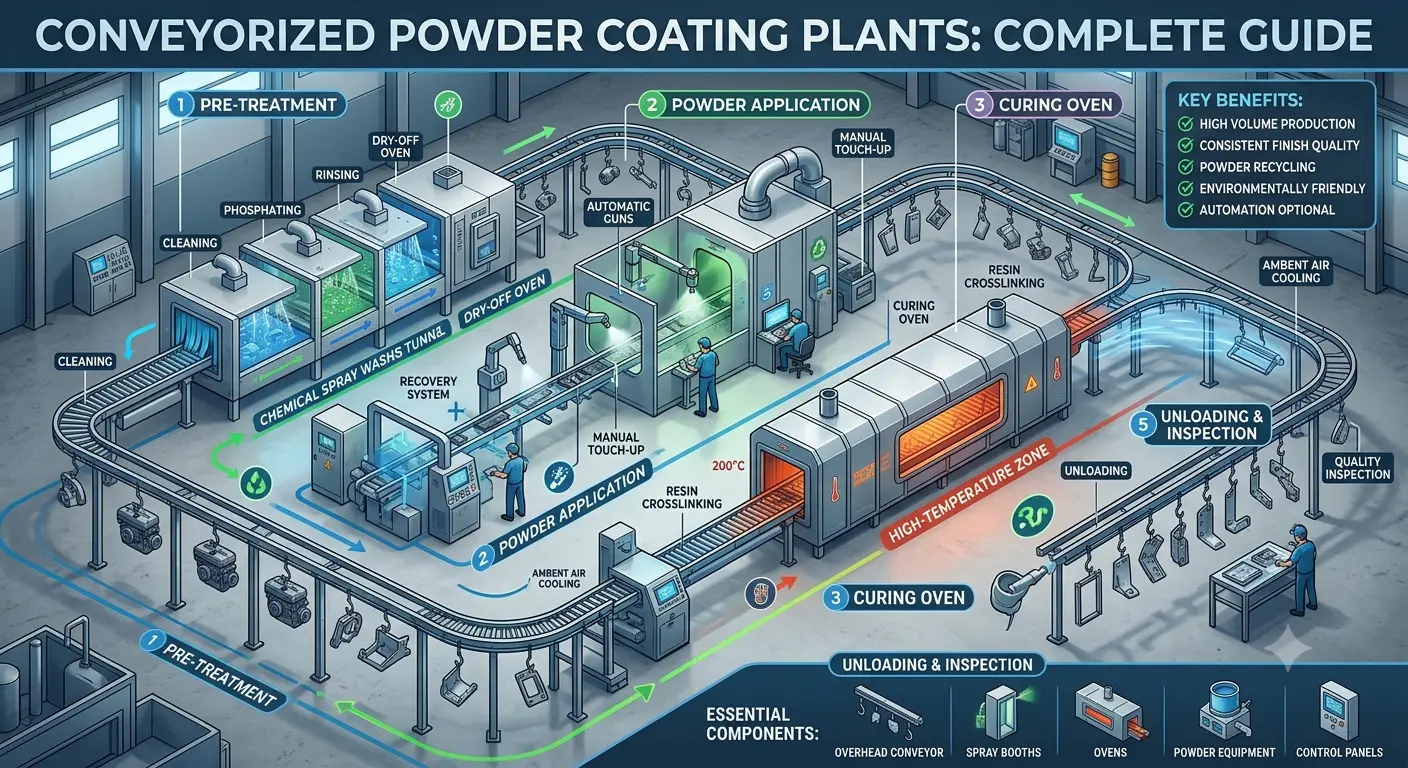
Conveyorized powder coating plants are automated finishing systems that continuously transport metal components through pretreatment, drying, powder application, curing, cooling, and unloading. They are designed for medium- to high-volume manufacturing where consistent coating quality, higher throughput, reduced manual handling, and production efficiency are important. The system can be customized according to product dimensions, production capacity, coating requirements, and factory layout.
What Is a Conveyorized Powder Coating Plant?
A conveyorized powder coating plant integrates material handling with the complete powder coating process.
Instead of manually moving components between individual stages, products are attached to a conveyor and automatically transported through the production line.
A typical system follows this sequence:
Loading → Pretreatment → Rinsing → Drying → Powder Coating → Curing → Cooling → Unloading → Inspection
The result is a more controlled and repeatable coating process.
Conveyorized systems are particularly suitable for:
- High-volume manufacturing
- Metal furniture production
- Aluminium profiles and sections
- Automotive components
- Electrical enclosures
- Agricultural equipment
- Industrial fabrication
- General engineering products
- OEM manufacturing
What Is a Conveyorized Powder Coating Plant?
A conveyorized powder coating plant is an integrated industrial coating system where components move continuously through different stages of the finishing process.
The conveyor acts as the backbone of the plant.
It connects equipment such as:
- Pretreatment tanks
- Drying oven
- Powder coating booth
- Automatic spray guns
- Powder recovery system
- Curing oven
- Cooling section
- Loading and unloading stations
Unlike a basic manual coating setup, a conveyorized plant is designed around continuous production flow.
This makes it possible to process larger quantities of components with less manual handling and greater process consistency.
How Does a Conveyorized Powder Coating Line Work?
The exact configuration depends on the product and coating specification, but a typical production sequence looks like this:
Step 1: Loading
Metal components are loaded onto conveyor hooks, fixtures, racks, or carriers.
The loading arrangement must be designed around the product’s:
- Size
- Weight
- Geometry
- Surface area
- Hanging points
Proper loading is critical because incorrect positioning can create coating shadow areas.
Step 2: Pretreatment
Components pass through a surface preparation process.
Depending on the material and required finish, this can include:
- Degreasing
- Cleaning
- Water rinsing
- Phosphating
- Conversion coating
- Passivation
Pretreatment removes contaminants and prepares the substrate for powder coating.
For a detailed explanation, see the pre-treatment systems for powder coating guide.
Step 3: Drying
After pretreatment, components must be adequately dried before powder application.
Residual moisture can negatively affect coating quality.
A drying oven removes water and prepares the components for the coating stage.
Step 4: Powder Application
Components enter the powder coating booth.
Electrostatic spray guns apply charged powder particles to grounded metal components.
The powder adheres to the surface before curing.
Depending on the production requirement, the system may use:
- Manual spray guns
- Automatic reciprocators
- Automatic spray guns
- Robotic systems
- Combined manual and automatic application
Step 5: Powder Recovery
Overspray is captured by the recovery system.
Depending on the booth configuration, recovery may use:
- Cartridge filters
- Cyclone systems
- Multi-stage recovery
- Filter-based collection
Efficient powder recovery can reduce material waste and improve operating economics.
Step 6: Curing
After powder application, components enter the curing oven.
Controlled heat causes the powder to melt, flow, and chemically cure into a durable coating.
The required curing profile depends on the powder manufacturer’s technical specifications.
Important parameters include:
- Oven temperature
- Part temperature
- Dwell time
- Air circulation
- Temperature uniformity
Step 7: Cooling
After curing, components pass through a cooling zone.
The cooling stage allows the coating to stabilize before unloading, handling, inspection, or packaging.
Step 8: Unloading and Inspection
Finished products are removed from the conveyor and inspected for:
- Color
- Gloss
- Coverage
- Surface defects
- Film thickness
- Adhesion
- Cure quality
Main Components of a Conveyorized Powder Coating Plant
A complete system can contain several interconnected subsystems.
| Component | Primary Function |
|---|---|
| Loading Station | Loads components onto conveyor |
| Pretreatment System | Cleans and prepares surfaces |
| Drying Oven | Removes moisture |
| Conveyor | Moves components through the plant |
| Powder Booth | Applies powder |
| Spray System | Provides electrostatic application |
| Recovery System | Captures overspray |
| Curing Oven | Cures powder coating |
| Cooling Zone | Stabilizes finished coating |
| Control Panel | Controls equipment |
| Exhaust System | Manages airflow |
| Wastewater System | Handles pretreatment effluent |
The exact equipment configuration should be engineered according to the production process.
Conveyor Systems: The Backbone of Automated Powder Coating System
The conveyor is one of the most important design decisions.
Common configurations include:
Overhead Conveyor
Components are suspended above the production floor.
Advantages
- Excellent floor-space utilization
- Suitable for continuous production
- Easy integration with automated spray systems
- Suitable for high-volume manufacturing
- Supports complex production layouts
For a deeper comparison, read the powder coating conveyor system guide.
Floor Conveyor
Components move using a ground-level transport system.
Advantages
- Good heavy-load handling
- Easier maintenance access
- Suitable for large fabricated components
- Flexible for certain plant layouts
The right system depends on product weight, dimensions, throughput, and factory configuration.
Pretreatment: The Foundation of Coating Quality
A conveyorized plant should not be evaluated only by its booth and oven.
Pretreatment has a major influence on final coating performance.
Poor surface preparation can result in:
- Poor adhesion
- Corrosion
- Peeling
- Blistering
- Premature coating failure
- Increased rejection
A properly designed pretreatment system creates a clean and chemically suitable surface for powder application.
Common pretreatment stages
Degreasing → Rinsing → Surface Conditioning → Conversion Coating → Rinsing → Passivation
The exact sequence should be selected based on:
- Metal substrate
- Contamination level
- Powder specification
- Corrosion-resistance requirement
- Environmental requirements
Powder Coating Booth
The powder coating booth provides a controlled environment for powder application and recovery.
A well-designed booth should consider:
- Airflow
- Powder containment
- Filtration
- Recovery
- Accessibility
- Cleaning requirements
- Color-change requirements
- Operator safety
For businesses processing multiple colors, booth design becomes especially important.
Read our guide to industrial powder coating booths for more information.
Powder Recovery System
Powder recovery directly influences material utilization.
A recovery system captures overspray that would otherwise become waste.
Common technologies include:
Cartridge Filter Recovery
Uses filter cartridges to capture powder particles.
Cyclone Recovery
Separates powder using centrifugal airflow.
Combined Recovery
Some industrial systems combine technologies to optimize recovery and filtration.
The correct solution depends on:
- Powder type
- Production volume
- Number of colors
- Color-change frequency
- Booth configuration
- Desired recovery efficiency
Curing Oven
The curing oven is another critical part of a conveyorized system.
An oven that is incorrectly sized or poorly designed can create:
- Uneven curing
- Excessive energy consumption
- Production bottlenecks
- Coating defects
A properly engineered oven should provide controlled and uniform heat distribution.
Important considerations
- Product dimensions
- Conveyor speed
- Required curing temperature
- Dwell time
- Fuel source
- Insulation
- Air circulation
- Exhaust arrangement
Energy efficiency should be evaluated as part of total cost of ownership.
Automation and Control Systems
Modern conveyorized powder coating plants can integrate automation throughout the process.
Typical controls can include:
- PLC-based control
- HMI interface
- Variable-frequency drives
- Temperature controllers
- Automatic chemical dosing
- Conveyor speed control
- Spray-gun controls
- Oven monitoring
- Safety interlocks
- Alarm systems
Automation provides greater process repeatability and makes production data easier to monitor.
Benefits of Conveyorized Powder Coating Plants
1. Higher Production Throughput
Continuous material movement reduces interruptions between process stages.
This makes conveyorized systems suitable for high-volume production.
2. Consistent Coating Quality
Controlled conveyor speed and automated spray parameters can improve coating consistency.
3. Reduced Manual Handling
Products move automatically between process stages.
This reduces unnecessary handling and can minimize scratches and physical damage.
4. Better Labor Productivity
Operators can focus on loading, quality control, monitoring, and maintenance instead of manually transporting components.
5. Improved Production Flow
Integrating pretreatment, coating, and curing creates a predictable manufacturing workflow.
6. Better Scalability
A properly designed conveyorized system can provide additional capacity for future production growth.
7. Improved Material Utilization
Efficient spray and recovery systems can reduce powder waste.
8. Better Space Utilization
Overhead conveyor configurations can preserve valuable floor space.
Conveyorized vs. Manual Powder Coating
| Factor | Manual System | Conveyorized System |
| Initial Investment | Lower | Higher |
| Production Volume | Low–Medium | Medium–High |
| Automation | Low | Medium–High |
| Labor Requirement | Higher | Lower per unit |
| Throughput | Limited | High |
| Consistency | Operator dependent | Higher repeatability |
| Product Flexibility | Excellent | Good |
| Continuous Production | Limited | Excellent |
| Scalability | Limited | Excellent |
| Best For | Small batches | High-volume production |
If you’re deciding between these systems, also see conveyorized vs manual powder coating plants.
Conveyorized vs. Batch Powder Coating
Batch systems can be highly flexible because products are processed in groups.
Conveyorized systems are designed around continuous flow.
| Requirement | Batch System | Conveyorized System |
| Small production batches | Excellent | Moderate |
| Frequent product changes | Excellent | Moderate |
| High-volume production | Moderate | Excellent |
| Continuous flow | No | Yes |
| Automation | Moderate | High |
| Floor-space efficiency | Moderate | High with overhead conveyor |
| Scalability | Moderate | Excellent |
The choice should be based on actual production economics rather than assuming that continuous automation is always better.
How Much Production Capacity Do You Need?
Plant capacity should be calculated before equipment design begins.
Important variables include:
- Products per hour
- Products per shift
- Number of shifts
- Product dimensions
- Product weight
- Hanging density
- Conveyor speed
- Curing time
- Pretreatment cycle time
For example, increasing conveyor speed does not automatically increase output if the curing oven or pretreatment system becomes the bottleneck.
A complete production-line analysis is therefore essential.
How to Calculate Conveyorized Plant Throughput
A simplified planning approach is:
Throughput = Conveyor Speed × Loading Density
However, actual capacity depends on:
- Product spacing
- Carrier configuration
- Product geometry
- Process dwell times
- Loading and unloading efficiency
- Booth capacity
- Oven capacity
This is why experienced plant designers evaluate the entire production flow, rather than sizing the conveyor independently.
Cost of a Conveyorized Powder Coating Plant
There is no single standard price.
The investment depends on:
- Plant capacity
- Conveyor length
- Pretreatment stages
- Booth dimensions
- Recovery technology
- Oven size
- Fuel source
- Automation
- Product dimensions
- Factory layout
- Installation requirements
- Wastewater treatment
- Electrical and utility requirements
For a detailed cost discussion, see conveyorised powder coating plant cost.
Initial Cost vs. Total Cost of Ownership
The lowest quotation is not necessarily the lowest-cost system.
Evaluate:
Capital Cost
- Equipment
- Installation
- Civil work
- Electrical work
- Commissioning
Operating Cost
- Electricity
- Gas/fuel
- Powder
- Chemicals
- Water
- Labor
Maintenance Cost
- Filters
- Pumps
- Conveyor components
- Spray equipment
- Burners
- Sensors
- Spare parts
A reliable ROI analysis should consider the full lifecycle.
For additional guidance, read hidden costs in powder coating systems.
Industries Using Conveyorized Powder Coating Plants
Metal Furniture
Used for:
- Chairs
- Tables
- Storage systems
- Office furniture
- Racks
- Cabinets
Aluminium Profiles
Conveyorized systems can be designed for architectural aluminium sections and profiles.
Automotive Components
Applications include:
- Brackets
- Chassis components
- Structural parts
- Wheels
- Hardware
Electrical Equipment
Common applications include:
- Electrical panels
- Enclosures
- Control cabinets
- Switchgear components
Agricultural Machinery
Powder coating provides a durable finish for fabricated agricultural equipment and components.
General Engineering
Suitable for:
- Fabricated components
- Industrial machinery
- Hardware
- Structural parts
- Metal assemblies
How to Choose the Right Conveyorized Powder Coating Plant
1. Define Your Products
Document:
- Maximum dimensions
- Minimum dimensions
- Weight range
- Material
- Geometry
- Required coating thickness
2. Determine Production Volume
Calculate current and expected future production.
Do not design only for today’s demand if substantial growth is expected.
3. Select the Pretreatment Process
The pretreatment system must match the substrate and corrosion-resistance requirements.
4. Select the Conveyor
Evaluate:
- Overhead vs floor
- Load capacity
- Conveyor speed
- Carrier spacing
- Layout
- Maintenance access
5. Design the Booth
Consider:
- Powder type
- Product size
- Automatic/manual spraying
- Recovery
- Color changes
6. Size the Curing Oven
The oven should be designed around:
- Product dimensions
- Conveyor speed
- Required cure profile
- Heat load
- Energy source
7. Plan Utilities
Calculate requirements for:
- Electricity
- Compressed air
- Gas
- Water
- Exhaust
- Drainage
8. Evaluate Automation
Determine whether you require:
- Manual controls
- Semi-automatic operation
- PLC automation
- Automatic spraying
- Automated chemical dosing
- Production monitoring
Common Design Mistakes
Oversizing the Plant
An oversized system increases capital and operating costs.
Undersizing the Plant
An undersized system becomes a production bottleneck.
Ignoring Pretreatment
Poor surface preparation can undermine the entire coating process.
Focusing Only on Purchase Price
Lifecycle cost is more important than initial price alone.
Poor Conveyor Layout
Incorrect product spacing or carrier selection can reduce actual throughput.
Inadequate Oven Design
Poor temperature uniformity can result in inconsistent curing.
Ignoring Future Expansion
A system without expansion potential may become restrictive as production grows.
Maintenance of Conveyorized Powder Coating Plants
Preventive maintenance helps maintain productivity and coating quality.
Daily
- Inspect conveyor operation
- Check booth cleanliness
- Monitor powder recovery
- Check oven temperature
- Inspect spray equipment
Weekly
- Inspect filters
- Check conveyor components
- Inspect pumps
- Check spray guns
- Clean critical areas
Monthly
- Inspect burners
- Check electrical systems
- Inspect conveyor chains
- Review airflow
- Verify temperature controls
Periodically
- Calibrate sensors
- Inspect structural components
- Service ovens
- Replace worn parts
- Review system performance
For booth-specific maintenance, see the powder coating booth maintenance guide.
When Should You Invest in a Conveyorized System?
A conveyorized system becomes increasingly attractive when:
- Production volumes are growing
- Manual handling is creating bottlenecks
- Consistent coating quality is essential
- Labor costs are increasing
- Products are relatively standardized
- Multiple shifts are planned
- OEM customers require repeatability
- Future expansion is expected
For very small or highly variable production, a manual or batch system may remain more economical.
Why Choose Brahma Fabricon?
Brahma Fabricon designs and manufactures industrial powder coating solutions based on individual production requirements.
Solutions can include:
- Conveyorized powder coating plants
- Automatic powder coating systems
- Pretreatment plants
- Powder coating booths
- Powder recovery systems
- Curing ovens
- Overhead conveyor systems
- Floor conveyor systems
- Turnkey finishing plants
The objective is to develop a complete production solution rather than simply supply individual machines.
Project planning can include:
- Production capacity analysis
- Plant layout
- Conveyor selection
- Pretreatment design
- Booth configuration
- Oven sizing
- Automation planning
- Utility calculations
- Installation and commissioning
Manufacturers can also compare their requirements with different plant configurations before finalizing the investment.
Quick Answers
What is a conveyorized powder coating plant?
It is an automated coating system that continuously transports metal components through pretreatment, drying, powder application, curing, cooling, and unloading.
What are the benefits of conveyorized powder coating?
The main benefits include higher throughput, consistent product handling, reduced manual movement, improved process control, better production flow, and scalability.
Is a conveyorized powder coating plant suitable for small businesses?
It depends on production volume. Conveyorized systems are generally more suitable when production volumes justify continuous automation. Smaller businesses may benefit from batch or manual systems.
How much does a conveyorized powder coating plant cost?
Cost depends on capacity, conveyor length, pretreatment stages, booth size, oven configuration, recovery technology, automation, and installation requirements. A customized quotation is necessary for an accurate project estimate.
Which conveyor is better for powder coating?
Overhead conveyors are commonly preferred for continuous high-volume production and efficient floor-space utilization, while floor conveyors can be advantageous for heavy or oversized components.
Frequently Asked Questions
1. What is a conveyorized powder coating plant?
A conveyorized powder coating plant is an integrated automated finishing line that transports components continuously through pretreatment, powder application, curing, cooling, and unloading.
2. What is the difference between conveyorized and manual powder coating?
A manual system relies heavily on operators to move and coat components, while a conveyorized system automates material movement and can integrate automatic powder spraying and process controls.
3. Are conveyorized powder coating plants suitable for high-volume production?
Yes. Continuous conveyor systems are particularly suitable for medium- and high-volume manufacturing.
4. What industries use conveyorized powder coating systems?
Common industries include metal furniture, automotive components, aluminium profiles, electrical equipment, agricultural machinery, construction products, and general engineering.
5. What components are included in a conveyorized powder coating plant?
A typical system may include pretreatment, drying, conveyor, powder booth, spray equipment, recovery system, curing oven, cooling section, controls, and loading/unloading stations.
6. How does a conveyor affect production capacity?
Conveyor speed, carrier spacing, product size, loading density, curing time, and process bottlenecks all influence the final production capacity.
7. How do I choose the right conveyor?
Consider product weight, dimensions, production volume, factory layout, automation requirements, maintenance access, and future expansion.
8. Is a conveyorized plant more expensive than a manual system?
The initial investment is generally higher because it includes integrated handling and process equipment. However, the higher capital cost may be justified by increased throughput and improved labor productivity.
9. Can a conveyorized powder coating plant be customized?
Yes. Plant configuration can be customized according to product dimensions, material, production capacity, coating requirements, factory layout, and automation level.
10. How long does a conveyorized powder coating plant last?
Service life depends on equipment quality, operating conditions, maintenance, and component replacement. A properly designed and maintained industrial system can provide long-term service.
Conclusion
Conveyorized powder coating plants provide an efficient solution for manufacturers that need repeatable, scalable, and high-volume coating production.
By integrating pretreatment, material handling, powder application, recovery, curing, and cooling into one coordinated production line, manufacturers can improve throughput while reducing unnecessary manual handling.
However, automation should be right-sized to the application.
The ideal system depends on:
- Production volume
- Product dimensions
- Material type
- Coating specification
- Factory layout
- Labor requirements
- Energy costs
- Future expansion plans
A properly engineered conveyorized system can become a long-term production asset rather than simply another piece of factory equipment.
Request a Conveyorized Powder Coating Plant Quotation
Planning a new automated coating line or upgrading an existing powder coating operation?
Brahma Fabricon can help you design a conveyorized powder coating plant around your actual production requirements.