
Quick Navigation
Latest Posts:
- Who Are the Largest Powder Coating Manufacturers?
- How Much Does It Cost to Set Up a Powder Coating Plant?
- Powder Coating Plant for Control Panels: Batch vs Conveyorised Systems, Layout & Equipment Selection
- Gas vs Electric Powder Coating Oven: Cost, Efficiency & Selection Guide
- Powder Coating Plant Installation Process: Planning, Factory Readiness, Commissioning & Handover
Everything you need to know about industrial powder coating – from 7-tank pre-treatment and electrostatic application to curing temperatures, defect troubleshooting, and plant equipment selection.
What is Powder Coating?
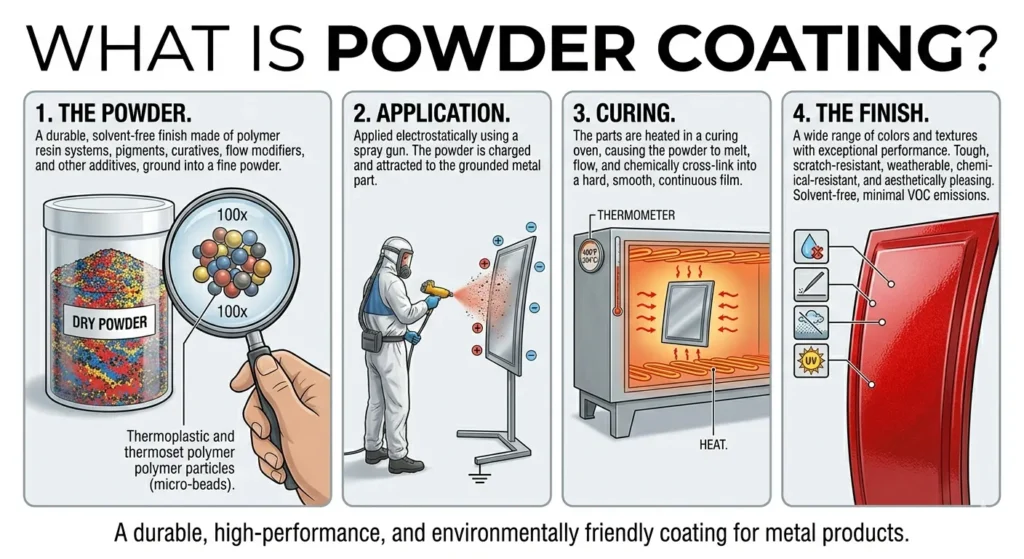
Powder coating is a dry, solvent-free surface finishing process in which finely ground particles of resin, pigment, and additives are electrostatically charged and sprayed onto a grounded metal substrate, then cured in an oven at 180–220°C to form a hard, chemically cross-linked, protective coating film.
Unlike conventional liquid paint, powder coating contains no solvents, produces no volatile organic compound (VOC) emissions, and delivers a significantly more durable finish in a single application. The process was first developed in the 1950s and commercialised widely from the 1970s – and today accounts for over 15% of the global industrial finishing market.
The coating material consists of a polymer resin base (thermoset or thermoplastic), combined with pigments for colour, flow modifiers for surface levelling, and curatives that trigger cross-linking during heat exposure. Most powder coatings have a particle size between 2 and 50 microns (μm), a melting point around 150°C, and achieve full cure at 180–200°C.
In India, powder coating has become the dominant surface finishing method for metal fabrication, automotive components, architectural aluminium, and white goods – driven by its superior corrosion resistance in high-humidity environments and significantly lower operational cost compared to wet paint systems.
Detailed Step-by-Step Powder Coating Process
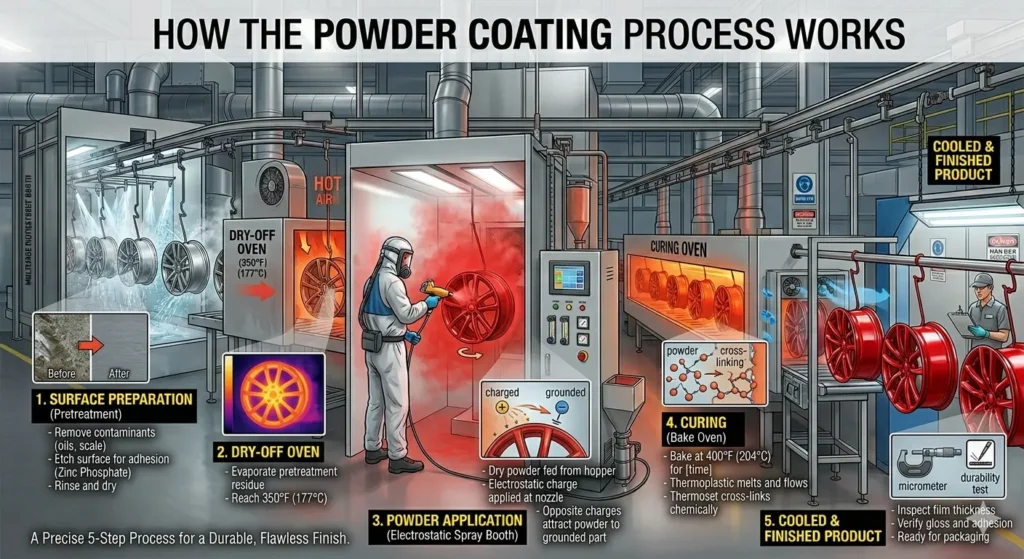
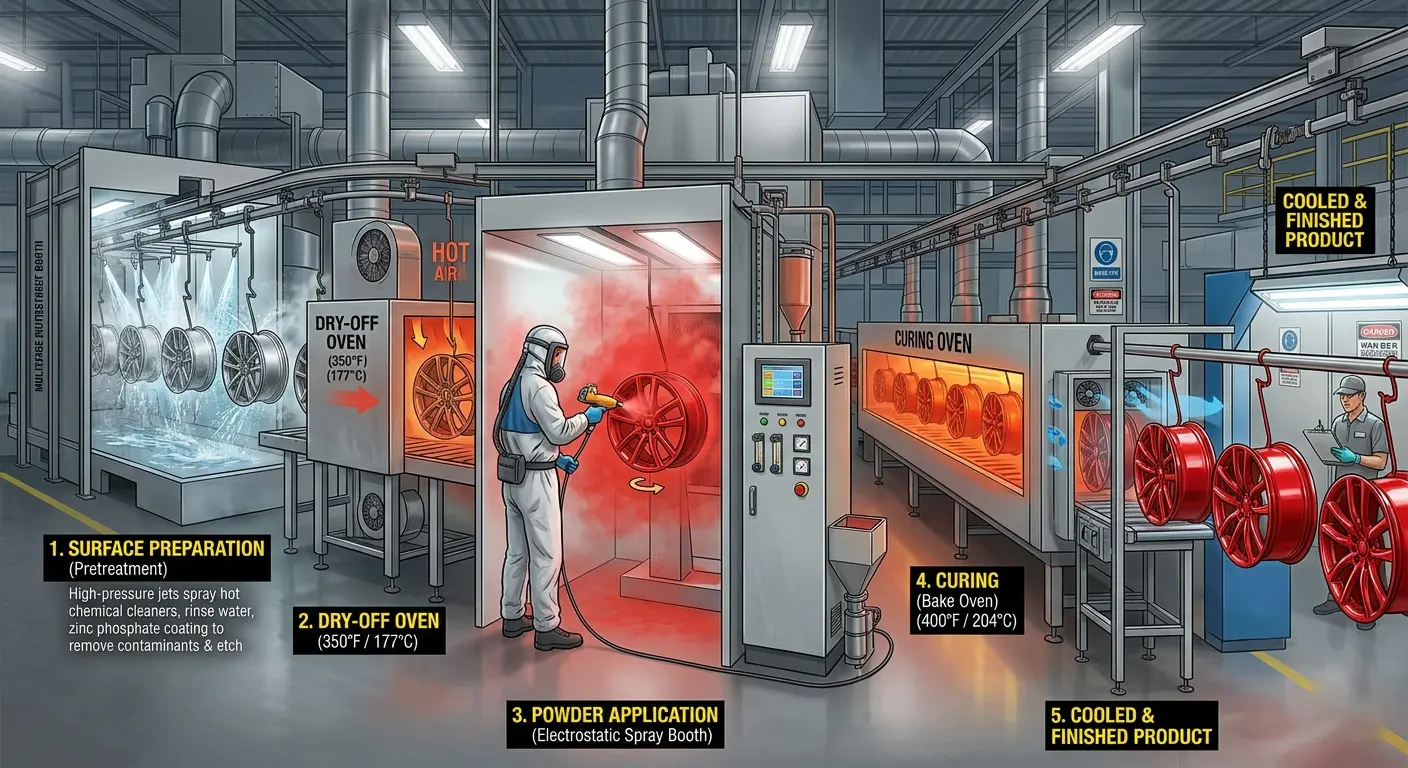
The complete industrial powder coating process involves six distinct stages. Every stage is critical – a failure at any point propagates defects that cannot be corrected at the next step. This is why leading manufacturers follow a disciplined, sequenced approach.
Surface Preparation / Pre-treatment
Metal components pass through a multi-stage chemical process (typically a 7-tank sequence) to remove oil, rust, scale, and other contaminants, and to apply a conversion coating (zinc or iron phosphate) that maximises adhesion and corrosion resistance. This is the single most critical stage — more than 80% of coating failures originate from inadequate pre-treatment.
Dry-Off (Drying Oven)
After pre-treatment, components pass through a dry-off oven at 80–100°C to evaporate all surface moisture. Even trace moisture trapped under powder coating causes adhesion failure, blistering, and early corrosion. In conveyorised plants, the dry-off oven is integrated into the line before the coating booth.
Masking (if required)
Areas that must remain uncoated — threaded holes, electrical contacts, bearing seats — are masked using heat-resistant tape, plugs, or caps before entering the coating booth. Masking is removed after curing.
Powder Application (Electrostatic Spray)
Powder particles are fed through a spray gun that imparts a negative electrostatic charge (typically –60kV to –100kV). The grounded metal component carries a positive charge, creating an electrostatic attraction that draws powder particles onto the surface uniformly – including recessed areas and inside edges. Powder is applied at a thickness of 60–80 microns for standard industrial applications.
Curing in Oven
The powder-coated parts move into a curing oven at 180–220°C for 10–20 minutes. The heat causes the powder to first melt and flow (levelling the surface), then chemically cross-link into a hard, continuous polymer film. This cross-linking is irreversible — it is what gives powder coatings their superior hardness, chemical resistance, and adhesion.
Cooling & Quality Inspection
Parts exit the oven and cool to ambient temperature – naturally or in a forced cooling zone. Quality checks include visual inspection, coating thickness measurement (60–80 μm), adhesion testing (crosshatch method per ISO 2409), gloss measurement, and impact resistance testing before dispatch.
Key principle: In a fully conveyorised powder coating plant, all six stages occur in a single continuous line. Components enter at the pre-treatment end and exit at the inspection end – fully finished – without manual handling. This is why conveyorised plants achieve dramatically higher throughput and consistency than batch systems.
Understanding the Powder Coating Manufacturing Process
The complete powder coating manufacturing process consists of surface preparation, pretreatment, powder application, curing, and inspection. Each stage contributes to achieving a uniform finish with excellent durability, corrosion resistance, and aesthetic appeal.
Stage 1 in Detail: The Pre-Treatment Process
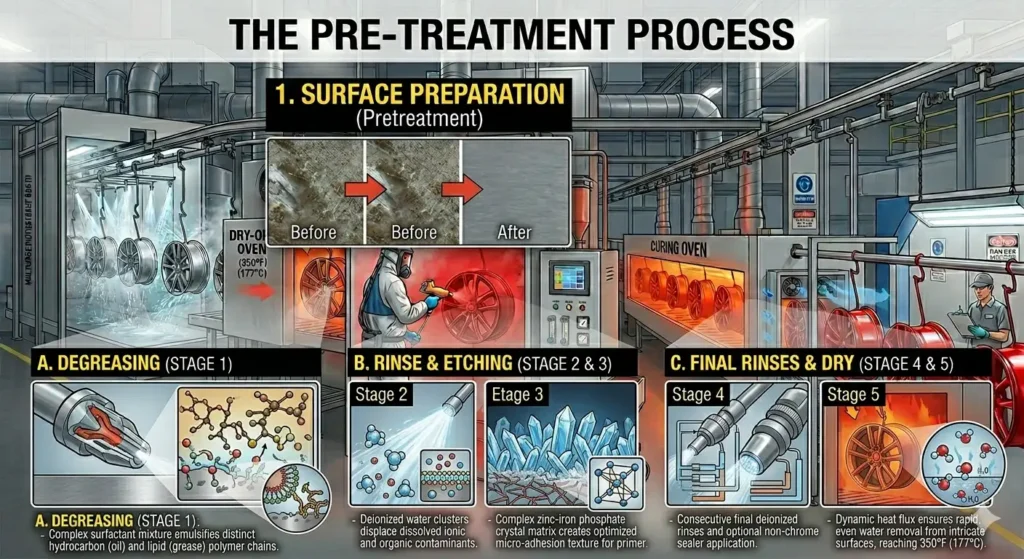
Pre-treatment is the foundation of the entire powder coating process, and advanced Pre-Treatment Plants play a critical role in ensuring long-lasting coating performance. The industry standard for ferrous metals (mild steel, galvanised steel) is the 7-tank chemical pre-treatment process. Skipping or shortcutting this stage is the primary cause of premature coating failure in the field.
The 7-Tank Pre-Treatment Process for Mild Steel
| Tank | Stage | Chemical / Process | Purpose | Typical Parameters |
|---|---|---|---|---|
| Tank 1 | Degreasing | Alkaline degreaser (pH 11–13) | Removes oil, grease, drawing compounds, fingerprints | 60–80°C, 5–10 min dip |
| Tank 2 | Water Rinse 1 | Fresh / tap water | Removes residual degreasing chemicals | Ambient, 1–2 min |
| Tank 3 | Derusting / Pickling | Dilute acid (H₂SO₄ or HCl) | Removes rust, mill scale, oxides | Ambient–50°C, 3–10 min |
| Tank 4 | Water Rinse 2 | Fresh water | Removes residual acid before phosphating | Ambient, 1–2 min |
| Tank 5 | Surface Activation | Titanium-based activator | Conditions surface for uniform, fine-crystalline phosphate deposit | Ambient, 1–2 min |
| Tank 6 | Zinc / Iron Phosphating | Zinc phosphate (Zn₃(PO₄)₂) or iron phosphate | Creates a crystalline conversion layer that anchors powder coating and provides corrosion resistance | 45–55°C (zinc), ambient (iron), 3–5 min |
| Tank 7 | Passivation / Final Rinse | Chromate-free sealer or deionised water | Seals phosphate layer, prevents flash rusting before drying | Ambient, 1–2 min |
Pre-Treatment for Aluminium
Aluminium requires a separate pre-treatment sequence because it naturally forms an oxide layer that prevents powder adhesion. The standard process involves degreasing → rinse → deoxidising (removing the aluminium oxide layer) → rinse → chromate or chrome-free conversion coating → rinse. The conversion coating on aluminium is typically chromate (Type I or Type II) for maximum corrosion protection, or increasingly zirconium-based chrome-free alternatives for environmental compliance.
Zinc Phosphate vs Iron Phosphate: When to Use Which
| Parameter | Zinc Phosphate | Iron Phosphate |
|---|---|---|
| Corrosion resistance | Excellent (600–1000 hrs salt spray) | Good (200–400 hrs salt spray) |
| Crystal structure | Heavy, coarse crystalline | Light, amorphous |
| Process temperature | 45–55°C (heated) | Ambient–40°C |
| Cost | Higher (chemicals + heating) | Lower |
| Best for | Automotive, outdoor, structural parts | Indoor furniture, general fabrication |
| Tanks required | 7-tank process | 5-tank process possible |
Stage 2 in Detail: Powder Application Methods
The powdercoating process uses electrostatic spray technology to apply powder particles uniformly on the workpiece before curing.
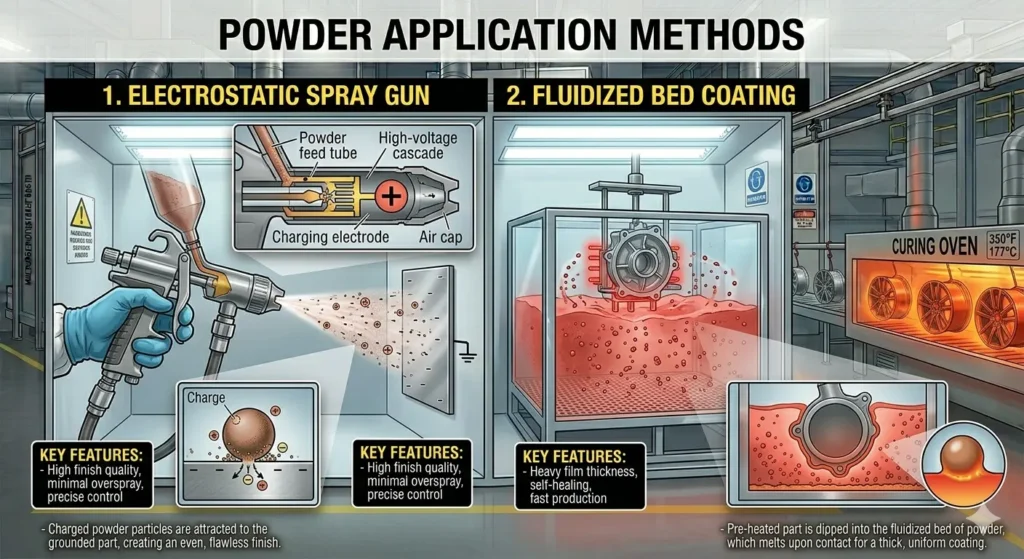
Method 1: Electrostatic Spray Deposition (ESD) — Most Common
This is the dominant method in 95%+ of industrial powder coating operations worldwide. A powder coating gun draws powder from a hopper or feed centre, mixes it with air, and passes it through a charging electrode that imparts a negative corona charge (–60 to –100kV) to each particle. The grounded workpiece carries an induced positive charge, creating a powerful electrostatic field that draws and holds particles onto the surface uniformly.
| Parameter | Typical Setting | Effect of Getting it Wrong |
|---|---|---|
| Charging voltage | 60–100 kV | Low voltage = poor wrap; high voltage = back ionisation, pinholes |
| Powder flow rate | 80–200 g/min (manual) | Too high = thick/uneven film; too low = thin coverage |
| Air pressure (feed) | 0.3–0.8 bar | Too high = powder waste, too low = inconsistent flow |
| Gun-to-part distance | 15–25 cm | Too close = back ionisation; too far = low transfer efficiency |
| Film thickness target | 60–80 microns (μm) | Under 40 μm = corrosion risk; over 100 μm = orange peel |
Method 2: Fluidised Bed Coating
In the fluidised bed method, pre-heated metal parts (heated to 200–300°C) are immersed in a tank of fluidised powder. The powder melts on contact with the hot surface, forming a thick coating (200–500+ microns). This method is used for wire racks, dishwasher baskets, electrical insulators, and parts requiring very thick protection — but is not suitable for thin sheet metal or complex geometries.
Method 3: Tribo Charging (Friction Charging)
Tribo guns charge powder by friction (PTFE barrel) rather than corona discharge, eliminating the Faraday cage effect that causes poor penetration into recessed areas with corona guns. Tribo charging is preferred for complex 3D shapes, hollow sections, and parts with deep recesses. The trade-off is slower charging buildup and sensitivity to powder formulation.
Expert tip: In fully automatic conveyorised lines, reciprocating automatic guns are synchronised with conveyor speed to maintain consistent gun-to-part distance and film thickness across every part. Brahma Fabricon’s conveyorised plants integrate Micro Static 100 and Dual Static 100 gun systems with programmable reciprocators for ±5 micron film thickness consistency.
Stage 3 in Detail: The Curing Process
Curing is one of the most important stages in the powder coating process, where heat transforms the powder into a durable and protective coating.
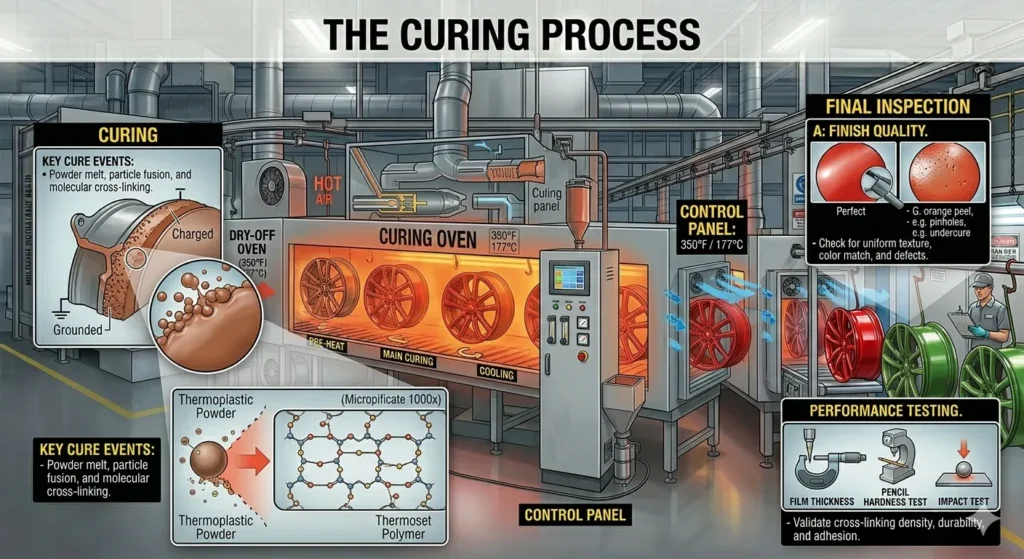
Curing is the chemical transformation stage – the point at which loose powder particles become a hard, cross-linked, permanent coating. Understanding curing is essential because under-curing and over-curing are both equally damaging to final coating performance.
What Happens During Curing
As oven temperature rises, the powder coating goes through three distinct phases:
- Melt phase (120–150°C): Powder particles soften and begin to flow together, levelling the surface.
- Flow / gel phase (150–180°C): The melted powder flows fully, eliminating particle boundaries and achieving a smooth, glossy surface.
- Cross-linking / cure phase (180–220°C): The curing agents (hardeners) react with the resin, forming irreversible covalent bonds between polymer chains. This chemical cross-linking is what creates the exceptional hardness and chemical resistance of powder coatings.
Curing Temperature and Time by Powder Type
| Powder Type | Curing Temperature | Curing Time | Common Application |
|---|---|---|---|
| Polyester TGIC | 180–200°C | 10–15 min | Outdoor structures, automotive |
| Polyester Primid (HAA) | 180–200°C | 12–18 min | General industrial, furniture |
| Epoxy | 160–185°C | 10–15 min | Functional/protective (indoor) |
| Epoxy-Polyester (Hybrid) | 170–185°C | 12–15 min | General purpose, white goods |
| Polyurethane | 180–200°C | 15–20 min | Premium decorative, automotive |
| UV-Curable | 110–130°C (melt) + UV | 60–120 sec | Heat-sensitive substrates |
Oven Types Used in Industrial Powder Coating
- Convection ovens (most common): Heated air circulates around parts. Well-suited to batch and conveyorised operations. Typical oven length in a conveyorised line: 10–20 metres.
- Gas-fired infrared (IR) ovens: Radiant heat penetrates parts faster, reducing cure time by 30–50%. Used where floor space is limited or high throughput is needed.
- Electric ovens: Cleaner and easier to control. Higher operating cost than gas in India. Preferred for precision applications.
- Combination (IR + convection): IR heats rapidly, convection maintains temperature uniformly. Best of both methods.
Types of Powder Coating
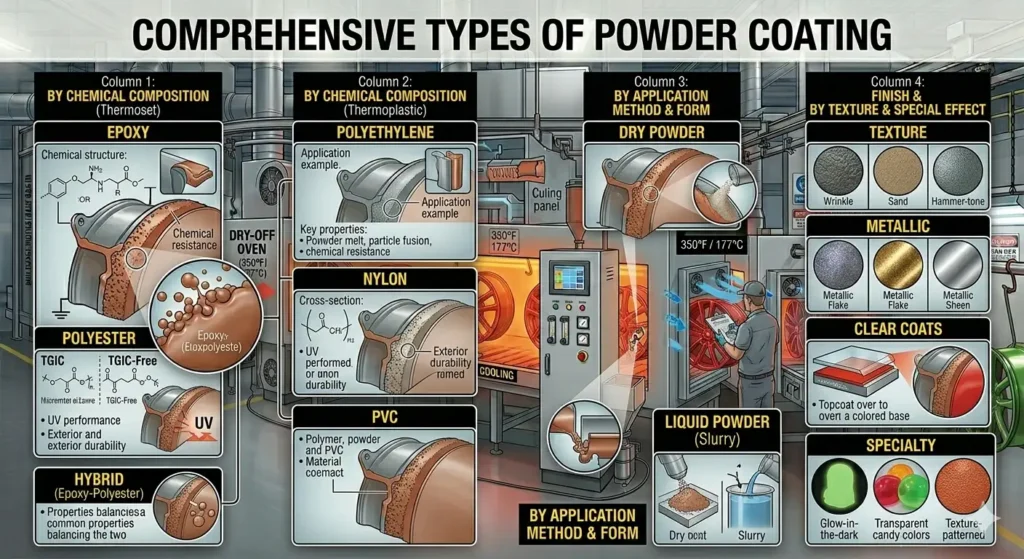
Powder coatings are broadly divided into two families: thermoset (which cure by irreversible chemical cross-linking) and thermoplastic (which melt and re-solidify without chemical change). Thermoset powders account for over 90% of industrial usage.
Polyester (TGIC / HAA) (Most popular)
The most widely used powder coating globally. Excellent UV resistance, colour retention, and weatherability. Available in thousands of colours and finishes.
Epoxy
Exceptional adhesion and chemical resistance. Poor UV resistance (chalks outdoors). Used for protective internal coatings, pipes, rebar, and as a primer under topcoats.
Epoxy-Polyester Hybrid
Combines the adhesion of epoxy with some UV resistance of polyester. The most economical general-purpose option. Widely used for white goods, shelving, and indoor furniture.
Polyurethane
Superior surface hardness, scratch resistance, and appearance. Premium option for automotive parts, luxury furniture, and medical equipment.
PVDF / Fluoropolymer
Extreme weatherability and chemical resistance. Used in architectural aluminium systems, coastal structures, and chemical process industries.
UV-Curable Powder
Low-temperature cure (110–130°C + UV). Suitable for MDF, wood, and heat-sensitive components. Fastest cure cycle available.
Powder Coating vs Liquid Paint: Full Comparison
This is one of the most common questions in industrial surface finishing. The answer depends on your production volume, substrate, finish requirements, and environmental compliance obligations – but for most metal fabrication applications, powder coating wins on nearly every metric.
| Parameter | Powder Coating | Liquid Paint |
|---|---|---|
| Solvent content | ✔ Zero (solvent-free) | ✘ 40–60% solvent |
| VOC emissions | ✔ Zero VOC | ✘ Significant VOC |
| Film thickness per coat | ✔ 60–80 microns (one coat) | ✘ 25–35 microns (multiple coats) |
| Powder / material efficiency | ✔ 95–98% (overspray recovered) | ✘ 35–65% (overspray wasted) |
| Corrosion resistance | ✔ 500–1000+ hrs salt spray | 150–400 hrs (depends on primer) |
| Scratch / impact resistance | ✔ Superior | ✘ Lower |
| UV / weathering resistance | ✔ Excellent (polyester) | Good (2-pack PU) |
| Heat-sensitive substrates | ✘ Unsuitable (requires 180°C+) | ✔ Suitable for any substrate |
| Colour change time | Moderate (5–20 min purge) | ✔ Faster (flush through system) |
| Regulatory compliance (India) | ✔ Easy (no hazardous waste) | ✘ Solvent disposal regulations |
| Operational cost (per m²) | ✔ Lower long-term | ✘ Higher (solvent + waste disposal) |
Common Powder Coating Defects, Causes & Solutions
Understanding defect root causes is essential for maintaining coating quality and reducing rework. Every defect in the finished coating traces back to a specific failure point in the process.
| Defect | Appearance | Root Cause | Solution |
|---|---|---|---|
| Orange Peel | Bumpy texture like orange skin | Wrong curing temperature, excessive film thickness, incorrect powder particle size | Calibrate oven temperature; reduce powder flow rate; check powder specification |
| Pinholes | Small pits or craters in film | Outgassing from the substrate (trapped gas released during curing), contamination, moisture | Pre-heat castings before coating; ensure substrate is dry; improve pre-treatment |
| Adhesion Failure / Peeling | Coating lifts or peels | Inadequate pre-treatment (contamination or wrong phosphate), under-curing, moisture at application | Review and improve pre-treatment process; verify curing temperature with oven probe |
| Colour Variation | Patches of different shades | Powder contamination from colour change, inconsistent film thickness, temperature variation across oven | Thorough colour change purge; check oven temperature uniformity; verify film thickness |
| Back Ionisation | Crater-like “stars” on surface | Excessive gun voltage causing over-charging; gun held too close to part | Reduce voltage to 60–80kV; increase gun-to-part distance to 20–25 cm |
| Thin Coverage in Recesses | Visible base metal in corners | Faraday cage effect with corona gun; insufficient gun angle | Switch to tribo gun for complex parts; use multiple gun angles; reduce conveyor speed |
| Yellowing / Discolouration | White or light colours turn yellow | Over-curing (too high temperature or too long), contamination from gas burner combustion products | Reduce oven temperature; verify oven calibration; check gas burner efficiency |
Industries and Applications of Powder Coating
Powder coating is one of the most versatile industrial finishing processes, used across virtually every sector that works with metal components.
Wheels, brackets, chassis, underbody parts, bumpers
White Goods
Washing machines, refrigerator cabinets, AC units, microwave bodies
Architectural Aluminium
Window profiles, curtain walls, door frames, cladding
Agricultural Equipment
Tractors, sprayers, implements, storage tanks
Control Panels & Enclosures
Electrical panels, MCC cabinets, switchgear boxes
Metal Furniture
Shelving, office furniture, hospital furniture, racks
Bicycle & Two-Wheeler
Frames, forks, rims, handlebar components
Lighting Fixtures
Street lights, industrial luminaires, floodlights
General Fabrication
Structural steel, gates, grilles, fencing, safety equipment
Equipment Required for an Industrial Powder Coating Plant
A complete industrial powder coating plant – whether manual batch or fully conveyorised – requires the following core equipment. The specific configuration depends on production volume, part size, and substrate type.
| Equipment | Function | Key Specifications |
|---|---|---|
| Pre-treatment system | Chemical cleaning and phosphating | 7-tank dip or spray type; SS/MS construction; heating capacity 0–80°C |
| Dry-off oven | Remove moisture after pre-treatment | 80–100°C; convection heating; matched to conveyor speed |
| Powder coating booth | Contain and recover overspray powder | Cyclone + cartridge filter recovery; 95–98% recovery rate |
| Powder spray guns | Apply electrostatic charge and spray powder | Corona (Micro Static / Dual Static) or tribo; 0–100kV adjustable |
| Automatic reciprocator | Move guns vertically in sync with conveyor | Programmable stroke length 300–2500mm; adjustable speed |
| Curing oven | Melt and cross-link powder coating | 180–220°C; gas or electric; 10–20 min residence time |
| Conveyor system | Move parts through the line continuously | Overhead monorail or power-and-free; 0.5–3.0 m/min adjustable |
| Powder management system | Fresh powder supply, sieving, reclaim blending | Automatic level sensor; sieve 100–150 mesh; fresh:reclaim ratio control |
| Compressed air system | Fluidise and convey powder | Clean, dry, oil-free air; dew point ≤ –20°C |
Planning a new plant?
The right plant configuration – line speed, oven dimensions, conveyor type, booth size – is determined by your production volume (kg/shift), part dimensions, substrate type, and available floor space. Brahma Fabricon has been designing and commissioning turnkey powder coating plants across India since 2000. We provide layout drawings, utility requirements, and ROI calculations before you commit to a purchase.
Frequently Asked Questions
What is the powder coating process?
The powder coating process is a dry surface finishing method where electrostatically charged powder particles are sprayed onto a grounded metal surface, then cured in an oven at 180–220°C to form a hard, durable, solvent-free coating. It involves six stages: pre-treatment, drying, (masking), powder application, curing, and quality inspection.
Why is powder coating preparation important?
Proper powder coating preparation ensures better adhesion, corrosion resistance, and improved coating performance.
What temperature is required for powder coating curing?
Most thermoset powder coatings cure at 180–200°C (356–392°F) for 10–20 minutes of metal temperature. Epoxy powders can cure at lower temperatures (160–185°C), while some specialty powders require up to 220°C. The time is measured from when the part — not the oven air — reaches target temperature.
What are the stages involved in the powder coating manufacturing process?
The powder coating manufacturing process includes cleaning, pretreatment, powder application, curing, and final inspection.
How many stages are in the powder coating pre-treatment process?
The standard industrial pre-treatment for mild steel uses a 7-tank process: (1) Degreasing, (2) Water rinse, (3) Derusting/pickling, (4) Water rinse, (5) Surface activation, (6) Zinc or iron phosphating, and (7) Final passivation rinse. Aluminium requires a different sequence using chromate or chrome-free conversion coating.
What is the difference between powder coating and liquid paint?
Powder coating uses no solvents, produces zero VOC emissions, delivers 60–80 micron thickness in a single coat with 95–98% material efficiency, and produces a harder, more corrosion-resistant finish. Liquid paint requires solvents, produces VOC emissions, typically needs multiple coats (25–35 microns each), and has lower material efficiency (35–65%). Powder coating cannot be used on heat-sensitive substrates.
What causes orange peel texture in powder coating?
Orange peel in powder coating is caused by incorrect curing temperature (too high or too low), excessive film thickness (over 100 microns), incorrect powder particle size for the application, contaminated surface, or incorrect gun-to-part distance. It can be prevented through proper oven calibration, controlled film thickness, and validated pre-treatment.
How long does the complete powder coating process take?
In a conveyorised plant: pre-treatment and drying takes 20–30 minutes, powder application 5–10 minutes, and curing plus cooling 20–30 minutes — total 45–70 minutes from raw part to finished component. In a manual batch operation, the same process typically takes 2–4 hours including setup, loading/unloading, and waiting for the oven cycle.
What is the standard coating thickness for industrial powder coating?
Standard industrial powder coating thickness is 60–80 microns (μm) for general applications. For outdoor/architectural applications, 80–100 μm is recommended. For heavy-duty corrosion protection (pipelines, offshore), 120–200 μm may be applied using multiple coats or fluidised bed methods. Minimum thickness for indoor applications is typically 40 μm.
Is powder coating suitable for aluminium?
Yes. Powder coating is widely used on aluminium extrusions, sheet, and castings — including architectural window profiles, cladding systems, and automotive components. Aluminium requires a specific pre-treatment sequence (chromate or chrome-free conversion coating instead of phosphating) to achieve proper adhesion. Quality standards for architectural aluminium powder coating are defined by QUALICOAT and GSB International specifications.
Planning a Powder Coating Plant for Your Production Line?
Brahma Fabricon has designed and commissioned 200+ turnkey powder coating plants across India since 2000 – for automotive, white goods, aluminium, agricultural equipment, and general fabrication. ISO 9001:2015 certified. Pan-India installation and commissioning.
Brahma Fabricon Engineering Team
ISO 9001:2015 Certified Powder Coating Plant Manufacturers, Vadodara, India · Since 2000
Brahma Fabricon has designed, fabricated, and commissioned conveyorised powder coating plants, pre-treatment systems, curing ovens, and powder coating equipment for 200+ industrial clients across India. Our engineering content is based on 25 years of hands-on plant commissioning experience.