
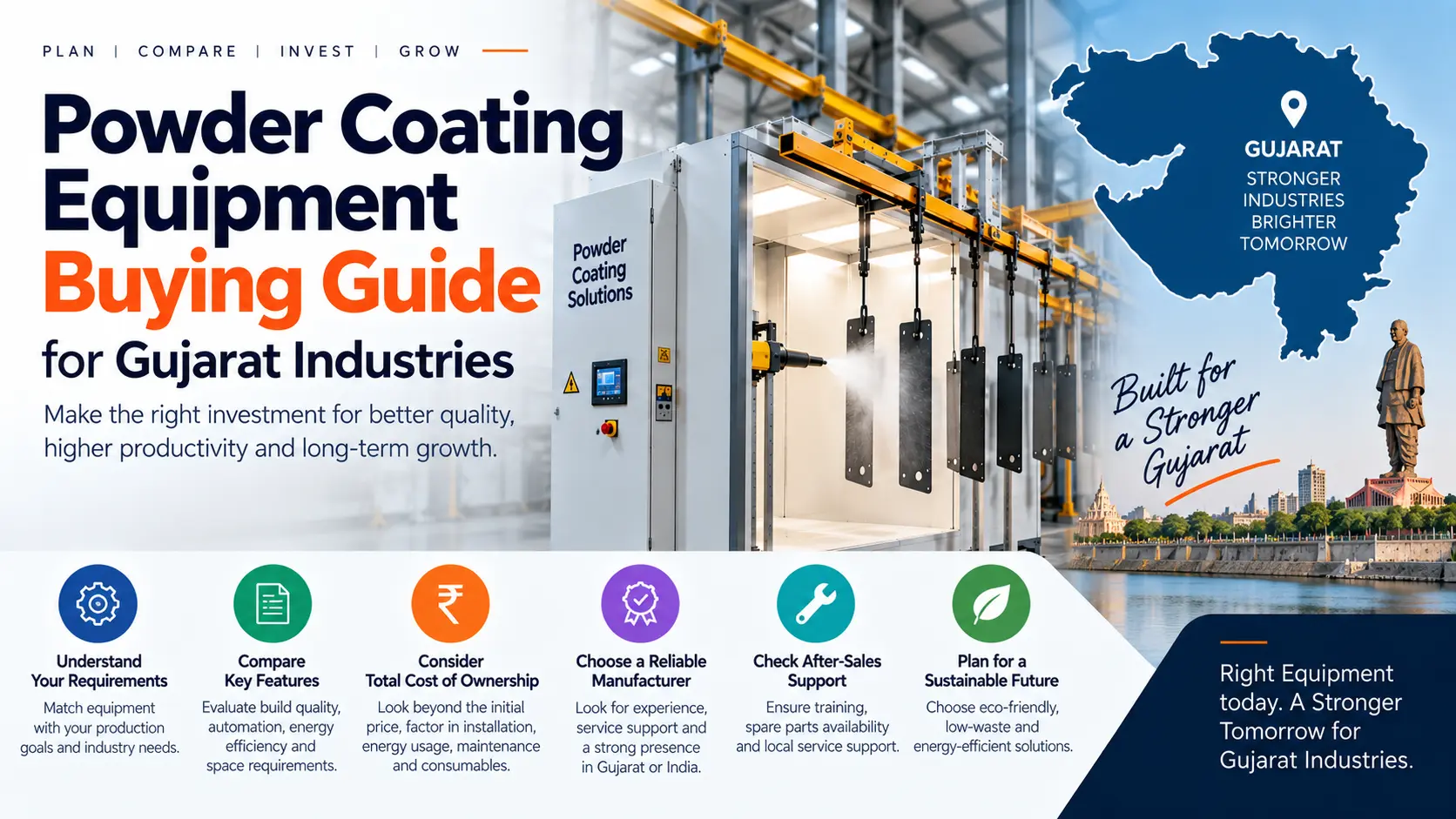
Buying powder coating equipment should start with the components you need to coat—not with a machine catalogue or the cheapest quotation.
For manufacturers in Gujarat, the correct system may range from a manual gun, booth and batch oven for flexible low-volume work to an integrated conveyorised line with automatic guns, powder recovery, pretreatment, PLC controls and continuous curing.
The most important buying principle is simple:
Specify the product, production requirement and finish standard first. Select the equipment second.
A complete industrial powder coating system normally combines surface preparation, powder application, powder containment/recovery, curing and material handling. The Powder Coating Institute describes the common electrostatic process as charging powder through a spray gun, attracting it to a grounded part and subsequently curing the coating with heat.
This guide explains how Gujarat manufacturers can select each part of that system, compare quotations properly and avoid expensive specification mistakes.
What powder coating equipment should you buy?
| Production situation | Equipment approach to investigate |
|---|---|
| Low-volume, varied components | Manual gun + manual booth + batch oven |
| Job coating with frequent colour changes | Flexible manual system with easy-clean booth |
| Growing medium-volume production | Manual/semi-automatic application with improved material handling |
| Repetitive medium/high-volume parts | Conveyorised line with automatic guns |
| High-volume mono-colour production | Automatic line with effective powder recovery |
| Frequent multi-colour production | Fast-clean booth/recovery configuration |
| Large/heavy fabrication | Batch or engineered conveyor system based on weight and thermal load |
| Long aluminium sections | Equipment sized around section length, pretreatment and handling |
| Automotive/EV components | High repeatability, controlled pretreatment, automation and process monitoring |
| Control panels/enclosures | Good grounding, recess coverage and flexible colour/application capability |
The final configuration should be validated against your actual parts, coating specification, factory layout, utilities and production targets.
What equipment is required for powder coating?
A complete industrial line can include:
- Surface pretreatment system
- Dry-off oven or drying system
- Electrostatic powder coating gun
- Powder feed equipment
- Powder coating booth
- Powder recovery system
- Reciprocators or automatic gun movers
- Powder curing oven
- Conveyor or material-handling system
- PLC/control panel and safety interlocks
- Compressed-air preparation
- Quality-control instruments
Not every factory needs every item at the same level of automation.
A small fabricator may need a flexible batch setup. A high-volume OEM may require a complete conveyorised powder coating plant.
That distinction should be made before suppliers quote.
Step 1: define the components before choosing equipment
The single most useful buying document is a component matrix.
Record the following before contacting equipment manufacturers:
| Input | Minimum | Typical | Maximum |
|---|---|---|---|
| Part length | |||
| Part width | |||
| Part height | |||
| Part weight | |||
| Surface area | |||
| Parts per shift | |||
| Colours per day | |||
| Batch size |
Also provide photographs or drawings of representative components.
Why maximum dimensions alone are insufficient
Two parts that fit through the same booth opening may require very different plants.
A thin sheet-metal enclosure and a heavy fabricated frame can have:
- different hanger requirements;
- different pretreatment needs;
- different powder-access challenges;
- different oven heat-up times;
- different conveyor loading;
- different curing residence requirements.
The supplier should therefore know both the physical envelope and thermal mass of the product family.
Step 2: define the finish requirement
Equipment should support the coating specification—not determine it afterwards.
Before selecting the plant, document:
- substrate;
- indoor or outdoor use;
- powder type;
- required colour and gloss;
- film-thickness requirement;
- corrosion-performance requirement;
- appearance standard;
- customer/OEM specification;
- masking requirements;
- production quality tests.
PCI specifically recommends selecting powder coating in cooperation with the powder supplier because factors such as substrate, cure time, cure temperature, application method, chemical resistance and weatherability interact.
This matters because the pretreatment system and curing oven cannot be specified correctly without knowing what coating performance is expected.
Step 3: select the right pretreatment system
Surface preparation is one of the easiest places to under-specify a coating plant.
The purpose of pretreatment is to remove contamination and prepare the substrate for the coating system.
Typical equipment may include:
- dip tanks;
- spray pretreatment tunnels;
- pumps;
- heaters;
- filtration;
- chemical dosing;
- rinsing stages;
- water-treatment equipment;
- drying equipment.
Brahma Fabricon’s technical guide to powder coating pretreatment systems explains dip, spray and conversion-treatment configurations in more detail.
Dip or spray pretreatment?
Dip systems can be practical where components are complex, production is batch-based or complete immersion is useful.
Spray systems are commonly integrated into conveyorised production where controlled continuous processing is required.
The choice should consider:
- component geometry;
- substrate;
- contamination;
- required corrosion performance;
- production volume;
- wastewater;
- available floor area;
- chemical supplier recommendations.
Buying question to ask
Do not ask:
“How many tanks should we buy?”
Ask:
“What pretreatment sequence does our substrate and coating specification require, and how will the equipment maintain that process?”
The second question produces a much better plant.
Manufacturers can also review Brahma Fabricon’s pretreatment plant configurations before specifying individual stages.
Step 4: choose the right powder coating gun
The spray gun directly affects powder charging, application control and operator productivity.
Broadly, the choice is between:
Manual guns
Best suited to:
- low or medium production;
- changing part geometries;
- frequent colour changes;
- job coating;
- touch-up;
- complex areas needing operator judgement.
Automatic guns
Best suited to:
- repetitive production;
- conveyorised lines;
- stable part positioning;
- high throughput;
- processes where repeatability is important.
Automatic guns plus manual touch-up
This hybrid configuration can work well where the automatic guns cover the majority of the surface while an operator addresses difficult recesses or changing geometries.
PCI’s professional training covers both manual and automatic application, including Faraday-cage effects, electrostatic rejection and automated gun setup—an indication that gun selection is only one part of achieving a stable coating process.
Brahma Fabricon’s industrial powder coating equipment range includes manual application equipment as well as automatic guns and reciprocators.
Do not choose a gun by kV alone
A common procurement mistake is comparing powder guns only by maximum output voltage.
Important evaluation criteria also include:
- voltage/current control;
- powder delivery stability;
- gun weight and operator ergonomics;
- nozzle options;
- cleaning time;
- hose and wear-part design;
- recipe storage;
- serviceability;
- spare-part availability;
- integration with automatic systems;
- performance on recesses and complex shapes.
The highest numerical specification does not automatically mean the best result for every component.
Step 5: choose a booth based on production and colour strategy
A powder booth has two fundamental jobs:
contain the sprayed powder and support an effective recovery/extraction process.
The correct booth depends strongly on colour mix and production pattern.
Cartridge recovery booth
Often attractive for:
- manual coating;
- limited colour ranges;
- smaller production systems;
- applications where compact equipment is desirable.
Cyclone recovery booth
Can be attractive where:
- reclaim is important;
- production volume is higher;
- the booth is engineered for colour-change requirements;
- the recovery circuit suits the powder and product mix.
Quick-colour-change booth
Worth investigating when frequent colour changes are a major production constraint.
Nordson’s current booth range illustrates why colour strategy belongs in the purchasing decision: it separates mono-colour, fast-colour-change, manual and special-application booth designs rather than treating one booth as suitable for every operation.
Gema’s automatic-booth documentation similarly shows that an industrial recovery circuit may combine a cyclone separator, sieve, recirculation equipment and powder-management centre.
For system-specific options, see Brahma Fabricon’s industrial powder coating booth guide.
Recovery efficiency and first-pass transfer efficiency are different
This distinction should appear in every serious equipment quotation discussion.
First-pass transfer efficiency concerns how much sprayed powder deposits on the component initially.
Recovery efficiency concerns how effectively suitable overspray is captured by the recovery system.
A buyer should therefore consider:
powder applied → powder deposited first pass → powder recovered → powder discarded → acceptable finished parts
not one headline recovery percentage.
Nordson currently publishes different recovery figures for different technologies, including over 95% for certain twin-cyclone configurations and over 99% reclaim efficiency for specific filter systems. These are equipment-specific figures, not universal powder-coating guarantees.
Step 6: choose the curing oven around the product, not a generic temperature
Powder must achieve the cure schedule specified for the chosen material.
The oven therefore needs to be selected around:
- powder cure requirement;
- part material;
- part thickness;
- part mass;
- production rate;
- conveyor speed;
- airflow;
- oven loading;
- factory utilities.
One of the most important concepts for buyers is the difference between oven-air temperature and actual component temperature.
PCI explains that oven cycle time contains the period required for the part to reach the required substrate temperature plus the required dwell time.
A thick fabricated component may take substantially longer to reach cure temperature than thin sheet metal.
Batch vs conveyorised oven
A batch oven is often worth considering for variable products, lower volumes and flexible production.
A conveyorised curing oven is generally more appropriate where parts move continuously and required throughput justifies an integrated line.
For a detailed oven-specific purchasing framework, use Brahma Fabricon’s electric powder coating oven buying guide alongside the supplier’s actual heat-load calculations.
Questions the oven supplier should answer
Ask for:
- usable internal dimensions;
- maximum component size;
- heating method;
- connected load/fuel requirement;
- insulation specification;
- airflow arrangement;
- temperature-control method;
- expected heat-up characteristics;
- production assumptions used for sizing;
- access for maintenance;
- how part-temperature profiling will be validated.
Do not approve the oven based only on “maximum temperature.”
Step 7: decide whether you need a conveyor
A conveyor does more than move components.
It determines:
- loading pitch;
- line speed;
- process residence time;
- production capacity;
- component spacing;
- hanger design;
- material flow.
A conveyorised plant makes the most sense when coating is sufficiently repetitive and continuous to justify synchronized material movement.
A batch system may be better when products are:
- large;
- highly variable;
- low volume;
- changed frequently;
- difficult to hang consistently.
If a continuous line is being considered, Brahma Fabricon’s existing conveyorised powder coating plant buyer’s guide should support rather than compete with this article.
Step 8: choose automation by the variation it removes
Do not automate simply because a fully automatic plant looks more sophisticated.
Good automation should remove a measurable source of variation or labour.
Examples include:
| Automation | Useful when |
|---|---|
| Automatic guns | Part flow and geometry are repeatable |
| Reciprocators | Consistent gun stroke is required |
| PLC/HMI | Multiple processes need coordinated control |
| Variable-speed conveyor | Production recipes require controlled line speed |
| Recipe storage | Product families use repeatable settings |
| Temperature monitoring | Cure conditions need verification |
| Powder feed centre | Consistent feeding/reclaim is important |
| Automatic booth cleaning | Colour-change time is a major bottleneck |
The buying question is:
What process problem will this automation solve?
If the supplier cannot answer that in measurable production terms, the feature may add capital cost without adding enough value.
Manual vs semi-automatic vs automatic powder coating equipment
| Factor | Manual | Semi-automatic | Automatic/conveyorised |
|---|---|---|---|
| Initial investment | Lower | Medium | Higher |
| Product flexibility | High | High/medium | Medium |
| Throughput | Low/medium | Medium | Medium/high |
| Operator dependence | High | Medium | Lower |
| Best for | Job shops, variable batches | Growing manufacturers | Repetitive industrial production |
| Colour flexibility | Often strong | Depends on booth | Depends heavily on recovery design |
| Footprint | Usually lower | Medium | Higher |
| Maintenance complexity | Lower | Medium | Higher |
| Future capacity | Limited/modular | Moderate | High when engineered correctly |
There is no universally superior option.
The best system is the one that delivers the required number of acceptable finished components at the lowest practical total cost.
Step 9: calculate actual production capacity
“Capacity” is one of the most abused terms in equipment quotations.
Do not accept a plant described only as:
“high capacity”
or
“1,000 kg capacity.”
For coating lines, useful capacity needs to relate to actual production.
For conveyor systems:
Approximate parts/hour = conveyor travel per hour ÷ hanger pitch × parts per hanger
But that calculation is only useful if pretreatment, spraying and curing can all support that line speed.
Ask suppliers to calculate capacity from your parts
Provide:
- component dimensions;
- weight;
- hanging arrangement;
- spacing;
- coating area;
- target film thickness;
- powder;
- cure schedule;
- shifts;
- changeover requirements.
The quoted capacity should then clearly state its assumptions.
Step 10: calculate powder requirements
A technically useful quotation should connect coating area with estimated powder consumption.
Powder consumption is affected by:
- surface area;
- coating density;
- target film thickness;
- first-pass transfer efficiency;
- reclaim policy;
- overspray losses;
- rejects/rework.
Do not compare two powder systems using only “kg/hour output.”
A system that sprays more powder is not automatically more productive.
The better metric is:
powder consumed per acceptable coated component or per square metre
That allows procurement and production teams to compare systems economically after installation.
Step 11: check compressed-air requirements before ordering
Powder coating application depends on compressed air.
The plant quotation should therefore identify:
- required pressure;
- air consumption;
- air-quality requirements;
- dryer requirement;
- filtration;
- line size;
- reserve capacity.
Wet or contaminated compressed air can contribute to powder-handling and application problems.
Include air preparation in the project scope rather than discovering after commissioning that the existing compressor network is inadequate.
Step 12: evaluate grounding and electrical design
Electrostatic powder application relies on the electrical relationship between the charged powder and grounded workpiece.
PCI specifically addresses grounding in its technical FAQ and recommends proper booth grounding; its training also treats grounding as a fundamental powder-application issue.
For buyers, this means grounding should be addressed at three levels:
Equipment grounding
Booth, application system and associated equipment.
Part grounding
Hooks, jigs, hangers and conveyor contact.
Maintenance
Coating buildup on hangers can progressively reduce electrical contact.
Ask the supplier to explain how grounding will be tested and maintained—not just how the gun is connected.
Step 13: assess factory layout and utilities before requesting the final quote
A machine can fit inside a factory while the process flow does not.
Before order placement, map:
incoming material → loading → pretreatment → drying → coating → curing → cooling → inspection → unloading
Check:
- floor area;
- roof height;
- columns;
- doors;
- crane paths;
- forklift routes;
- loading zones;
- operator access;
- maintenance access;
- drainage;
- water supply;
- electrical supply;
- compressed air;
- exhaust;
- fuel;
- cooling space;
- future expansion.
This is particularly relevant for factories in established Gujarat industrial estates where the existing building may not have been designed around a coating line.
GIDC says its estates provide industrial infrastructure such as water, power and road networks and highlights common environmental infrastructure in relevant estates, but individual factories still need to verify whether their specific site and utilities suit the proposed process.
Gujarat-specific equipment considerations
Gujarat manufacturers cover very different production environments.
A system for aluminium components in Ahmedabad is not automatically suitable for heavy engineering equipment in Vadodara or general fabrication in Rajkot.
The plant should be designed around the manufacturing process, not city name.
Automotive and EV suppliers
Prioritize:
- process repeatability;
- production synchronization;
- controlled pretreatment;
- automatic application where volumes justify it;
- traceable operating parameters;
- quality inspection;
- downtime support.
Electrical panels and control enclosures
Prioritize:
- recess coverage;
- grounding;
- flexible colour handling;
- film control;
- masking;
- batch/conveyor decision based on production mix.
Aluminium sections and architectural products
Prioritize:
- maximum section length;
- transport/hanging arrangement;
- substrate-compatible pretreatment;
- booth dimensions;
- colour change;
- curing requirements.
Steel furniture and racking
Prioritize:
- high hanging density;
- line throughput;
- powder utilization;
- fast loading/unloading;
- oven capacity.
Heavy fabrication and machinery
Prioritize:
- component weight;
- trolley/conveyor capacity;
- oven dimensions;
- thermal mass;
- handling equipment;
- maintenance access.
Step 14: compare total cost of ownership, not quotation price
Equipment purchase price is only one part of the investment.
Capital costs
Consider:
- pretreatment equipment;
- booth;
- application guns;
- recovery system;
- curing oven;
- dry-off oven;
- conveyor;
- controls;
- installation;
- electrical work;
- ducting;
- civil/factory modifications.
Operating costs
Consider:
- powder;
- chemicals;
- electricity;
- fuel;
- compressed air;
- filters;
- wear parts;
- maintenance;
- labour;
- cleaning;
- wastewater handling.
Hidden costs
Also consider:
- colour-change downtime;
- rejects;
- recoating;
- spare-part lead time;
- production downtime;
- operator training;
- preventive maintenance;
- lost production during installation.
A cheaper quotation may have the higher five-year cost.
The best commercial comparison is therefore:
Total ownership cost ÷ acceptable finished production
rather than equipment price alone.
Step 15: compare powder coating suppliers properly
A supplier comparison should go far beyond price.
Use a weighted scorecard.
| Supplier criterion | Suggested importance |
|---|---|
| Understanding of your components | Very high |
| Process engineering | Very high |
| Capacity calculation | Very high |
| Pretreatment design | High |
| Oven sizing methodology | High |
| Booth/recovery suitability | High |
| Automation logic | Medium/high |
| Utility transparency | High |
| Safety design | Very high |
| Reference installations | High |
| Spare-part availability | High |
| Gujarat service capability | High |
| Operator training | Medium/high |
| Documentation | High |
| Warranty terms | Medium |
| Purchase price | High, but not alone |
Do not award a plant solely to the lowest bidder before confirming that all suppliers are quoting the same technical scope.
15 questions to ask a powder coating equipment supplier
- What production data did you use to size the system?
- What is the maximum part envelope and weight?
- What output can the plant achieve with our actual hanger pitch?
- What pretreatment process are you assuming?
- How did you calculate oven size and residence time?
- How will part-metal temperature be verified?
- What booth/recovery system is proposed and why?
- How long will typical colour changes take?
- Which powder can be reclaimed and under what conditions?
- What compressed-air capacity and quality are required?
- What connected electrical/fuel load is required?
- Which consumables require routine replacement?
- Which spare parts should we hold at site?
- What installation, commissioning and operator training are included?
- What happens if the plant does not achieve the agreed acceptance criteria?
These questions make supplier quotations much easier to compare.
Step 16: include safety in the technical specification
Powder coating uses combustible dry powder, electrostatic equipment, ventilation, electrical systems and heating equipment. Safety therefore belongs in the design stage.
The exact legal and engineering requirements depend on the installation and jurisdiction.
As an international technical reference, NFPA 33 specifically includes a chapter covering powder-coating applications and requirements around enclosures and protection. Gujarat manufacturers should use the standards and statutory requirements applicable to their site and have the design reviewed by appropriately qualified safety/electrical professionals.
The purchasing specification should address at minimum:
- booth extraction;
- powder containment;
- grounding/earthing;
- electrical protection;
- interlocks;
- emergency stops;
- fire protection;
- oven safety;
- operator PPE;
- housekeeping;
- dust accumulation;
- safe maintenance access.
Do not treat safety features as optional quotation add-ons.
Step 17: specify maintenance access and spare parts
Equipment that performs well when new but is difficult to maintain can become expensive quickly.
Before purchasing, inspect:
- cartridge access;
- cyclone access;
- gun wear-parts;
- pump cleaning;
- filter replacement;
- conveyor lubrication points;
- burner/heater access;
- motor accessibility;
- electrical panel layout;
- common consumables.
Nordson and Gema both emphasize accessibility and cleaning in modern booth and recovery design, particularly where colour changes are frequent.
Brahma Fabricon’s powder coating booth maintenance guide can be linked here as a post-purchase supporting resource.
Step 18: require a factory acceptance and site acceptance plan
This is one of the most valuable additions to the purchasing process.
Before issuing the purchase order, define what constitutes successful delivery.
Factory acceptance test (FAT)
Where practical, confirm:
- equipment construction;
- motors and controls;
- conveyor operation;
- gun movement;
- safety interlocks;
- panel functions;
- documentation.
Site acceptance test (SAT)
After installation, verify the actual production system.
Acceptance criteria may include:
- agreed line speed;
- maximum part handling;
- oven performance;
- temperature uniformity/profile;
- coating coverage;
- film thickness;
- recovery/extraction operation;
- production output;
- safety interlocks;
- operator training.
Do not wait until commissioning to decide what “working correctly” means.
Put measurable acceptance criteria in the purchase agreement.
Powder coating equipment RFQ checklist
A serious RFQ should include the following information.
| RFQ item | Information to provide |
|---|---|
| Company/location | Factory and Gujarat industrial area |
| Components | Drawings/photos |
| Maximum part size | L × W × H |
| Maximum part weight | kg |
| Substrate | MS/aluminium/galvanized/etc. |
| Surface area | m²/part where available |
| Production | parts/hour or shift |
| Working hours | shifts/day |
| Colours | number and change frequency |
| Powder | chemistry/product specification |
| Finish | thickness, gloss, appearance |
| Pretreatment | current/required process |
| Quality standard | Customer/OEM specification |
| Factory layout | CAD/dimensions |
| Available height | clear height |
| Electricity | available supply |
| Fuel | LPG/PNG/electric/etc. where relevant |
| Compressed air | capacity/quality |
| Water | supply/quality |
| Automation | manual/semi/automatic |
| Expansion | expected future production |
| Installation | scope required |
| Training | operators/maintenance |
| Acceptance test | measurable criteria |
This table should become one of the central assets on the published page because it gives buyers something they can use immediately.
Red flags when comparing equipment quotations
Be cautious when a quotation contains:
No reference to your component drawings
The equipment may have been priced from a standard configuration rather than designed for your products.
Capacity without calculation
Ask how parts/hour was derived.
“98% recovery” without system definition
Ask which powder, booth, recovery method and operating condition the number refers to.
Oven size without thermal assumptions
Ask how component mass and required cure schedule were considered.
No utility schedule
You need connected electrical load, compressed air, fuel and water requirements before installation.
No consumables list
Ask what filters, nozzles, pumps, hoses and wear parts will require replacement.
No acceptance criteria
A vague promise of “good finish” is difficult to enforce after installation.
No spare-parts or service plan
Downtime cost can exceed the saving achieved through a low purchase price.
Which equipment should a small Gujarat manufacturer buy?
For a small manufacturer or job coater with varying product sizes and uncertain production volume, starting with a flexible batch system can make more financial sense than purchasing a full automatic conveyor line.
A typical setup could include:
pretreatment → manual booth → manual electrostatic gun → batch curing oven
with equipment sized for current products while allowing sensible future expansion.
For a deeper MSME investment discussion, see Brahma Fabricon’s powder coating plant guide for MSMEs.
When should you move to automatic powder coating equipment?
Automation becomes more attractive when several of these conditions are present:
- production volume is consistently high;
- part geometry is repeatable;
- products can be hung consistently;
- coating specifications are stable;
- labour-intensive spraying is a bottleneck;
- coating variation is causing rejects;
- continuous pretreatment and curing are justified;
- higher throughput is genuinely required.
The trigger should be production economics—not the desire to own the most advanced equipment.
Should Gujarat manufacturers buy individual machines or a turnkey plant?
Individual equipment may make sense when:
- upgrading an existing booth;
- replacing an old gun;
- adding recovery;
- replacing a curing oven;
- increasing automation;
- expanding an established line.
A turnkey system is more attractive when the entire process must be engineered together.
The advantage of integrated engineering is that:
pretreatment capacity = application capacity = curing capacity = material-handling capacity
can be designed around a common production target.
Manufacturers planning a complete line should review Brahma Fabricon’s powder coating plant range rather than selecting every machine independently.
Final buying decision framework
Before signing a purchase order, answer these seven questions:
1. What are we coating?
Know dimensions, weight, substrate and geometry.
2. How much are we coating?
Know real output per hour, shift and month.
3. What finish must we achieve?
Define coating and quality requirements.
4. How often will products and colours change?
This strongly affects automation and recovery design.
5. What does the factory support?
Confirm space, power, fuel, water, air and drainage.
6. What will the equipment cost to operate?
Compare total ownership cost, not just CAPEX.
7. How will performance be accepted and supported?
Define FAT/SAT, training, service and spares before ordering.
If those seven answers are clear, equipment quotations become substantially easier to evaluate.
FAQ:
What equipment do I need to start powder coating?
A basic industrial setup generally needs surface preparation, an electrostatic powder gun, a suitable booth and a curing oven. Larger systems may add powder recovery, drying ovens, conveyors, automatic guns, reciprocators and centralized controls.
How do I choose powder coating equipment?
Start with the part dimensions, weight, substrate, required finish, production volume and colour-change frequency. Then select pretreatment, application, booth/recovery, curing and material-handling equipment around those requirements.
Is manual or automatic powder coating equipment better?
Manual equipment is usually more flexible for variable and lower-volume production. Automatic equipment becomes more attractive for repetitive medium- or high-volume production where automation can improve throughput and repeatability.
What is the most important specification for a powder coating booth?
There is no single specification. Buyers should evaluate powder containment, airflow, recovery method, colour-change requirements, cleaning access, component size and how the booth integrates with the application equipment.
Should I choose cartridge or cyclone powder recovery?
The answer depends on production volume, colour mix, powder reclaim requirements and cleaning/changeover priorities. Both technologies can be effective when matched correctly to the application.
How do I select a powder curing oven?
Choose the oven according to component dimensions, thermal mass, powder cure schedule, required throughput and available energy source. Do not select an oven solely by its maximum temperature.
How much does powder coating equipment cost in Gujarat?
There is no reliable single price because a manual gun, batch booth and fully automatic conveyor line represent completely different scopes. Request pricing only after defining part size, production volume, pretreatment, oven, recovery, automation and installation requirements.
Is local after-sales support important?
Yes. Production downtime can quickly become expensive, so spare-part availability, service response, commissioning capability and operator training should be evaluated alongside the purchase price.
Where can I buy powder coating equipment in Gujarat?
Multiple manufacturers, suppliers and dealers operate in Gujarat. Brahma Fabricon manufactures powder coating equipment from Vadodara and lists manual application systems, booths, ovens, pretreatment systems, reciprocators and complete plants on its powder coating equipment page. Compare technical scope, acceptance criteria, service and total ownership cost before choosing any supplier.
What information should I send a supplier for a quotation?
Send component drawings/photos, maximum dimensions and weight, substrate, production volume, finish requirements, colours, factory layout, utility availability and required automation. The RFQ table earlier in this guide can be used as a template.
Conclusion
Buying the right powder coating equipment for a Gujarat manufacturing facility is not primarily a matter of choosing between brands or comparing machine prices.
The correct process is:
define the component → define production → define coating performance → select pretreatment → select application and recovery → size curing → design material handling → confirm utilities → calculate TCO → compare suppliers → define acceptance criteria.
That approach helps prevent three expensive mistakes: buying equipment that is too small, paying for automation the factory does not need, or installing individual machines that do not work efficiently as one production system.
For manufacturers in Vadodara, Ahmedabad, Sanand, Halol, Bharuch, Ankleshwar, Rajkot, Surat, Vapi and other Gujarat industrial centres, the most useful quotation will therefore be the one built around actual parts and production data, not a generic powder coating plant package.
Brahma Fabricon manufactures and supplies industrial finishing equipment from Vadodara, Gujarat. Buyers can review its powder coating equipment range or contact the team with component and factory details for a project-specific technical discussion.