
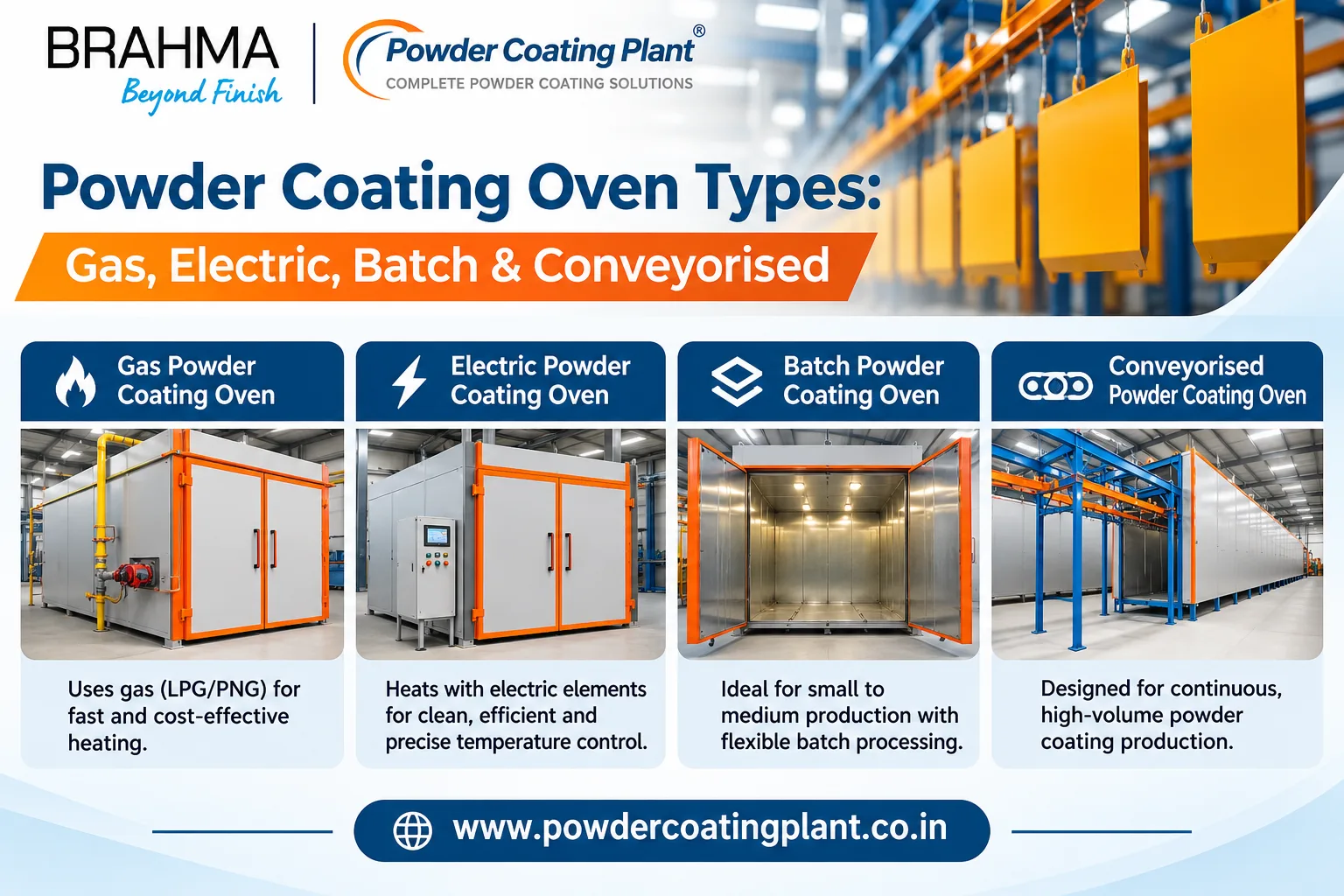
 A powder coating oven provides the controlled heat required to cure an applied powder coating and develop its final finish and performance. Choosing the right oven involves more than selecting gas or electric heating. Manufacturers also need to decide how components will move through production, how much thermal load the oven must handle and what production capacity the complete coating line must achieve.
The four configurations most industrial buyers compare are:
- gas-fired powder coating ovens;
- electric powder coating ovens;
- batch powder coating ovens;
- conveyorised powder coating ovens.
These categories overlap. A batch oven can use gas or electricity, and a conveyorized oven can also use either heating source.
The best choice therefore starts with production method first and energy source second.
Brahma Fabricon manufactures powder curing ovens in batch and conveyorized configurations with gas and electric heating options.
What Is a Powder Coating Oven?
A powder coating oven is an industrial heating system used after powder has been electrostatically applied to a component.
During curing, the applied powder melts, flows and undergoes the chemical reaction required to develop the finished coating.
The Powder Coating Institute explains that after powder application, coated parts enter a curing oven where heat causes the coating to chemically react and develop its final structure.
A typical process is:
Surface Preparation → Drying → Powder Application → Curing Oven → Cooling → Inspection
The oven is therefore a critical part of the overall powder coating process.
What Are the Main Types of Powder Coating Ovens?
Powder coating ovens can be classified in two ways.
By Production Method
- Batch oven
- Conveyorized or continuous oven
By Heating Source
- Gas-fired oven
- Electric oven
This distinction is important because buyers sometimes compare “gas oven vs batch oven,” although they describe different characteristics.
For example:
Gas-fired batch oven = batch production + gas heating
Electric batch oven = batch production + electric heating
Gas-fired conveyorized oven = continuous production + gas heating
Electric conveyorized oven = continuous production + electric heating
- Gas-Fired Powder Coating Oven
A gas-fired powder coating oven uses a gas burner to generate the heat required for curing.
Depending on the plant and available infrastructure, fuels may include:
- PNG;
- LPG;
- other suitable industrial gas systems.
Gas heating is frequently considered for larger industrial ovens and plants operating for extended periods.
Advantages of Gas-Fired Powder Coating Ovens
Potential advantages include:
- suitable for larger thermal loads;
- practical for continuous industrial production;
- comparatively fast heat generation;
- available for batch and conveyorized configurations.
Factors to Consider
Before selecting gas heating, evaluate:
- local fuel availability;
- delivered gas cost;
- burner capacity;
- gas-line infrastructure;
- ventilation;
- exhaust requirements;
- safety controls;
- operating hours.
Gas should not automatically be selected simply because the oven is large.
The actual economic comparison depends on fuel tariffs, electricity tariffs, production schedule and oven efficiency.
For a more detailed comparison, read Gas vs Electric Powder Coating Oven.
- Electric Powder Coating Oven
An electric powder coating oven uses electrical heating elements to generate process heat.
Electric ovens can be used for:
- batch production;
- smaller industrial parts;
- specialized applications;
- facilities where adequate electrical capacity is available.
Advantages of Electric Powder Coating Ovens
Electric systems can offer:
- straightforward heat-source installation where electrical capacity is already available;
- accurate temperature control;
- no on-site combustion from the heating elements;
- simplified fuel handling.
What Should Be Checked Before Selecting Electric Heating?
Confirm:
- available electrical load;
- transformer capacity;
- electricity tariff;
- oven size;
- loaded component mass;
- daily operating hours;
- expected production volume.
A small oven operating intermittently creates a very different energy requirement from a large conveyorized oven running several shifts.
Brahma Fabricon also provides electric powder coating oven solutions for industrial applications.
Gas vs Electric Powder Coating Oven
| Factor | Gas-Fired Oven | Electric Oven |
| Heating source | LPG/PNG or suitable gas | Electricity |
| Batch operation | Yes | Yes |
| Conveyorized operation | Yes | Possible |
| Combustion equipment | Required | Not required for resistance heating |
| Electrical demand | Lower for heating system | Can be substantial |
| Fuel infrastructure | Required | Not required |
| Best choice | Depends on load and fuel economics | Depends on load and electrical capacity |
There is no universal winner.
Calculate the expected operating cost using:
energy requirement + local tariff + operating hours + production load + maintenance
rather than comparing fuel prices alone.
- Batch Powder Coating Oven
A batch powder coating oven processes one load of components at a time.
Components may be placed on:
- racks;
- trolleys;
- carts;
- hanging frames;
- overhead rails.
Once the batch is loaded, the doors close and the components remain inside until the required heating and curing cycle is completed.
Batch ovens are widely used where products vary in size, weight or shape. Industrial oven guidance also identifies batch ovens as suitable for varied product loads and flexible production.
Best Applications for Batch Ovens
Batch powder coating ovens can be suitable for:
- job coating;
- control panels;
- metal furniture;
- machine components;
- fabricated products;
- mixed production;
- lower-to-medium output;
- frequent product changes.
Advantages of Batch Ovens
Key benefits include:
- production flexibility;
- ability to handle different product sizes;
- easier operation for separate jobs;
- compatibility with manual powder coating;
- suitable for changing production schedules.
Limitations
Compared with a properly sized continuous line, batch processing may involve:
- more manual handling;
- loading and unloading time;
- waiting between batches;
- lower continuous throughput.
The capacity should therefore be based on the complete batch cycle, not simply oven chamber size.
- Conveyorized Powder Coating Oven
A conveyorized powder coating oven is designed for continuous production.
Components enter the oven on a moving conveyor and travel through a defined heated path before exiting for cooling.
The production sequence may be:
Loading → Pre-treatment → Drying → Powder Booth → Conveyorized Curing Oven → Cooling → Unloading
Continuous ovens are commonly integrated with overhead conveyor systems and are designed around conveyor speed, component spacing and required heating time.
Best Applications for Conveyorized Ovens
They are generally most suitable for:
- repetitive components;
- medium-to-high production volume;
- continuous manufacturing;
- automated powder coating lines;
- products with predictable hanging arrangements.
Brahma Fabricon’s conveyorised powder coating plants integrate pre-treatment, powder application, curing and material handling into a continuous production system.
Batch vs Conveyorized Powder Coating Oven
| Selection Factor | Batch Oven | Conveyorized Oven |
| Production flow | Separate batches | Continuous |
| Production volume | Low to medium | Medium to high |
| Product variety | High flexibility | Best with repeatable parts |
| Material handling | Trolley/rack/manual | Conveyor |
| Automation | Low to medium | Medium to high |
| Component variation | Excellent | Depends on conveyor envelope |
| Factory space | Can be compact | Usually requires more line space |
| Production scheduling | Flexible | Continuous |
| Best for | Mixed jobs | Repetitive high-volume production |
How Does a Powder Coating Oven Cure the Coating?
A common mistake is to focus only on oven-air temperature.
What actually matters is whether the component reaches the metal temperature and dwell time specified by the powder manufacturer.
For example, if a powder supplier specifies a particular curing schedule, the timing should be evaluated according to that product’s instructions rather than assuming every powder requires the same temperature and time.
Heavy steel fabrications take longer to reach temperature than thin sheet-metal panels.
That means two components placed in the same oven can require different total oven cycles.
Why Component Thermal Mass Matters
Consider two parts:
Component A: Thin electrical enclosure panel
Component B: Heavy fabricated steel frame
Even if both enter the same oven at the same temperature, the heavy frame will generally require more energy and time to reach the required metal temperature.
This is why oven selection must consider:
- part dimensions;
- material;
- thickness;
- total batch weight;
- rack or trolley weight;
- production loading.
Airflow and Temperature Uniformity
A well-designed convection powder coating oven needs effective recirculation.
The objective is to distribute heated air across the loaded components rather than creating excessively hot and cold regions.
Important design considerations include:
- recirculation fan capacity;
- duct design;
- supply-air distribution;
- return-air path;
- component spacing;
- rack arrangement.
Poor loading can restrict airflow even when the oven itself is correctly designed.
How to Select the Right Powder Coating Oven
Start with the component rather than selecting a standard oven size.
Provide the oven manufacturer with:
Component Information
- maximum length;
- maximum width;
- maximum height;
- typical component size;
- maximum weight;
- substrate and thickness.
Production Information
- components per hour;
- components per shift;
- batch quantity;
- working hours per day;
- number of shifts.
Powder Information
- powder type;
- required cure schedule;
- expected coating specification.
Factory Information
- available floor space;
- electrical capacity;
- LPG or PNG availability;
- exhaust arrangements;
- material-handling method.
How Is Conveyorized Oven Size Determined?
For a continuous system, conveyor speed and required residence time strongly influence oven length.
At the planning stage, a simple relationship is:
Required heated travel length ≈ conveyor speed × required residence time
However, final oven design also needs to account for:
- component heat-up time;
- entry and exit arrangements;
- product spacing;
- thermal load;
- air circulation;
- powder cure specification.
It should therefore not be sized from this calculation alone.
Common Powder Coating Oven Selection Mistakes
Avoid these common mistakes:
- choosing an oven only by internal dimensions;
- assuming one cure temperature works for every powder;
- measuring cure time only from oven-air temperature;
- ignoring component thermal mass;
- selecting gas solely because it is assumed to be cheaper;
- selecting electric without checking connected load;
- overcrowding batch ovens;
- ignoring conveyor speed in continuous systems;
- providing insufficient airflow around components;
- comparing quotations with different usable chamber dimensions.
A reliable specification should describe the actual production load, not only the oven.
Powder Coating Oven Selection Checklist
Before requesting a quotation, confirm:
- Maximum component dimensions
- Typical component dimensions
- Component weight
- Parts per batch or hour
- Powder cure requirement
- Batch or continuous production
- Gas availability
- Electrical capacity
- Working hours per shift
- Material-handling method
- Factory dimensions
- Loading and unloading space
- Future production requirements
Frequently Asked Questions About Powder Coating Ovens
What is a powder coating oven?
A powder coating oven is an industrial heating system used to cure applied powder coating by heating the coated component according to the powder manufacturer’s specified cure schedule.
What types of powder coating ovens are available?
The main production configurations are batch and conveyorized ovens. Both can be designed with gas or electric heating depending on the application.
Is a gas or electric powder coating oven better?
Neither is universally better. Selection depends on component thermal load, operating hours, local gas and electricity costs, electrical capacity, fuel infrastructure and plant design.
What is a batch powder coating oven?
A batch oven processes separate loads of components. It is particularly useful for mixed products, changing batch sizes and flexible production.
What is a conveyorized powder coating oven?
A conveyorized oven cures components continuously while they move through the heated chamber on a conveyor. It is generally suited to repetitive, higher-volume production.
What temperature should a powder coating oven use?
The required temperature depends on the powder formulation. Follow the powder manufacturer’s technical data sheet and verify actual component temperature instead of relying only on the oven setpoint.
How do I choose the correct powder coating oven size?
Define the largest loaded component or rack, total thermal mass, production capacity, cure requirements and handling method before determining usable oven dimensions.