
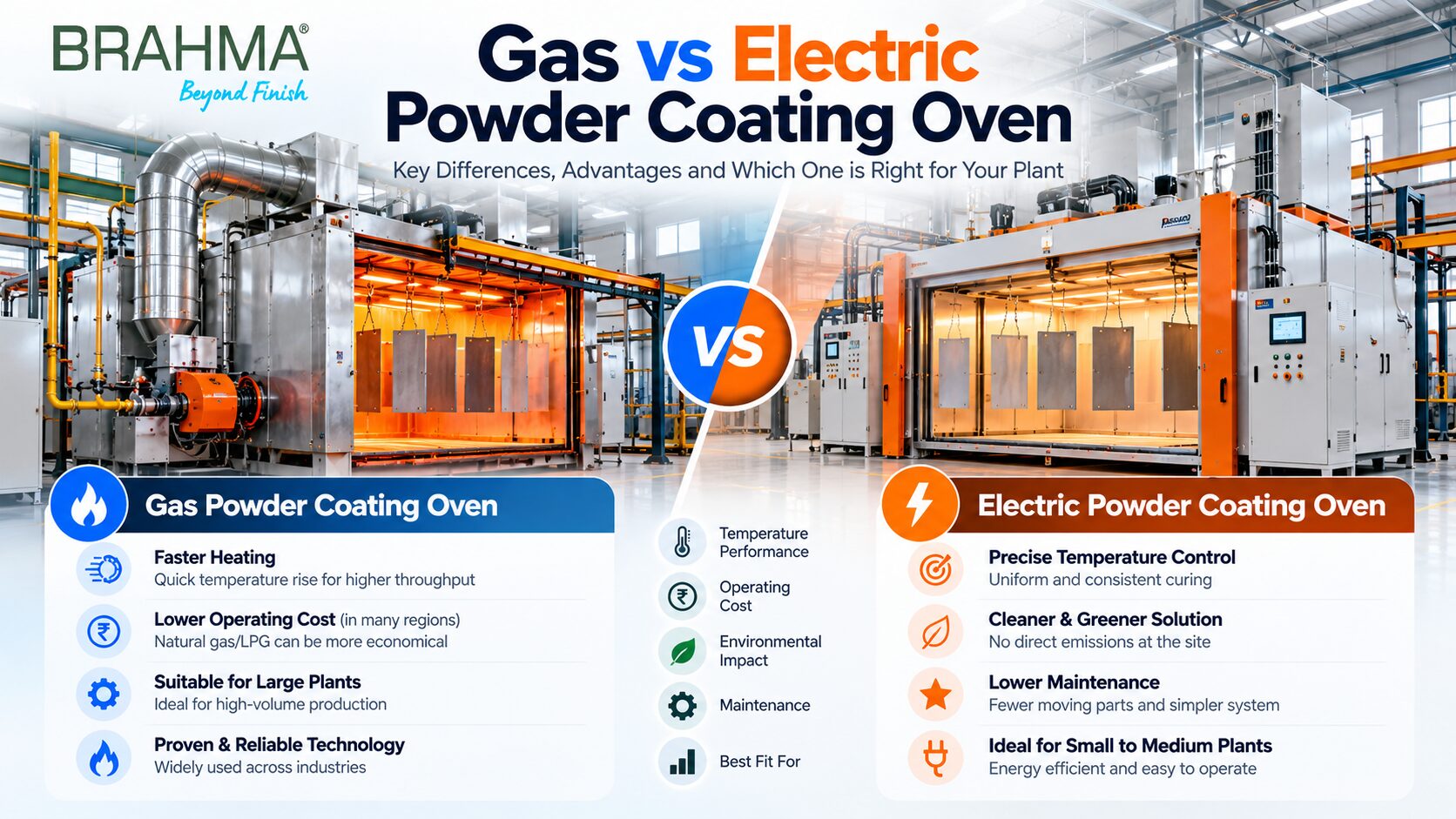
Choosing between a gas vs electric powder coating oven should not come down to a simple rule such as “gas is cheaper” or “electric gives better quality.” Both heating systems can produce properly cured powder coatings when the oven is engineered correctly.
The better choice depends on your component size and thermal mass, production volume, operating hours, local electricity and fuel prices, available electrical capacity, gas infrastructure, oven design, maintenance resources and long-term operating strategy.
For a small batch operation running only a few cycles each day, an electric oven may offer simpler installation and easier operation. For a large, continuously operated curing oven, gas may become economically attractive where reliable LPG or PNG is available at a competitive delivered energy cost.
The most important principle is:
Compare gas and electric ovens using the same component load, cure requirement and production target—not simply the purchase price of the oven.
Brahma Fabricon manufactures both gas- and electrically heated powder curing ovens, allowing the heating source to be selected around the actual production requirement rather than forcing every factory into one technology.
Gas vs Electric Powder Coating Oven: Quick Comparison
| Factor | Gas Powder Coating Oven | Electric Powder Coating Oven |
|---|---|---|
| Heat source | LPG, PNG or natural gas depending on availability | Electric resistance heaters or another specified electrical heating system |
| Installation | Requires suitable fuel supply, burner system and associated safety infrastructure | Requires sufficient electrical capacity and suitable electrical distribution |
| Operating cost | Can be attractive where fuel cost per useful unit of heat is low | Can be attractive where electricity is competitively priced or operating hours are limited |
| Large heat loads | Often practical where high burner capacity and reliable fuel supply are available | Practical where sufficient connected electrical load is available |
| Temperature control | Good with correctly designed modulating burner and airflow controls | Good with correctly sized heaters and modern temperature controls |
| Combustion products | Present in fuel-fired systems; handling depends on direct- or indirect-fired design | No onsite combustion products from the heating elements |
| Maintenance | Includes burner, gas train, combustion and related safety equipment | Typically focuses on heaters, contactors/SSRs, controls and circulation equipment |
| Utility constraint | Fuel availability, pressure and approved installation | Electrical connected load and tariff |
| Typical decision driver | High operating hours or large thermal demand where fuel economics are favorable | Simpler utility setup, lower-volume operation or sites favoring electrification |
Neither column should be interpreted as universally better. A properly engineered gas oven can deliver excellent temperature control, and an electric oven can support significant industrial production when the factory electrical infrastructure is designed for it.
What Does a Powder Coating Oven Actually Need to Do?
A powder coating oven provides the thermal energy required for applied thermosetting powder to melt, flow and chemically crosslink into its finished coating.
The important curing requirement is not simply the air temperature displayed on the oven controller.
The Powder Coating Institute explains that proper cure requires two conditions: the specified metal temperature and time. It also distinguishes between part bring-up time—the time required for the component to reach its cure temperature—and dwell time at that temperature.
This means the oven should be selected around:
| Input | Why It Matters |
|---|---|
| Powder cure schedule | Defines the required time/metal-temperature relationship |
| Component dimensions | Determines usable oven chamber or conveyor opening |
| Component material | Affects thermal behaviour |
| Part thickness | Influences heat-up time |
| Total loaded mass | Changes the amount of heat required per cycle |
| Fixtures/trolleys | They must also be heated and add thermal mass |
| Parts per batch/hour | Determines total thermal demand |
| Operating hours | Strongly influences energy economics |
This is why choosing between gas and electric heating should happen after the thermal load is defined.
How Does a Gas Powder Coating Oven Work?
A gas powder coating oven uses combustion to generate heat. Depending on the plant and local infrastructure, the fuel may be LPG, PNG or another approved gaseous fuel.
A typical convection system combines a burner or heat-generation section with recirculation fans that distribute heated air throughout the curing chamber.
Direct-Fired Gas Heating
In a direct-fired process, combustion products enter the process air that transfers heat to the workpiece.
The U.S. Department of Energy distinguishes direct fuel-fired heating from indirect heating on this basis: in direct systems, combustion gases can contact the material or process environment.
Direct heating can provide an efficient route for transferring combustion heat, but the complete system must be designed around the coating process, combustion controls, airflow and applicable safety requirements.
Indirect-Fired Gas Heating
In an indirect-fired system, combustion occurs separately and heat passes through a heat exchanger before the process air enters the curing chamber.
This keeps the combustion stream separate from the oven circulation air.
The trade-off is that additional heat-exchange hardware can add complexity and thermal losses. Whether direct or indirect heating is appropriate should therefore be determined from the application rather than assuming one method is always superior.
How Does an Electric Powder Coating Oven Work?
An electric powder coating oven commonly uses resistance heating elements to convert electrical energy into heat. Recirculation fans then distribute that heat through the chamber in a convection-style oven.
The U.S. Department of Energy describes resistance heating as an electric process-heating method in which electrical resistivity is used to generate thermal energy.
Electric ovens avoid a combustion burner and onsite fuel train. However, large curing systems may require substantial electrical capacity, so the factory’s available connected load should be confirmed before an electrically heated oven is selected.
For a deeper electric-specific buying guide, see Brahma Fabricon’s electric powder coating oven guide.
Gas vs Electric Powder Coating Oven Cost
There is no responsible universal answer to the question, “Which oven costs less?” because there are two different costs to compare:
initial installed cost and lifetime operating cost.
Initial Equipment and Installation Cost
An electric oven may have a simpler heating architecture because it does not need a gas burner, fuel train or combustion system. However, this does not automatically mean the complete installed project will be cheaper.
If the factory lacks adequate electrical capacity, an electric system may require:
transformer or sanctioned-load upgrades, larger cables, switchgear, panels and additional electrical distribution capacity.
A gas oven may require:
fuel piping, pressure-regulation equipment, burner controls, safety devices, exhaust arrangements and appropriate statutory or site approvals.
The correct comparison is therefore:
Total installed gas oven cost vs total installed electric oven cost at the same production capacity.
Operating Cost
Operating cost depends primarily on the actual energy consumed and the tariff paid for that energy.
A useful comparison is:
Electric hourly energy cost = average electrical demand × electricity tariff
and:
Gas hourly energy cost = fuel consumed per hour × delivered fuel price + auxiliary electricity
For a more technically comparable calculation, both fuel sources should be converted to the same energy basis and adjusted for the actual oven-system efficiency.
Compare Cost per Acceptable Part
An even better KPI is:
Oven energy cost per acceptable finished part = total oven energy cost ÷ accepted production
This accounts for production volume rather than simply comparing hourly consumption.
An oven with lower hourly fuel cost can still be economically poor if it runs partially loaded for long periods or if process problems create rework.
Why Local Energy Prices Matter More Than Generic Claims
The statement “gas is always cheaper than electricity” is too simplistic.
The result can change according to:
| Cost Variable | Impact |
|---|---|
| Electricity tariff | Directly changes electric operating cost |
| Demand charges | Can materially change the economics of high connected loads |
| PNG availability | Can make gas convenient where infrastructure already exists |
| LPG price and logistics | Affects delivered fuel cost |
| Operating hours | Determines how quickly operating-cost differences accumulate |
| Average oven loading | Changes energy consumed per finished component |
| Insulation and leakage | Affects both gas and electric ovens |
Request the supplier to calculate both options using your actual commercial electricity tariff and current fuel price rather than a national-average assumption.
Which Oven Is More Energy Efficient?
This question requires an important distinction between heater efficiency and complete oven-system efficiency.
Electric resistance heating converts electricity into heat at the point of use without combustion-stack losses. A gas system has combustion-related losses, with performance depending on burner design, excess air, exhaust and whether heating is direct or indirect.
But the oven’s real energy performance is also affected by:
insulation, door openings, conveyor openings, exhaust rate, air infiltration, recirculation, production scheduling, idle time, loading density and component thermal mass.
The U.S. Department of Energy’s Process Heating Sourcebook emphasizes that efficient industrial heating should be evaluated according to the energy required to produce acceptable output, while also reducing heat losses and improving production scheduling.
That leads to a better question:
Which oven uses less purchased energy per acceptable component under our real production conditions?
Gas vs Electric Oven Heat-Up Time
Gas ovens are often specified with high available heat input, which can make them attractive for large chambers and heavy thermal loads.
However, “gas heats faster” should not be treated as a universal rule.
An electric oven can also be designed with substantial heating capacity if the factory has sufficient electrical infrastructure.
Actual heat-up time depends on:
available heat input → oven losses → circulating airflow → loaded component mass → fixture mass → starting temperature
A more useful supplier question is:
“How long will this oven take to bring our specified production load to the required metal temperature?”
Ask for the assumptions behind the answer.
Gas vs Electric Temperature Control
Another oversimplification is that electric ovens are accurate while gas ovens are not.
Both can provide stable curing conditions when correctly engineered.
Electric Temperature Control
Electric heating can be controlled through staged elements, contactors, solid-state switching and PID-based temperature regulation. This can provide straightforward modulation without managing a combustion process.
Gas Temperature Control
Modern gas systems can use modulating burners, temperature sensors and controlled recirculation to maintain stable oven conditions.
The final temperature uniformity depends not only on the heater but also on:
air distribution, chamber geometry, product loading, recirculation design, sensor position and oven leakage.
Therefore, do not select an oven because a brochure states a precise controller accuracy.
Ask how temperature uniformity will be validated with the oven loaded.
Part-Metal Temperature Matters More Than the Heat Source
Whether an oven uses gas or electricity, the powder does not know which energy source created the heat.
What matters to cure is whether the component receives the required time and metal temperature specified by the powder manufacturer.
The Powder Coating Institute’s curing guidance specifically recommends verifying actual time and temperature and notes that oven cycle time combines the component’s bring-up time with the required dwell period.
This is particularly important when comparing parts with very different thermal mass.
| Component | Likely Thermal Behaviour |
|---|---|
| Thin sheet-metal panel | Generally reaches metal temperature relatively quickly |
| Electrical enclosure | Moderate thermal load depending on construction |
| Aluminium extrusion | Different heat response from equivalent steel section |
| Heavy fabricated frame | Longer bring-up time |
| Thick cast component | Potentially substantial thermal mass |
This is why a heat-source comparison without component information has limited engineering value.
Gas vs Electric Powder Coating Oven for Batch Production
Batch ovens process components in separate loads.
They are commonly considered where:
product sizes change frequently, production is intermittent, large components are loaded using trolleys, and continuous conveying is unnecessary.
When Electric Can Make Sense for Batch Ovens
Electric heating deserves consideration when the factory has adequate power, operating hours are moderate, production is intermittent or a gas connection would add disproportionate installation complexity.
When Gas Can Make Sense for Batch Ovens
Gas deserves consideration when batches are large or heavy, the oven runs for long periods, fuel is reliably available and its delivered heat economics are favorable.
The correct selection should include the energy consumed during:
heat-up + loaded cure + unloaded waiting/idle time.
Frequent door opening can materially affect either system.
Gas vs Electric Powder Coating Oven for Conveyorised Lines
A conveyorised oven continuously processes components moving through a heated path.
The core relationship is:
oven residence time = effective heated travel length ÷ conveyor speed
The heat source then needs to provide enough thermal energy to bring the continuous production load to its required cure condition while compensating for:
entry/exit losses, exhaust, wall losses and incoming cold material.
Large continuous production can create substantial heat demand, making energy cost particularly important.
Manufacturers planning the complete finishing system can review Brahma Fabricon’s powder coating plant configurations alongside the oven itself.
Gas vs Electric Oven Maintenance
Maintenance should be included in total cost of ownership rather than considered only after installation.
| Maintenance Area | Gas Oven | Electric Oven |
|---|---|---|
| Heating equipment | Burner and associated combustion equipment | Heating elements and electrical switching/control components |
| Fuel system | Gas train, valves and related components | Not applicable |
| Air circulation | Fans, motors and ducts | Fans, motors and ducts |
| Temperature sensors | Required | Required |
| Insulation/doors | Required | Required |
| Control panel | Required | Required |
Electric heating removes the burner and combustion fuel train, which can simplify some maintenance activities.
However, large electric ovens can have many heating elements and high-current electrical components, so “electric = maintenance-free” would also be incorrect.
Gas vs Electric Oven Safety
Industrial ovens should be designed, installed and operated according to the safety requirements applicable to the plant location and process.
Gas heating introduces fuel-system and combustion-safety requirements.
Electric heating introduces high electrical loads and corresponding protection, isolation and electrical-safety requirements.
NFPA 86, Standard for Ovens and Furnaces, is an established technical reference addressing fire and explosion hazards associated with industrial ovens and furnaces.
The applicable Indian statutory, fire, electrical, fuel and factory requirements should be confirmed by qualified professionals for the actual installation.
Onsite Emissions: Gas vs Electric
A gas-fired oven produces combustion gases at the factory because fuel is burned onsite.
An electrically heated resistance oven has no onsite combustion emissions from its heating elements.
However, this does not mean electricity has zero lifecycle carbon impact. Its broader emissions depend on how the electricity is generated.
This distinction is increasingly relevant to manufacturers evaluating:
corporate decarbonization targets, renewable electricity, future electrification, onsite solar or other energy strategies.
The U.S. Department of Energy identifies industrial electrification as one route for replacing fossil-fuel-based process heat, while also noting that different electric technologies and industrial applications have different performance characteristics.
Direct-Fired vs Indirect-Fired Gas Oven
If gas is selected, buyers should ask another important question:
Is the oven direct-fired or indirect-fired?
| Factor | Direct-Fired Gas | Indirect-Fired Gas |
|---|---|---|
| Combustion products | Enter process heating air | Separated through heat exchanger |
| Heat-transfer path | More direct | Additional heat-exchange step |
| Equipment | Combustion and circulation system | Includes heat exchanger arrangement |
| Selection | Application-specific | Application-specific |
The Department of Energy’s process-heating guidance recognizes both direct and indirect fuel-based heating arrangements.
Do not assume that all quotations describing a “gas oven” represent the same heating architecture.
Which Is Better for Heavy Fabrication?
Heavy fabrications can require significant energy because the oven must heat a large mass of steel plus racks or fixtures.
For these applications, evaluate:
maximum individual component weight, total batch weight, steel thickness, required production cycles/day, gas availability and available electrical capacity.
Where very high electrical capacity would require a major infrastructure upgrade, gas may deserve serious consideration.
Where low-carbon electricity is available or fuel infrastructure is impractical, electric heating may still make sense.
There is no substitute for a thermal-load calculation.
Which Is Better for Sheet Metal and Small Components?
Thin sheet-metal components generally reach cure temperature faster than heavy structures, reducing the heat needed per individual part.
This can make electric batch systems attractive for certain:
job shops, electrical panels, prototypes, brackets, short-run fabrication and smaller production facilities.
But a large-volume sheet-metal factory operating continuously can still create enough heating demand for gas economics to become attractive.
Production duty matters as much as component thickness.
Which Is Better for Intermittent Production?
A factory operating its oven only occasionally should pay particular attention to fixed infrastructure cost and warm-up/idle losses.
If gas infrastructure must be installed exclusively for an oven that operates only a few hours each week, the operating-cost advantage may take a long time to recover.
An electric system can be easier to justify where the existing electrical supply can support it without substantial upgrades.
For intermittent manufacturing, calculate the actual annual operating hours before making the investment decision.
Which Is Better for High-Volume Production?
For continuous high-volume production, small differences in energy cost per hour can accumulate into significant annual expenditure.
That makes the comparison more sensitive to:
local gas tariff, electricity tariff, load factor, oven insulation, exhaust losses, line utilization and production scheduling.
A high-volume factory should request a formal annual energy model rather than relying on a generic “gas saves X%” claim.
How Insulation Changes the Gas vs Electric Calculation
Poor insulation wastes purchased energy regardless of the heat source.
Heat can escape through:
wall panels, roof panels, doors, seals, conveyor openings and poorly insulated joints.
The Department of Energy’s industrial process-heating resources specifically identify reducing furnace heat loss and air infiltration as important efficiency opportunities.
Before spending more money changing fuel source, manufacturers should therefore ask whether the existing oven can be improved through:
better insulation, improved door seals, reduced opening losses, optimized recirculation and better production loading.
A DOE Better Plants example reported a substantial reduction in gas consumption after improving insulation and reducing exhaust losses in an industrial curing oven, illustrating how oven design can sometimes matter as much as fuel selection.
How Production Loading Affects Oven Efficiency
An oven uses energy to heat:
the parts + fixtures + oven structure + incoming replacement air + heat lost through the enclosure.
If a large oven regularly processes only a few small components, energy cost per component can become high regardless of whether it uses gas or electricity.
This makes loading density an important efficiency variable.
Track:
energy consumed per accepted part or per square metre coated
rather than judging performance from the oven’s hourly energy input alone.
Can Low-Cure Powder Change the Decision?
Yes.
A powder requiring a lower part-metal temperature or shorter dwell can reduce thermal demand regardless of whether the oven uses gas or electricity.
The Powder Coating Institute’s low-bake powder guidance notes that lower curing temperatures can reduce the energy required per component and shorten oven dwell.
However, powder chemistry should still be selected according to:
substrate, durability, appearance, weathering, chemical resistance and customer specification.
Do not change powder solely to reduce oven energy unless the coating still meets the product’s performance requirements.
What About Electric Infrared?
Electric infrared should be treated as a separate technology from a conventional electrically heated convection oven.
Infrared transfers radiant energy toward the workpiece and can provide fast heating in suitable applications.
Its effectiveness depends strongly on:
part geometry, line-of-sight exposure, surface characteristics, component mass and process arrangement.
For complex three-dimensional parts, conventional convection or a hybrid system may provide more uniform heating.
This article’s primary gas vs electric comparison therefore refers mainly to gas-fired convection vs electric resistance convection.
Gas vs Electric Powder Coating Oven: Total Cost of Ownership
Purchase price alone is a poor decision metric for equipment expected to operate for many years.
A better comparison is:
Total cost of ownership = equipment + installation + utility infrastructure + energy + maintenance + downtime + compliance + major replacement parts
Calculate this over a realistic ownership period such as five or ten years using your company’s normal capital-investment methodology.
Gas Oven TCO Should Include
Include the oven, burner, fuel train, piping, safety systems, installation, annual fuel consumption, auxiliary electricity, maintenance and applicable inspection/compliance costs.
Electric Oven TCO Should Include
Include the oven, heating elements, electrical panels, transformer or sanctioned-load upgrades where necessary, cabling, annual electricity consumption and electrical maintenance.
Simple Payback for the More Expensive Option
If one option requires more initial investment but is expected to reduce annual operating cost:
Simple payback = additional installed investment ÷ expected annual operating saving
This calculation should use conservative utilization assumptions rather than assuming the oven will operate at full production every working day.
Gas vs Electric Oven Selection Matrix
| Factory Situation | Option Worth Investigating First |
|---|---|
| Small/intermittent batch production with adequate power | Electric |
| Large continuous heat load with economical gas available | Gas |
| No practical fuel supply | Electric |
| Insufficient electrical capacity for required heater load | Gas or electrical-infrastructure upgrade comparison |
| Corporate onsite-combustion reduction target | Electric |
| Large heavy components | Compare thermal load and utility infrastructure carefully |
| Small lightweight components | Electric can be attractive; validate annual cost |
| Very high annual operating hours | Choose based on delivered useful-heat cost and TCO |
| Existing PNG infrastructure | Gas deserves strong consideration |
| Strong electrical infrastructure and renewable power strategy | Electric deserves strong consideration |
This table is a starting point, not a substitute for a project-specific energy calculation.
How to Choose Between Gas and Electric Powder Coating Ovens
- Get the powder cure schedule. Use the powder manufacturer’s technical data rather than assuming one standard curing temperature.
- Define the production load. Record component dimensions, material, thickness, weight, fixtures and parts per batch or hour.
- Calculate the required heat duty. Include the actual production load and process losses.
- Check available utilities. Confirm electrical capacity, electricity tariff, fuel availability, pressure and delivered fuel price.
- Request both operating-cost models. Compare gas and electric at the same production capacity and duty cycle.
- Compare total installed cost. Include infrastructure upgrades rather than oven price alone.
- Compare lifecycle cost. Include energy, maintenance, downtime and realistic annual utilization.
- Define performance acceptance criteria. Require temperature profiling and confirmation using representative production loads.
Questions to Ask a Powder Coating Oven Manufacturer
| Question | Why It Matters |
|---|---|
| How was the oven heat load calculated? | Confirms whether sizing is based on your actual products |
| What maximum loaded mass was assumed? | Prevents sizing from dimensions alone |
| What is the expected connected electrical load? | Important for electric and auxiliary gas-system equipment |
| What is the estimated gas consumption? | Needed for gas operating-cost calculation |
| Is the gas system direct or indirect fired? | Clarifies heating architecture |
| What insulation construction is proposed? | Affects heat loss |
| How is air circulated? | Affects temperature uniformity |
| How will temperature uniformity be verified? | Supports process validation |
| How will part-metal temperature be measured? | Confirms the actual cure rather than air temperature alone |
| What maintenance is required? | Supports lifecycle-cost comparison |
| What utilities must the customer provide? | Prevents installation surprises |
| What is included in commissioning? | Ensures performance testing is defined |
Gas vs Electric Oven: Common Buying Mistakes
Choosing Gas Only Because Someone Said It Is Cheaper
Calculate your own fuel economics. A low fuel tariff can favor gas, but infrastructure and operating hours matter.
Choosing Electric Only Because Installation Looks Simpler
A large oven may require a substantial electrical connection. Confirm the complete connected load before ordering.
Comparing Different Oven Capacities
A smaller electric oven and a larger gas oven do not provide a valid cost comparison.
Compare equivalent:
usable dimensions + loaded mass + throughput + cure requirement.
Ignoring Fixtures and Trolleys
The oven must heat these along with the components.
Using Maximum Oven Temperature as the Main Specification
The ability to reach a high air temperature says little about real production performance.
Cure uniformity and load handling matter more.
Ignoring Idle Energy
An oven running hot between production batches continues to consume energy.
This can materially change economics in low-utilization plants.
Ignoring Maintenance
Energy cost is only one part of ownership cost.
Assuming Electric Means Zero Carbon
Electric eliminates onsite combustion, but lifecycle emissions depend on electricity generation.
Information to Send for a Gas vs Electric Oven Comparison
| Information | What to Provide |
|---|---|
| Largest component | Length × width × height |
| Typical component | Dimensions and product mix |
| Part weight | Typical and maximum |
| Material/thickness | Steel, aluminium, etc. |
| Batch load | Total parts + fixture/trolley mass |
| Production | Parts/batch, hour or shift |
| Powder | Technical data sheet and cure schedule |
| Electricity | Available load and actual tariff |
| Gas | PNG/LPG availability and current delivered rate |
| Operating schedule | Hours/day and days/year |
| Loading arrangement | Trolley, rack or conveyor |
| Factory layout | Available space and utility locations |
Providing this information allows both heating options to be compared on the same engineering basis.
Frequently Asked Questions About Gas vs Electric Powder Coating Ovens
Is a gas or electric powder coating oven better?
Neither is universally better. Electric ovens can offer a simpler heating system and avoid onsite combustion, while gas can be economically attractive for large or heavily utilized ovens where fuel is competitively priced. Compare both against the same component load and production schedule.
Is a gas powder coating oven cheaper to run than an electric oven?
It can be, but not in every factory. Operating cost depends on the local electricity tariff, gas or LPG price, oven efficiency, production load and annual operating hours. Calculate the cost per accepted part rather than relying on a generic percentage-saving claim.
Is an electric powder coating oven cheaper to install?
Electric heating can simplify the heating-system installation because no gas train is required, but a large oven may require expensive upgrades to the factory’s electrical capacity. The complete installed cost should include all required utility infrastructure.
Does a gas oven heat faster than an electric oven?
Gas ovens can be designed with high heat input, which is useful for large loads, but heat-up speed depends on the installed heating capacity, oven losses, airflow and component mass. A properly sized electric oven can also provide high heat input if sufficient electrical capacity is available.
Which oven gives better temperature uniformity?
Either system can provide good temperature uniformity when correctly engineered. Chamber design, recirculation airflow, loading pattern, insulation and control strategy are as important as the heating source.
Which oven is better for a small powder coating business?
An electric batch oven is often worth evaluating where production is intermittent and adequate electrical capacity already exists. However, the final choice should be based on component size, operating hours and local utility costs.
Which oven is better for high-volume manufacturing?
High-volume manufacturers should compare annual energy consumption and total ownership cost carefully. Gas may be economically attractive where reliable, competitively priced fuel is available, but electric can also be viable where power infrastructure and electricity economics are favorable.
Can both gas and electric ovens cure the same powder?
Yes, provided the oven brings the component to the time and metal-temperature conditions specified by the powder manufacturer. The powder’s cure requirement is based on the component’s thermal history rather than whether the heat originated from gas or electric resistance elements.
What temperature should a powder coating oven operate at?
There is no single temperature suitable for every powder. Use the powder manufacturer’s technical data sheet and verify the actual component temperature and dwell time. Different formulations can have different cure schedules.
How do I calculate powder coating oven operating cost?
Calculate the actual electricity or fuel consumed during representative production, multiply it by your current tariff and divide by accepted output. Include auxiliary fans, burners, controls and idle energy where relevant.
Should I choose LPG or PNG for a gas oven?
Compare availability, delivered energy cost, storage/infrastructure, supply reliability and the burner’s approved fuel specification. Where PNG infrastructure is available it can simplify continuous fuel supply, while LPG may be practical where a gas network is unavailable.
Can an existing gas powder coating oven be converted to electric?
Conversion can sometimes be technically possible, but it should be treated as an engineering project. The heater capacity, airflow, electrical infrastructure, controls, oven structure and required production load all need to be reassessed before conversion.
Conclusion
The gas vs electric powder coating oven decision should be based on the complete production and energy picture—not on one simple claim about fuel price or temperature control.
Gas heating deserves serious consideration when the oven has a large thermal demand, operates for long hours and has access to reliable fuel with favorable economics.
Electric heating deserves serious consideration when the factory has sufficient electrical capacity, values simpler non-combustion heating, operates at lower or intermittent production, or is pursuing an electrification strategy.
In either case, coating quality ultimately depends on the same principle:
the component must achieve the powder manufacturer’s required metal temperature for the required time.
The best purchasing process therefore begins with the product and cure requirement, calculates the real heat demand, evaluates available utilities and then compares total installed cost + annual energy + maintenance + lifecycle cost.
Brahma Fabricon manufactures custom gas and electric powder curing ovens for batch and conveyorised production. Manufacturers planning a complete finishing line can also explore Brahma Fabricon’s powder coating plant solutions or contact Brahma Fabricon with component dimensions, production targets, available utilities and curing requirements for a project-specific oven configuration.