
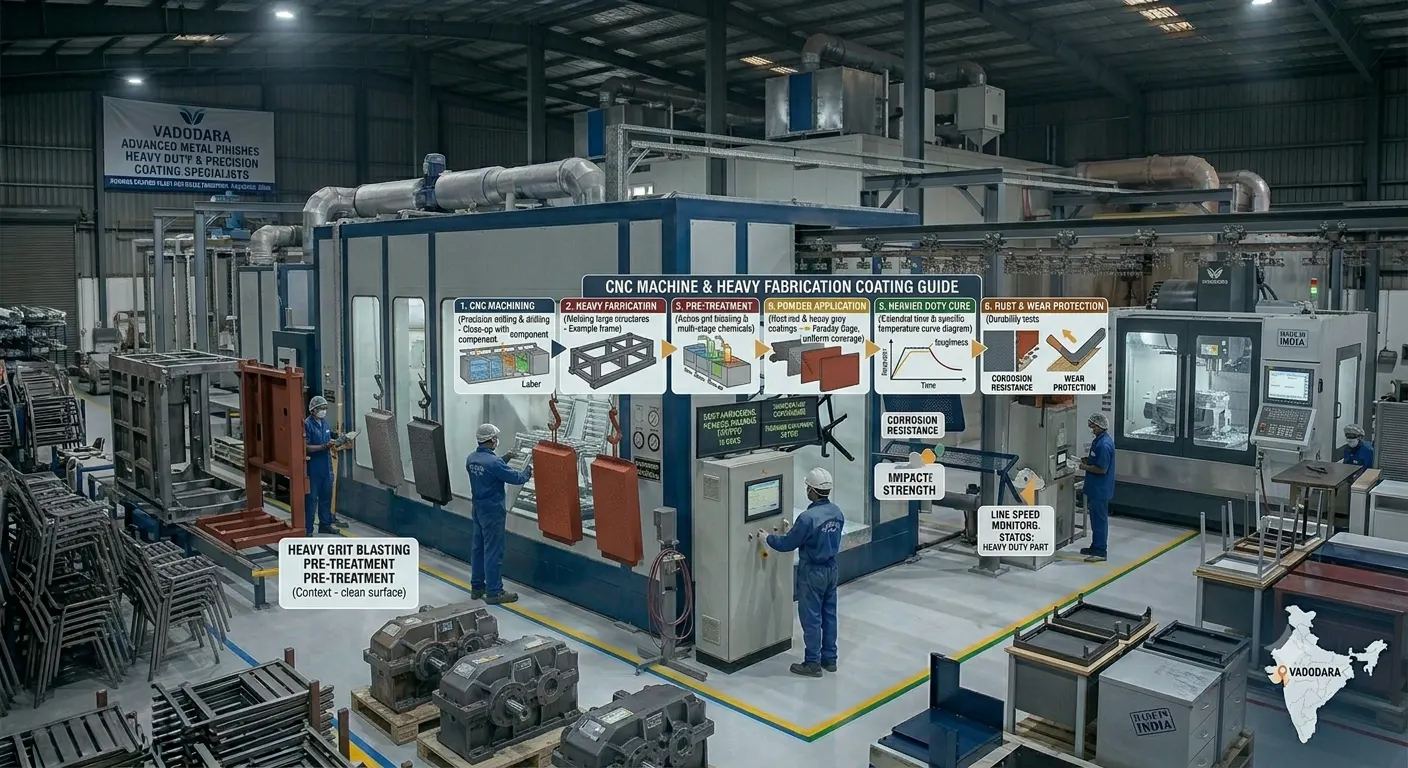
CNC machine powder coating is a durable surface finishing process that protects fabricated metal parts, machine components, and industrial equipment from corrosion, abrasion, chemicals, and environmental damage. Using electrostatically applied powder cured at high temperatures, manufacturers achieve a long-lasting, attractive finish that extends equipment life while reducing maintenance costs.
What Is CNC Machine Powder Coating?
CNC machine powder coating is an industrial finishing process used to apply a durable protective coating to machined components, fabricated structures, welded assemblies, sheet metal parts, and heavy engineering products.
Unlike traditional liquid paint, powder coating creates a thicker, harder, and more uniform finish that resists:
- Rust
- Corrosion
- Abrasion
- Impact
- Chemicals
- Moisture
- UV exposure
For manufacturers of CNC-machined parts and fabricated equipment, powder coating improves both product durability and visual appeal.
Why Heavy Fabrication Components Need Powder Coating
Heavy fabrication products often operate in demanding environments where exposure to moisture, chemicals, dust, and mechanical wear can reduce service life.
Powder coating provides an additional protective barrier that helps maintain structural integrity and surface quality over many years.
Key Benefits
Corrosion Protection
Industrial equipment is frequently exposed to:
- Rain
- Humidity
- Coastal conditions
- Industrial chemicals
Powder coating minimizes oxidation and rust formation.
Wear Resistance
Machine frames, fabrication assemblies, and industrial equipment experience continuous mechanical contact.
Powder coating improves resistance to scratches, abrasion, and impact.
Chemical Resistance
Industrial environments expose components to:
- Oils
- Coolants
- Cleaning chemicals
- Solvents
Modern powder coatings provide excellent chemical resistance for long-term protection.
Enhanced Appearance
Manufacturers can offer finishes such as:
- Matte
- Gloss
- Semi-gloss
- Textured
- Metallic
- Wrinkle finish
These finishes improve both product aesthetics and perceived quality.
CNC Machine Parts Commonly Powder Coated
Powder coating is suitable for a wide range of fabricated and machined components.
CNC Machine Components
- Machine frames
- Base structures
- Control cabinets
- Sheet metal covers
- Guard panels
- Tool storage units
Heavy Fabrication Products
- Steel structures
- Welded assemblies
- Conveyor frames
- Material handling equipment
- Industrial racks
- Fabricated enclosures
OEM Equipment
- Generator frames
- Compressor housings
- Agricultural machinery
- Construction equipment
- Electrical panels
- Industrial cabinets
Powder Coating Process for Heavy Fabrication
Step 1: Surface Preparation
Proper surface preparation ensures excellent coating adhesion.
Typical pretreatment stages include:
- Degreasing
- Rust removal
- Phosphating
- Water rinsing
- Drying
For fabricated structures, abrasive blasting may also be used before chemical pretreatment.
Step 2: Drying
All moisture must be removed before powder application.
Residual moisture can lead to coating defects.
Step 3: Electrostatic Powder Application
Electrostatic spray guns apply powder uniformly to the metal surface.
Modern powder coating booths improve transfer efficiency while minimizing overspray.
Step 4: Curing
Components enter a curing oven where the powder melts and chemically cross-links.
Typical curing conditions:
- Temperature: 180–220°C
- Time: 15–25 minutes
This creates a strong, durable finish.
Step 5: Inspection
Finished components undergo:
- Coating thickness measurement
- Adhesion testing
- Gloss testing
- Visual inspection
- Impact resistance testing
Powder Coating vs Liquid Paint
| Feature | Powder Coating | Liquid Paint |
|---|---|---|
| Corrosion Resistance | Excellent | Good |
| Scratch Resistance | Excellent | Moderate |
| Impact Resistance | High | Medium |
| Chemical Resistance | High | Moderate |
| Finish Uniformity | Excellent | Good |
| VOC Emissions | Very Low | Higher |
| Material Utilization | High (with recovery) | Lower |
| Service Life | Long | Moderate |
For industrial machinery and fabricated steel products, powder coating generally provides a more durable and cost-effective finish.
Benefits of Powder Coating for Industrial Equipment
Longer Equipment Life
A protective coating reduces corrosion-related failures and extends the operational life of fabricated components.
Reduced Maintenance
Powder-coated surfaces require less frequent repainting and maintenance.
Improved Product Quality
Consistent finishes enhance product appearance and customer satisfaction.
Better Environmental Performance
Powder coating contains minimal volatile organic compounds (VOCs) and allows recovery of unused powder.
Cost Savings
Although the initial investment may be higher than traditional painting, powder coating reduces lifecycle maintenance and replacement costs.
Choosing the Right Powder Coating Plant for Heavy Fabrication
Selecting the correct powder coating system depends on several factors.
Product Size
Large fabricated structures require appropriately sized booths and curing ovens.
Production Volume
High-volume operations benefit from conveyorized powder coating lines.
Coating Requirements
Different applications may require specific powder formulations and curing cycles.
Automation Level
Automatic systems improve consistency and productivity while reducing labor requirements.
Future Expansion
Scalable systems support increasing production demands.
Industry Applications
Powder coating is widely used across multiple industries.
CNC Machine Manufacturers
Protect machine bases, covers, and fabricated assemblies.
Heavy Engineering
Coat fabricated steel structures and industrial equipment.
Material Handling Equipment
Enhance durability of conveyors, racks, and lifting systems.
Construction Machinery
Protect frames and structural components.
Agricultural Equipment
Improve resistance to harsh outdoor environments.
Electrical Equipment
Provide durable finishes for control panels, cabinets, and enclosures.
Quality Standards & Testing
High-quality powder-coated components should be evaluated using recognized testing methods.
Typical quality checks include:
- Dry film thickness measurement
- Adhesion test
- Impact resistance test
- Salt spray resistance
- Gloss level measurement
- Cure confirmation
- Visual inspection
Following consistent quality procedures helps ensure reliable long-term performance.
Why Manufacturers Choose Brahma Fabricon
Brahma Fabricon designs advanced powder coating plants for CNC machine manufacturers and heavy fabrication industries.
Our Solutions Include
- Automatic powder coating plants
- Conveyorized powder coating lines
- Powder coating booths
- Pretreatment systems
- Curing ovens
- Powder recovery systems
- Turnkey finishing solutions
Why Partner With Us?
- Customized plant layouts
- Energy-efficient equipment
- High powder recovery systems
- Robust engineering
- Reliable after-sales support
- Complete installation and commissioning services
Our systems are designed to improve coating quality, reduce operating costs, and increase production efficiency for demanding industrial applications.
Quick Answers:
Why is powder coating used on CNC machine components?
Powder coating provides superior corrosion protection, impact resistance, and durability compared to conventional liquid paint.
What industries use powder coating for heavy fabrication?
Heavy engineering, automotive, agriculture, construction, material handling, electrical equipment, and OEM manufacturing.
Is powder coating suitable for fabricated steel?
Yes. Proper surface preparation combined with high-quality powder coating offers excellent long-term protection for fabricated steel components.
What equipment is required for powder coating heavy fabrication?
A complete system typically includes a pretreatment plant, drying oven, powder coating booth, electrostatic spray equipment, curing oven, powder recovery system, and material handling conveyor.
Frequently Asked Questions
1. What is CNC machine powder coating?
It is an electrostatic powder coating process used to protect CNC machine components and fabricated metal parts from corrosion and wear.
2. Can large fabricated structures be powder coated?
Yes. With appropriately sized booths and curing ovens, large fabricated assemblies can be coated effectively.
3. Is powder coating better than paint for industrial equipment?
In most industrial applications, powder coating provides superior durability, corrosion resistance, and finish quality.
4. What metals can be powder coated?
Steel, aluminum, stainless steel, galvanized steel, and many other conductive metals.
5. How long does powder coating last?
With proper surface preparation and application, powder-coated finishes can provide many years of reliable protection.
6. Does powder coating resist chemicals?
Yes. Many powder coating formulations offer excellent resistance to oils, solvents, cleaning agents, and industrial chemicals.
7. What industries benefit from heavy fabrication powder coating?
Heavy engineering, OEM manufacturing, construction equipment, agriculture, electrical equipment, and material handling industries.
8. What is the curing temperature for powder coating?
Most industrial powder coatings cure between 180°C and 220°C depending on the powder formulation.
9. Can powder coating improve product appearance?
Yes. Powder coating provides uniform, attractive finishes in a wide range of colors and textures.
10. How do I select the right powder coating plant?
Evaluate production volume, product size, automation requirements, quality standards, and future expansion plans before selecting a system.
Conclusion
For CNC machine manufacturers and heavy fabrication companies, powder coating is one of the most effective surface finishing technologies available. It delivers long-lasting protection against rust, abrasion, chemicals, and harsh industrial environments while improving product appearance and reducing maintenance requirements. Investing in a well-designed powder coating plant with efficient pretreatment, application, and curing systems helps manufacturers produce durable, high-quality products that meet customer expectations and lower lifecycle costs.
Request a Technical Consultation
Planning a powder coating solution for CNC machines or heavy fabrication products?
Contact Brahma Fabricon for:
- Technical consultation
- Custom powder coating plant
- Conveyorized powder coating lines
- Powder coating booths and curing ovens
- Pretreatment system recommendations
- Turnkey installation and commissioning
- Detailed project quotations
Our engineering experts will recommend the most suitable powder coating solution based on your component size, production volume, and quality requirements.