
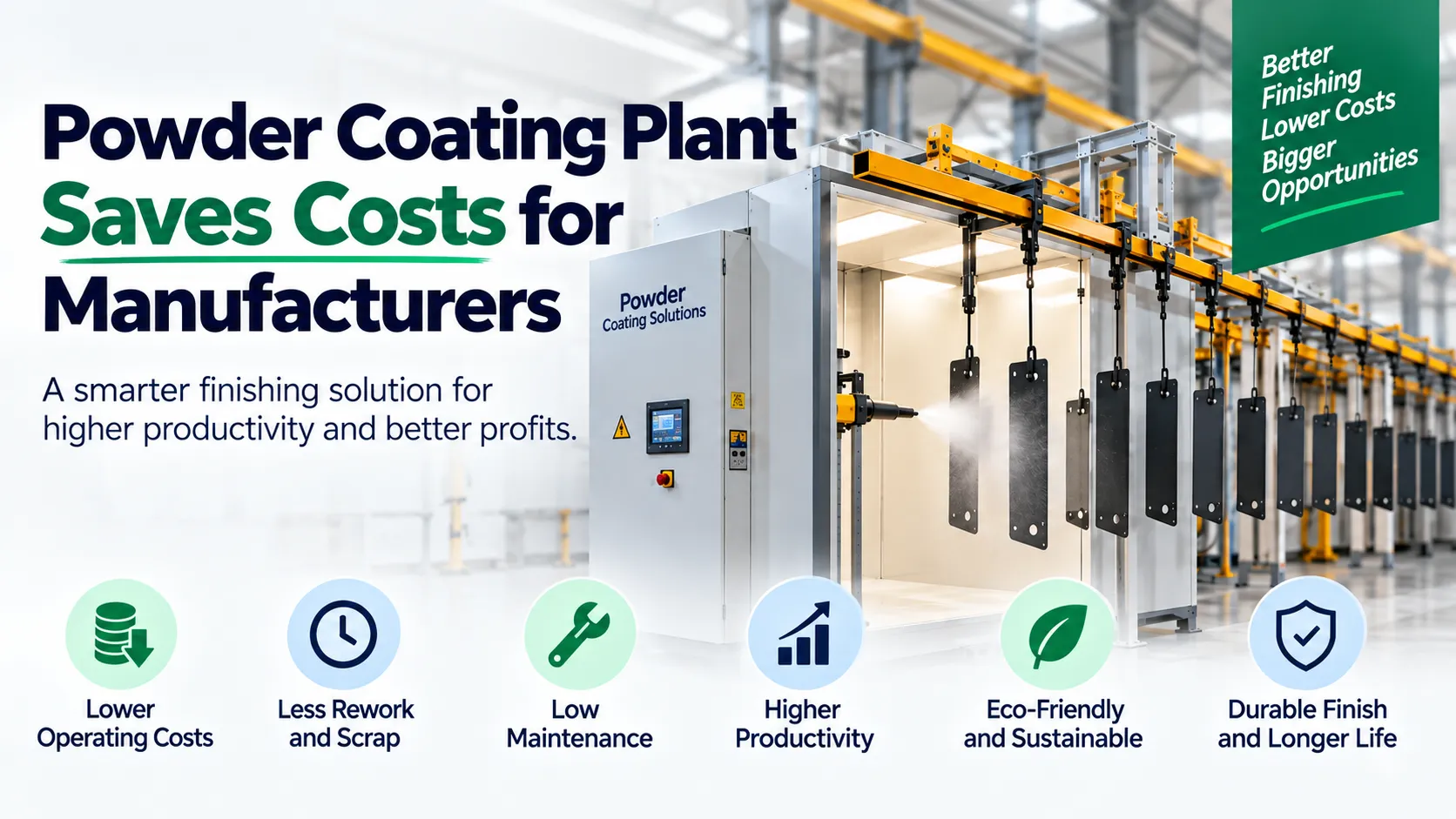
For a manufacturer, the financial benefit of a powder coating plant should not be measured by the price of the machine alone. A more useful measure is cost per acceptable finished component.
A correctly specified powder coating plant can reduce manufacturing costs by improving powder utilization, reducing manual handling, lowering rework, increasing throughput and bringing finishing operations under tighter process control. For companies that currently outsource coating, an in-house plant may also reduce transport, vendor handling and production-waiting costs.
But none of these savings are automatic.
A plant that is oversized, poorly insulated, badly maintained or operated below its intended capacity can cost more than expected. Manufacturers in Vadodara should therefore compare total cost of ownership and cost per finished part, rather than choosing a powder coating plant solely on purchase price.
The Powder Coating Institute (PCI) identifies three major economic advantages of powder coating over traditional liquid spray systems: material savings, lower operating expenses and reduced environmental-compliance costs. PCI also notes that appropriate recovery systems can push overall powder material utilization above 95%.
For manufacturers evaluating a complete system, Brahma Fabricon’s powder coating plant range shows the major equipment combinations used in manual, batch and conveyorised finishing operations.
Where does a powder coating plant save money?
| Cost area | How savings can occur |
|---|---|
| Powder material | Recovering suitable overspray reduces material loss |
| Labour | Automation reduces repetitive spraying and material handling |
| Rework | Controlled pretreatment, application and curing improve process consistency |
| Production | Continuous lines can lower processing time per component |
| Energy | Correct oven sizing, insulation and process control prevent unnecessary heat loss |
| Outsourcing | In-house coating can remove supplier margins, transport and waiting time |
| Inventory/WIP | Shorter internal processing can reduce components waiting for external finishing |
| Waste | Reclaimable powder can reduce coating-material disposal |
| Quality | Better process repeatability can lower reject and warranty-related costs |
| Downtime | Preventive maintenance and accessible local service can reduce disruption |
| Cost visibility | Internal coating provides better measurement of powder, energy and labour per batch |
The amount saved will depend on your actual production volume, part geometry, colour-change frequency, coating specification, plant utilization and existing finishing cost.
What does “saving cost” really mean in powder coating?
A lower powder coating cost does not necessarily mean buying the least expensive plant.
A useful manufacturing calculation is:
Coating cost per acceptable part = material + chemicals + energy + labour + consumables + maintenance + rework + waste + downtime + capital cost allocation
The important word is acceptable.
If a low-cost process coats 1,000 parts but 80 require stripping and recoating, its true unit cost is very different from a process that produces the same 1,000 parts with substantially less rework.
This is why manufacturers should evaluate the whole finishing line-from the pre-treatment system through application, powder recovery and the curing oven rather than judging one machine in isolation.
1. Recovering overspray can reduce powder consumption
Powder is one of the most visible recurring costs in a coating operation.
During electrostatic application, not every powder particle reaches the component on its first pass. The difference with a properly designed recoverable powder system is that suitable overspray can be captured, separated and returned to the process where the application allows reclaim.
PCI states that powder systems using proper application equipment and recovery methods can achieve 95–98% material utilization. Its coatings comparison guidance similarly reports that overall utilization can exceed 95% because overspray can be captured, sieved and returned to the feed hopper.
That does not mean every booth automatically provides 98% usable powder.
Actual economics depend on factors such as:
- first-pass transfer efficiency;
- part geometry;
- grounding;
- booth airflow;
- recovery-system design;
- contamination;
- powder condition;
- colour-change frequency;
- whether reclaimed powder is acceptable for the finish specification.
Nordson, for example, reports more than 95% recovery for certain twin-cyclone systems and more than 99% powder utilization for one of its filter-based mono-colour booth configurations. These are equipment-specific figures rather than universal guarantees, but they demonstrate why recovery design matters economically.
Manufacturers evaluating this part of the line can review Brahma Fabricon’s powder coating booth configurations.
The metric buyers should request
Do not ask only:
“What is the recovery percentage?”
Also ask:
“What powder consumption should we expect per acceptable coated component under our actual production conditions?”
That question connects equipment performance to money.
2. Automation can reduce labour cost per component
Labour savings do not necessarily mean eliminating operators. More often, automation allows the same production team to process more parts with less repetitive manual intervention.
A manual operation may require people to:
- transport racks;
- position components;
- spray each component;
- monitor coating coverage;
- move parts into and out of the oven;
- handle production between separate process stations.
A conveyorised powder coating plant can integrate multiple stages into a controlled material flow.
Automatic guns and reciprocators can further reduce repetitive spraying on suitable high-volume product families.
The main financial question should therefore be:
How many labour minutes are required per acceptable finished part before and after automation?
This metric is much more useful than simply counting operators.
A business may keep the same number of people but increase production significantly. In that situation, labour cost per part falls even though headcount does not.
PCI also identifies automation, reduced process complexity and lower reject levels as potential contributors to lower labour and operating costs.
3. Better pretreatment can reduce the hidden cost of rework
A coating defect becomes expensive long before the rejected part reaches final inspection.
Rework can involve:
inspection → segregation → stripping or surface correction → cleaning → recoating → recuring → reinspection
The manufacturer pays for some combination of powder, chemicals, energy, labour, machine time and delayed production twice.
Proper pretreatment therefore has a financial function as well as a technical one.
Its purpose is to remove contaminants and prepare the substrate so that the coating system can achieve the required adhesion and corrosion performance.
Brahma Fabricon’s technical guide to pre-treatment systems explains the process in greater detail, while its separate pre-treatment cost and ROI guide examines the cost-benefit relationship.
A better way to measure rework
Track:
First-pass yield = components accepted without rework ÷ total components coated
Then calculate:
Monthly rework cost = reworked parts × average rework cost per part
Improving first-pass yield by even a few percentage points can matter significantly when monthly production volume is high.
This is one reason the cheapest pretreatment arrangement is not necessarily the lowest-cost finishing process.
4. A continuous line can reduce cost through higher throughput
Production cost is strongly influenced by how much useful output a factory obtains from its equipment, space and workforce.
Powder coating can support efficient industrial production because it does not require the same solvent flash-off stages associated with many liquid coating processes. PCI notes that powder systems can support closer conveyor racking and faster production flow, helping lower unit cost.
For a Vadodara manufacturer producing repeat volumes of:
- electrical enclosures;
- control panels;
- machine bodies;
- fabricated components;
- metal furniture;
- aluminium sections;
- automotive or engineering components,
the right question is not simply “How fast is the conveyor?”
It is:
How many acceptable finished parts can the entire line produce per shift?
The pretreatment tunnel, drying stage, spray booth, powder guns, curing oven, cooling section and unloading area must all support the same target output.
A fast conveyor attached to an undersized oven does not create a fast production line.
5. Correct oven design can control one of the largest operating costs
Curing requires heat, making energy an important component of powder coating operating cost.
Saving energy does not mean simply reducing oven temperature. The coating still has to achieve the powder manufacturer’s specified cure condition.
Instead, manufacturers should examine where energy is being unnecessarily consumed.
Important variables include:
| Energy-cost driver | What should be evaluated |
|---|---|
| Oven size | Is heated volume appropriate for actual components and output? |
| Insulation | How much heat escapes through the enclosure? |
| Door/opening design | How much hot air is lost at entry and exit? |
| Air circulation | Is temperature distributed effectively? |
| Burner/heater control | Is heat input matched to production demand? |
| Conveyor loading | Is the oven heating products or running partially empty? |
| Product mass | How much energy is needed to heat the actual component? |
| Cure schedule | Is excessive residence time being used as a safety margin? |
| Start/stop practice | How much energy is consumed outside productive coating time? |
PCI notes an important nuance: conventional powder coatings often require elevated curing temperatures, so powder coating should not automatically be described as “low energy.” However, energy trade-offs can be improved through faster production, reduced rework, efficient oven designs and newer low-cure technologies.
This balanced explanation is important because energy savings must be engineered-not assumed.
Manufacturers comparing oven technologies should review the available powder curing oven configurations before deciding between batch, conveyorised, gas-fired or electric arrangements.
6. In-house coating can reduce outsourcing and logistics costs
For some Vadodara manufacturers, the biggest financial opportunity is not replacing an existing internal paint line. It is bringing outsourced powder coating into the factory.
Outsourcing may involve costs that do not appear on the coating vendor’s invoice.
These can include:
outward transport + return transport + loading/unloading + packaging + administrative coordination + inspection + waiting time + urgent-job premiums + production delays
An in-house plant can reduce some of these costs.
However, it is only economical when there is enough suitable production to justify the capital and operating expenses.
Compare the two models properly
Current outsourced cost per month:
Coating vendor invoices
- transport
- special packaging/handling
- rejected/reworked outsourced jobs
- internal coordination cost
- measurable production-delay cost
In-house powder coating cost per month:
Powder
- pretreatment chemicals
- energy
- labour
- compressed air
- filters/consumables
- maintenance
- waste treatment
- quality control
- depreciation/finance cost
- expected downtime
Then compare the two on the same volume and quality requirement.
This produces a much more defensible investment decision than assuming that owning a coating plant is automatically cheaper.
7. Faster internal turnaround can reduce work-in-progress
Coating is part of the manufacturing flow.
If fabricated components wait two or three days for an external finishing cycle, that inventory remains work-in-progress instead of moving toward assembly or dispatch.
Moving coating in-house can potentially shorten that waiting period.
The resulting business benefit may include:
- lower work-in-progress;
- faster response to urgent orders;
- shorter manufacturing lead time;
- fewer transport batches;
- easier rescheduling;
- better synchronization between fabrication, coating and assembly.
The financial value varies substantially between factories, so it should be calculated rather than converted into a generic percentage.
Useful metric
Track:
Fabrication complete → coating complete lead time
before and after the proposed process change.
For a high-value manufacturing business, lead-time improvement can matter as much as powder savings.
8. Process consistency can reduce quality-related costs
An automatic plant becomes valuable when automation controls the variables that actually affect output.
Examples include:
Conveyor speed controlling residence time.
Automatic gun movement improving repeatability.
Recipe settings reducing operator-to-operator variation.
Oven temperature controls helping stabilize curing.
Controlled pretreatment making surface preparation more repeatable.
Booth recovery and airflow helping maintain application conditions.
Better process repeatability can reduce scrap and rework, but automation itself does not guarantee quality. Poor settings simply automate the wrong process.
The purpose of automation should therefore be:
reduce variation → increase first-pass yield → increase acceptable output per hour
rather than adding automation simply because it sounds more advanced.
9. Powder coating can reduce some waste-management costs
Powder coating contains no solvent carrier, and unused overspray can be reclaimable depending on the system and production requirements.
PCI states that powder coatings emit negligible, if any, VOCs and that reusable overspray can reduce waste. It also notes that reduced exhaust requirements can lower the heating or cooling burden associated with replacement air compared with certain solvent-based coating operations.
These advantages can reduce operating complexity compared with some liquid coating systems.
However, a powder coating plant is not waste-free.
Pretreatment may still generate wastewater, bath residues or sludge. Filters and contaminated powder must be managed appropriately, and local environmental, fire, worker-safety and factory requirements still apply.
Manufacturers comparing the two technologies can use Brahma Fabricon’s powder coating vs liquid painting guide as a supporting comparison, but site-specific compliance requirements should always be verified independently before investment.
10. Local plant support can reduce downtime risk for Vadodara manufacturers
Downtime is one of the least visible costs in an equipment quotation.
Consider a coating line feeding an assembly department.
If the line stops, the cost may include:
lost coating output + idle labour + delayed assembly + rescheduling + expedited production + delayed dispatch
This makes spare-part accessibility, preventive maintenance and technical support part of the economic calculation.
Brahma Fabricon is based at Por in Vadodara and manufactures powder coating equipment and turnkey finishing systems locally.
For manufacturers around Vadodara, local proximity can simplify activities such as plant surveys, installation coordination, commissioning and service compared with sourcing every intervention from a distant supplier. The exact service advantage, however, should be confirmed commercially through agreed response times, spare-parts availability and support terms rather than assumed.
Where a powder coating plant creates the biggest savings
The strongest economics normally occur when several cost advantages happen together.
| Factory situation | Potential financial opportunity |
|---|---|
| Large amount of outsourced coating | Logistics + vendor cost + lead-time reduction |
| High-volume repetitive parts | Automation + throughput + labour productivity |
| High powder consumption | Better application + reclaim + film-control opportunity |
| Frequent rejects | Pretreatment/process-control improvement |
| Manual material handling | Conveyor/material-flow improvement |
| High curing energy | Oven and production-schedule optimization |
| Long production queues | Faster internal turnaround |
| High-volume mono-colour work | Strong opportunity for recovery and automation |
| Frequent colour changes | Savings depend heavily on booth/changeover strategy |
| Irregular low-volume products | Flexible batch system may be economically better |
This is why the “best” powder coating plant is not automatically the most automated one.
A smaller manufacturer may achieve a better return from a correctly sized manual or batch plant than from an underutilized automatic conveyor system.
Batch vs conveyorised plant: which saves more?
Neither system is universally cheaper.
| Factor | Batch/manual system | Conveyorised system |
|---|---|---|
| Initial investment | Usually lower | Usually higher |
| Best production pattern | Variable/low-volume | Repetitive medium/high-volume |
| Labour dependence | Higher | Lower per unit when well utilized |
| Throughput | Lower | Higher |
| Product flexibility | High | Depends on design |
| Process synchronization | Manual | Integrated |
| Cost per part | Can be low at small volumes | Can fall substantially at sustained volume |
| Risk of overinvestment | Lower | Higher if production is insufficient |
If your Vadodara factory produces varied parts in small batches, a manual or batch plant can be the economically sensible choice.
If production is repetitive and coating volume is consistently high, a conveyorised system can spread fixed costs over more components while reducing manual handling.
The correct selection should follow production data-not the assumption that “more automation = better ROI.”
How to calculate powder coating plant ROI
Before requesting quotations, collect at least three to six months of actual finishing-cost data.
Use this framework.
Step 1: Calculate current annual coating cost
Existing coating material or outsourcing cost
- labour
- energy
- transport
- consumables
- maintenance
- rework
- rejects
- waste/disposal
- measurable downtime
Step 2: Estimate annual cost with the proposed plant
Use vendor specifications plus your own production assumptions for:
powder consumption
- chemicals
- electricity/fuel
- compressed air
- labour
- consumables
- maintenance
- waste treatment
- planned downtime
- finance/depreciation
Step 3: Calculate estimated annual operating saving
Current annual cost − proposed annual cost = estimated annual operating saving
Step 4: Calculate simple payback
Total installed investment ÷ estimated annual net saving = simple payback period
Step 5: stress-test the calculation
Run the calculation again at:
50% utilization, expected utilization and high utilization.
Then test changes in:
powder price, fuel/electricity cost, production volume, reject rate and labour requirement.
If the project only looks attractive under perfect production conditions, the business case is too fragile.
PCI provides a coatings comparison calculator designed around the same general principle: comparing material, manpower, energy, waste-disposal and other operating costs instead of comparing coating prices alone.
Powder coating plant cost-saving worksheet for a Vadodara factory
Use this before requesting a final quotation.
| Cost metric | Current process | Proposed plant |
|---|---|---|
| Parts coated/month | ₹ / units | |
| Powder/paint material | ₹ | ₹ |
| Pretreatment chemicals | ₹ | ₹ |
| Electricity | ₹ | ₹ |
| Fuel | ₹ | ₹ |
| Compressed air | ₹ | ₹ |
| Direct labour | ₹ | ₹ |
| Coating outsourcing | ₹ | ₹ |
| Transport | ₹ | ₹ |
| Rework | ₹ | ₹ |
| Rejected components | ₹ | ₹ |
| Filters/consumables | ₹ | ₹ |
| Maintenance | ₹ | ₹ |
| Waste treatment/disposal | ₹ | ₹ |
| Downtime | ₹ | ₹ |
| Total monthly cost | ₹ | ₹ |
| Acceptable finished parts | ||
| Cost per acceptable part | ₹ | ₹ |
This table is considerably more useful during procurement than asking only:
“What is the powder coating plant price?”
Five metrics to monitor after installation
Once the plant is commissioned, manufacturers should track:
| KPI | What it tells you |
|---|---|
| Powder consumed per m² or part | Material efficiency |
| First-pass yield | Quality and rework performance |
| Energy per accepted part | Thermal/process efficiency |
| Accepted parts per labour hour | Labour productivity |
| Accepted parts per production hour | Overall line productivity |
A sixth metric-unplanned downtime hours-should be added for conveyorised lines.
Together, these numbers show whether the plant is actually delivering the economic improvement assumed in the investment proposal.
Cost-saving mistakes manufacturers should avoid
Choosing by purchase price alone
An inexpensive plant can become expensive if it consumes excessive fuel, wastes powder, causes rework or suffers frequent downtime.
Evaluate five-year total cost of ownership, not only CAPEX.
Oversizing the plant
A large oven and high-capacity conveyor create little financial value if production rarely uses their capacity.
Oversizing can increase both capital and operating cost.
Undersizing the plant
The reverse problem is equally costly. A plant that cannot meet required production becomes a bottleneck and may force overtime or continued outsourcing.
Ignoring product geometry
The coating line should be designed around actual component dimensions, weight, thermal mass, hanging orientation and production mix.
Treating recovery percentage as the only powder metric
High recovery does not compensate for poor first-pass transfer efficiency, excessive film build or constant contamination.
Ignoring colour changes
A high-recovery mono-colour operation and a business changing colours repeatedly have very different economics.
Ignoring maintenance
Dirty filters, poor grounding, worn gun parts, air leaks and burner problems can gradually increase costs without causing an obvious plant failure.
Brahma Fabricon’s powder coating booth maintenance guide provides a useful supporting maintenance checklist.
When might a powder coating plant not save money?
A manufacturer should not invest simply because powder coating is generally considered efficient.
In-house powder coating may have weak economics where:
- coating volume is very low;
- demand is unpredictable;
- components are extremely diverse;
- frequent specialist finishes are required;
- the factory has insufficient space or utilities;
- products cannot tolerate the required thermal cycle;
- a nearby job coater already provides excellent pricing and turnaround;
- the coating plant would remain idle for much of the week;
- compliance and pretreatment infrastructure would outweigh the operational benefit.
In these cases, outsourcing or a flexible smaller batch plant may be financially preferable.
This is an important distinction because the aim should be lower manufacturing cost-not simply equipment ownership.
How Vadodara manufacturers should specify a cost-efficient plant
A manufacturer approaching a plant supplier should provide actual operating information before asking for a price.
The key inputs are:
Part dimensions and weight
Define minimum, typical and maximum workpieces.
Production target
Specify components per hour, shift and month.
Surface area
Important for calculating powder consumption and line capacity.
Substrate
MS, aluminium, galvanized material or other metals can change pretreatment requirements.
Existing reject/rework rate
Provides a baseline against which improvement can be measured.
Colours and colour-change frequency
Critical for recovery-system economics.
Current coating cost
Include outsourcing, transport, labour and rework.
Factory dimensions
Allows the system to be engineered around available space.
Utilities
Electricity, fuel, compressed air, water and drainage.
Future production
Avoid designing solely for today’s volume when documented growth is expected.
For a broader planning framework, the turnkey powder coating plant setup guide covers line design, equipment, utilities, automation and installation considerations.
A practical cost-saving decision framework
The financial case for a powder coating plant becomes strongest when the manufacturer can answer four questions clearly:
1. What does coating cost us today?
Not simply vendor price-total finishing cost.
2. Which costs will the proposed plant actually change?
Powder? Labour? Transport? Rework? Throughput? Energy?
3. What production volume is required to achieve the expected saving?
This reveals the utilization risk.
4. Can we measure the result after commissioning?
Without baseline metrics, “cost saving” remains a marketing claim instead of a manufacturing result.
FAQ:
Does a powder coating plant reduce manufacturing costs?
It can. The main opportunities are higher coating-material utilization, less rework, improved labour productivity, increased throughput and lower outsourcing or transport costs. Actual savings depend on production volume, equipment design and utilization.
How much powder can a recovery system save?
There is no universal saving percentage. PCI states that properly configured powder systems can achieve approximately 95–98% overall material utilization, but actual results depend on application efficiency, recovery design, colour changes, contamination and production requirements.
Is an automatic powder coating plant cheaper to operate than a manual plant?
At sufficient production volume, automation can reduce labour cost per part and improve throughput and repeatability. At low utilization, however, the additional capital, maintenance and energy costs may make a simpler batch system more economical.
Is powder coating cheaper than liquid painting?
It depends on the application. Powder coating can provide advantages in material utilization, overspray recovery, production speed and waste reduction, while liquid painting may remain practical for very low volumes, heat-sensitive substrates or applications requiring certain finishes. PCI identifies material, operating and environmental-cost advantages for powder systems but recommends comparing the complete processes.
Can bringing powder coating in-house save money?
Yes, when sufficient volume exists. Potential savings include outsourced coating charges, transport, handling and shorter production lead times, but these must exceed the equipment, labour, energy, maintenance and capital costs of operating the plant internally.
What is the biggest recurring cost in a powder coating plant?
The answer varies by operation. Powder material and curing energy are often significant costs, while labour, chemicals, compressed air, maintenance and rework can also materially affect total cost.
How can manufacturers reduce curing-oven costs?
Use an oven correctly sized for the product and throughput, maintain insulation and air circulation, operate at the powder manufacturer’s required cure schedule, load production efficiently and maintain burners or heating elements. Do not lower temperature simply to save energy if doing so compromises cure.
Which powder coating plant is best for an MSME in Vadodara?
The best configuration depends on coating volume and product mix. Lower-volume or highly variable manufacturing may suit a manual/batch plant, while repeat medium- or high-volume production may justify a conveyorised system. Brahma Fabricon also provides a dedicated powder coating plant guide for MSMEs.
How should I calculate ROI before buying a powder coating plant?
Compare your current total annual coating cost with the expected total operating cost of the new system, then divide total installed investment by annual net savings. Test the calculation at multiple production-utilization levels rather than assuming full capacity.
Where can manufacturers in Vadodara discuss a custom plant requirement?
Brahma Fabricon manufactures powder coating and finishing equipment from Vadodara. Manufacturers can provide component dimensions, production volume, coating specifications and factory-layout information through the company’s Vadodara contact and project enquiry page.
Conclusion
A powder coating plant saves money only when it reduces the total cost of producing an acceptable finished component.
For manufacturers in Vadodara, the largest opportunities can come from a combination of higher powder utilization, controlled pretreatment, lower rework, better labour productivity, increased throughput, optimized curing and-where coating is currently outsourced-reduced transport and external processing costs.
The investment should therefore be evaluated as a manufacturing system, not simply as a booth, oven and conveyor quotation.
Start with your current cost per acceptable part. Identify where that money is being spent. Then engineer the powder coating line around the production constraints responsible for those costs.
Brahma Fabricon, based in Vadodara, manufactures manual, batch and conveyorised powder coating systems along with pretreatment plants, booths, ovens, powder application equipment and turnkey lines. Manufacturers evaluating an upgrade can begin with the company’s complete powder coating plant solutions and request a configuration based on real component and production data rather than a generic plant size.