
Pre-Treatment Plant Manufacturer in India
Get a Free Project Consultation & Quote
- Conveyorized Powder Coating Plants
- Manual & Batch Type Powder Coating Plants
- Specialized Powder Coating Plants for Industries
Conveyorised Powder Coating plants
- Conveyorized System
- Deep Type Pre Treatment Line
- Dip Type Pre Treatment Tanks
- Spray Pre Treatment Tanks
- Transporter Type Dip Pre Treatment Plant
Liquid Spray Painting Booths & Plant
- Down Draft Wet Type Spray Painting Booth
- Side Draft Closed Chamber Type Spray Painting Booth
- Side Draft Dry Type Liquid Painting Booth
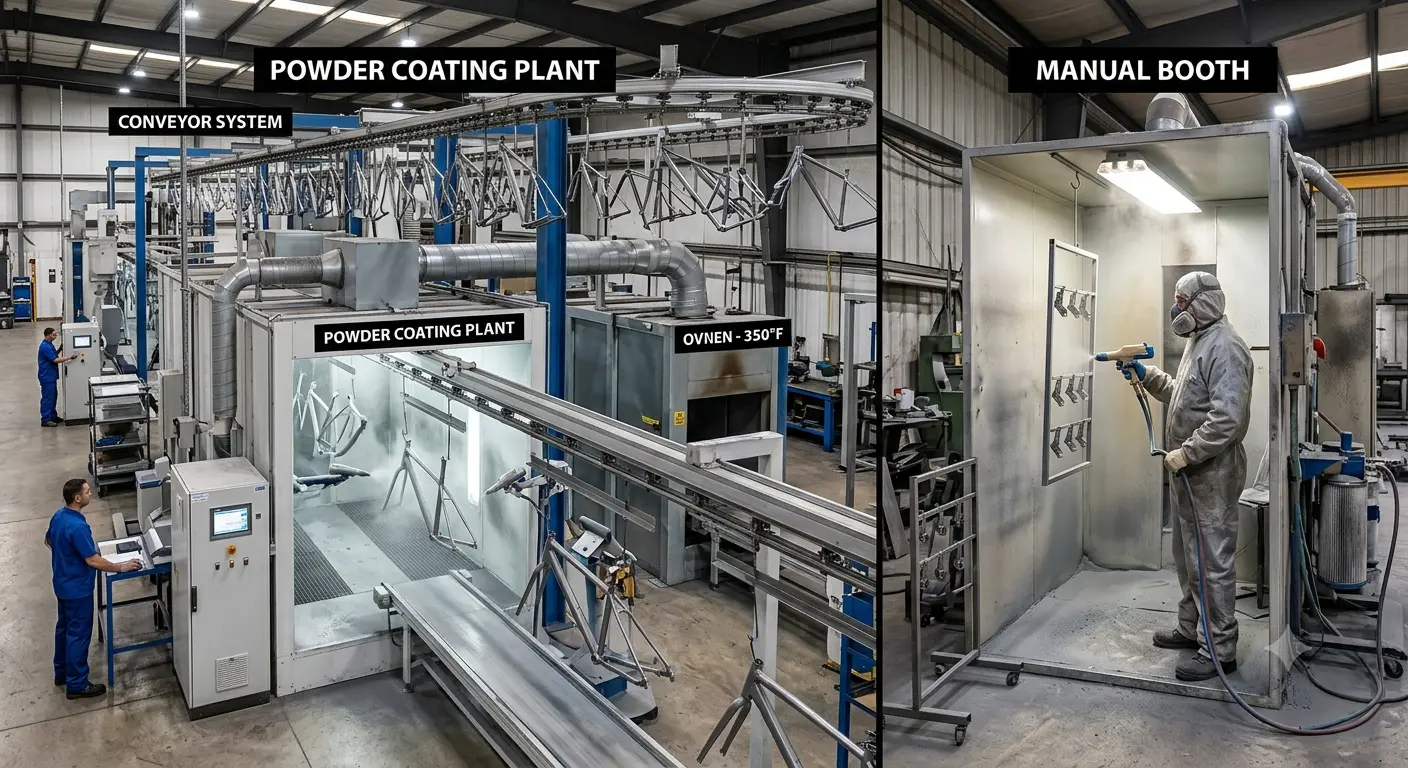
- Conveyorized Powder Coating Booth
- Filter Cartridge Manual Powder Coating Booth
- Manual Powder Coating Booth For Control Panel
- Conveyorized Powder Curing Oven
- Manual Gas Fired Powder Curing Oven
- Batch Curing Oven
- Electric Powder Oven
- Industrial Oven for Powder Coating
- Micro Static 100
- Dual Static 100
- Opti-Static 100
- Autoguns & Reciprocator
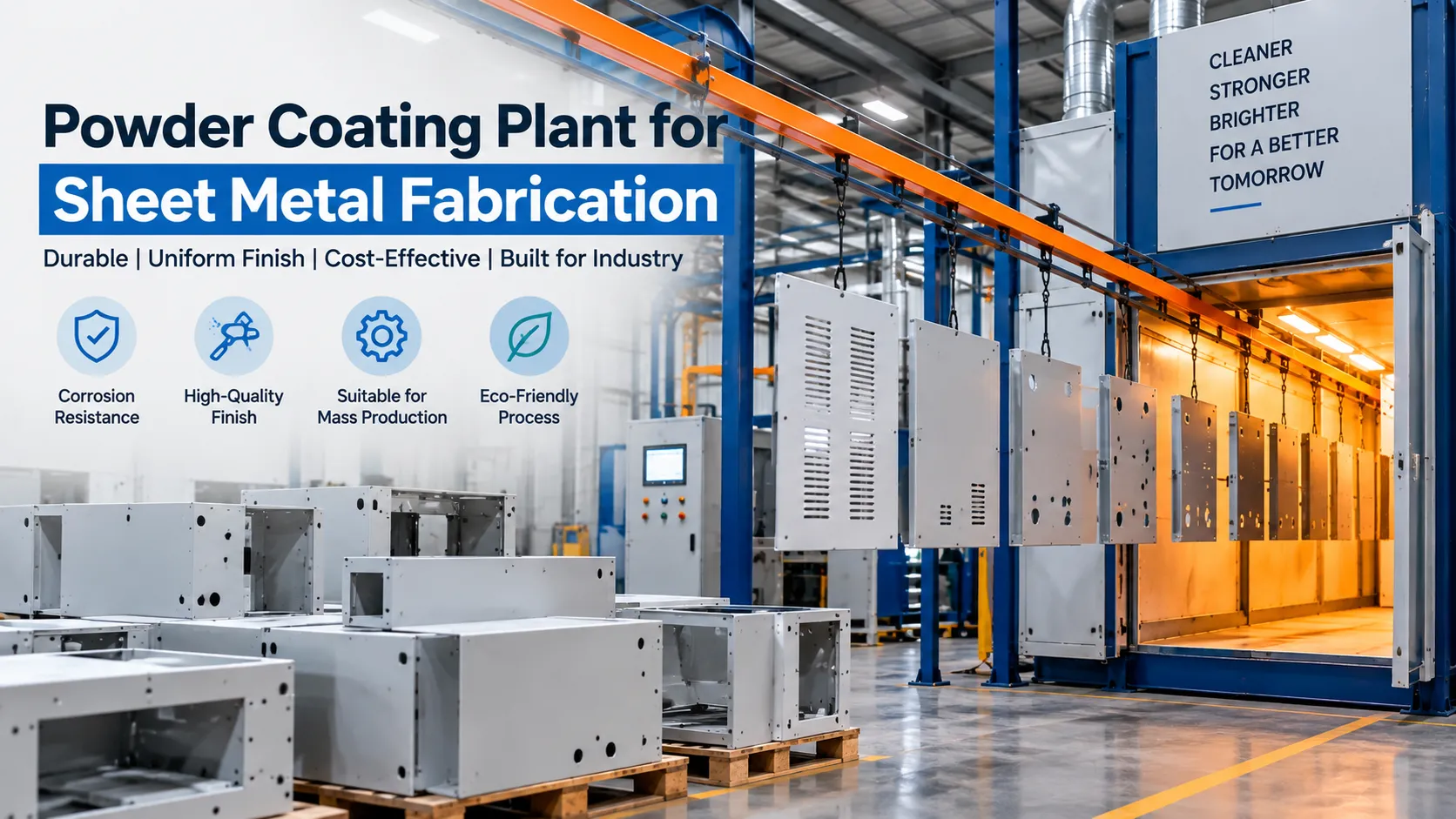
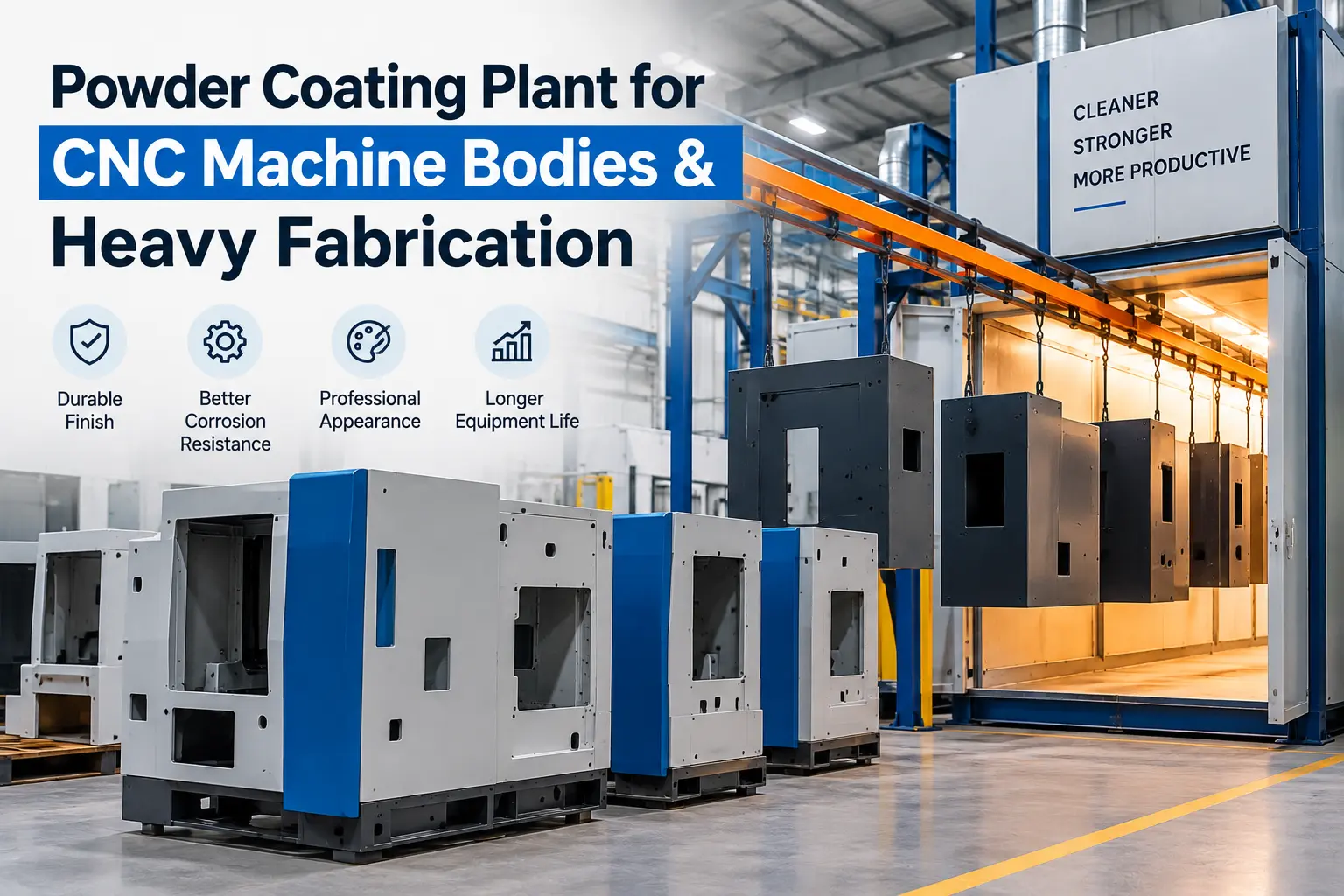

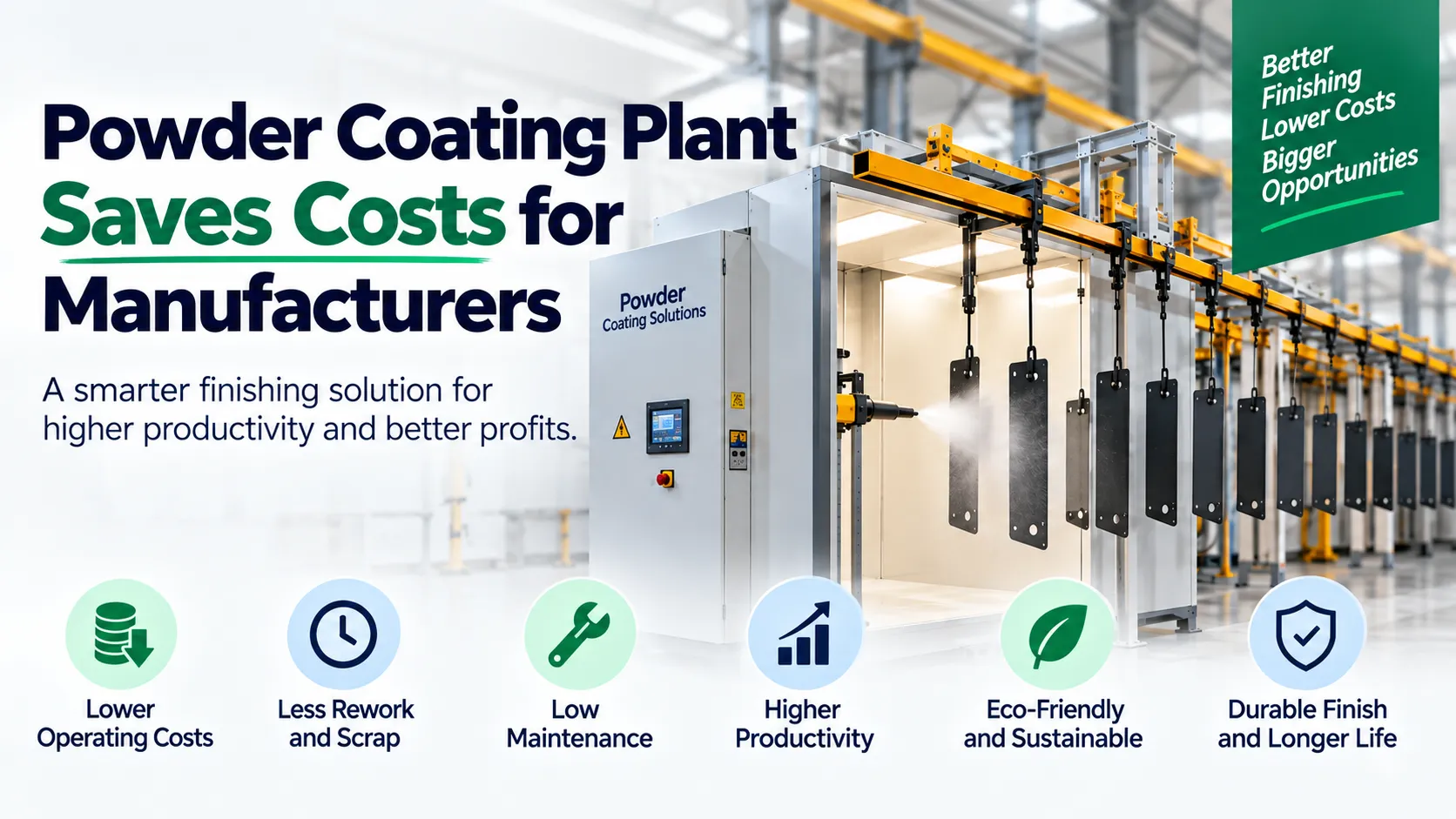
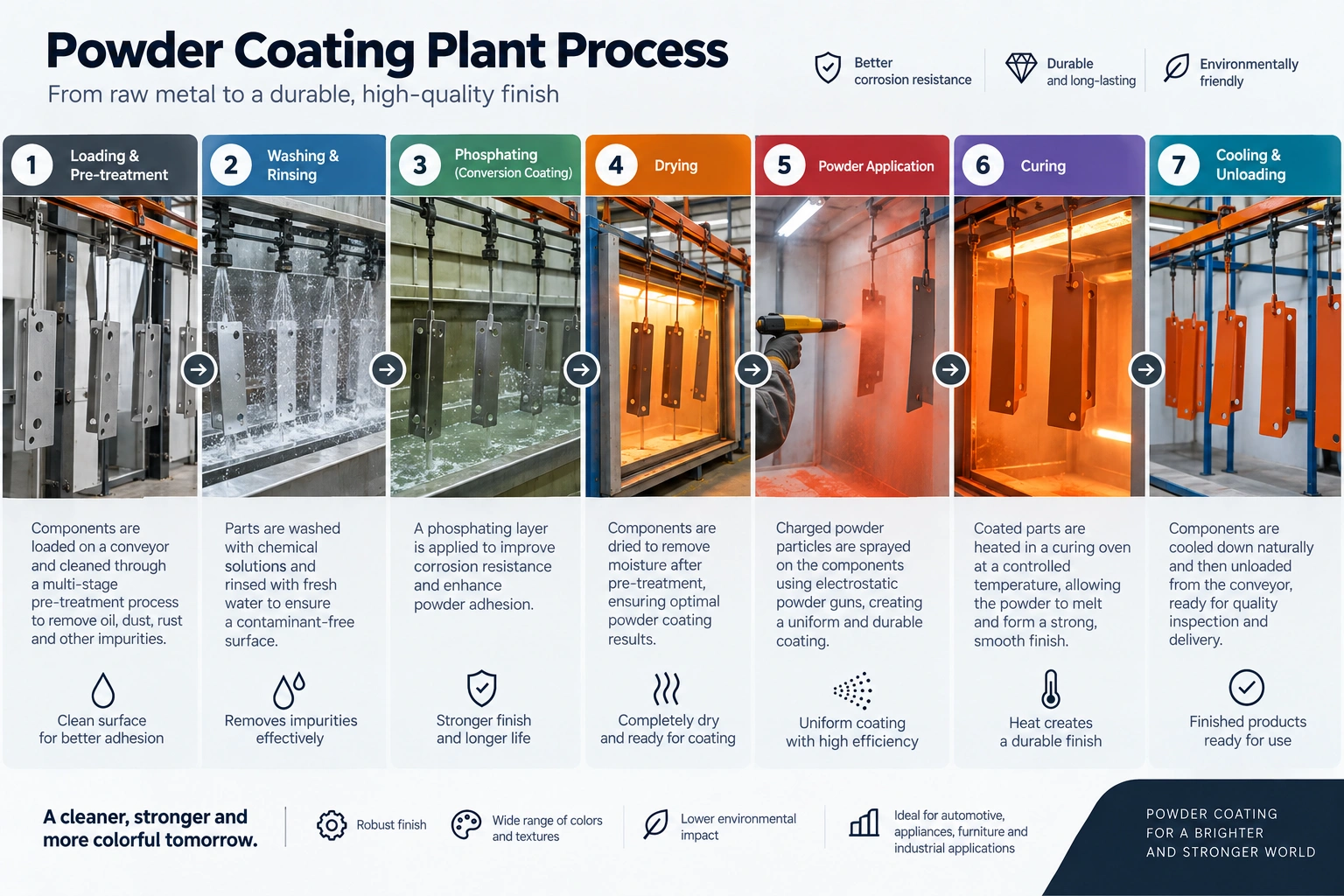
Pre-treatment systems designed around your components, production and coating requirements
A reliable powder coating finish starts before the powder is applied.
Brahma Fabricon designs and manufactures industrial pre-treatment plants for powder coating and metal finishing applications, including dip, spray, deep-tank and transporter-type systems.
The right pre-treatment plant depends on more than the number of tanks or stages. Component material, size, geometry, contamination, production volume, required coating performance, handling method, available factory space and downstream coating process all influence the final configuration.
Our objective is to help manufacturers select a pre-treatment system that fits the actual production requirement rather than forcing every application into the same standard layout.
Already planning a complete finishing line? Explore our powder coating plants and conveyorised powder coating plants.
What is a pre-treatment plant?
A pre-treatment plant is an industrial system used to clean and chemically prepare components before powder coating or liquid painting.
Depending on the substrate and process specification, pre-treatment may remove:
- oil and grease;
- dust and shop contamination;
- rust and oxides;
- mill scale;
- fabrication residues;
- fingerprints and handling contamination;
- previous process residues.
The treatment sequence may then prepare the surface for improved coating adhesion and corrosion performance.
A typical industrial sequence can include:
Cleaning → Rinsing → Surface treatment → Rinsing → Final treatment/passivation where required → Drying → Powder coating
The exact sequence should be selected for the substrate, coating specification and production requirement rather than copied from another factory.
For a broader explanation of the finishing process itself, see this general Wikipedia overview of powder coating.
For deeper engineering information about cleaning, conversion treatment, rinsing and process selection, read our complete technical guide to pre-treatment systems for powder coating.
Types of pre-treatment plants we design
Different production environments require different material-handling and chemical-treatment approaches.
Brahma Fabricon offers pre-treatment systems that can be engineered around component geometry, production volume and available space.
Deep-type pre-treatment line
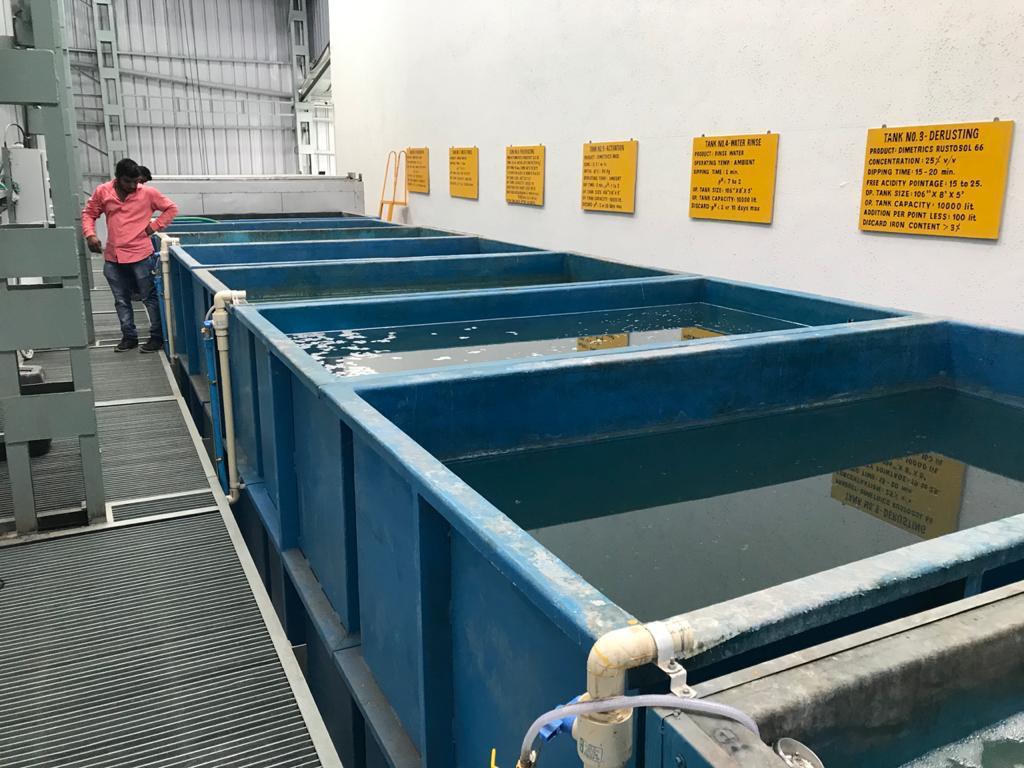


A deep-type pre-treatment line uses larger immersion tanks where components are lowered into the required treatment stages.
This approach can be considered for:
- large fabricated components;
- bulky components;
- components that require full immersion;
- batch-oriented production;
- products with difficult-to-reach areas;
- applications where spray access may be difficult.
The final tank dimensions, number of stages, lifting arrangement, heating method and handling system should be selected from actual component dimensions and production requirements.
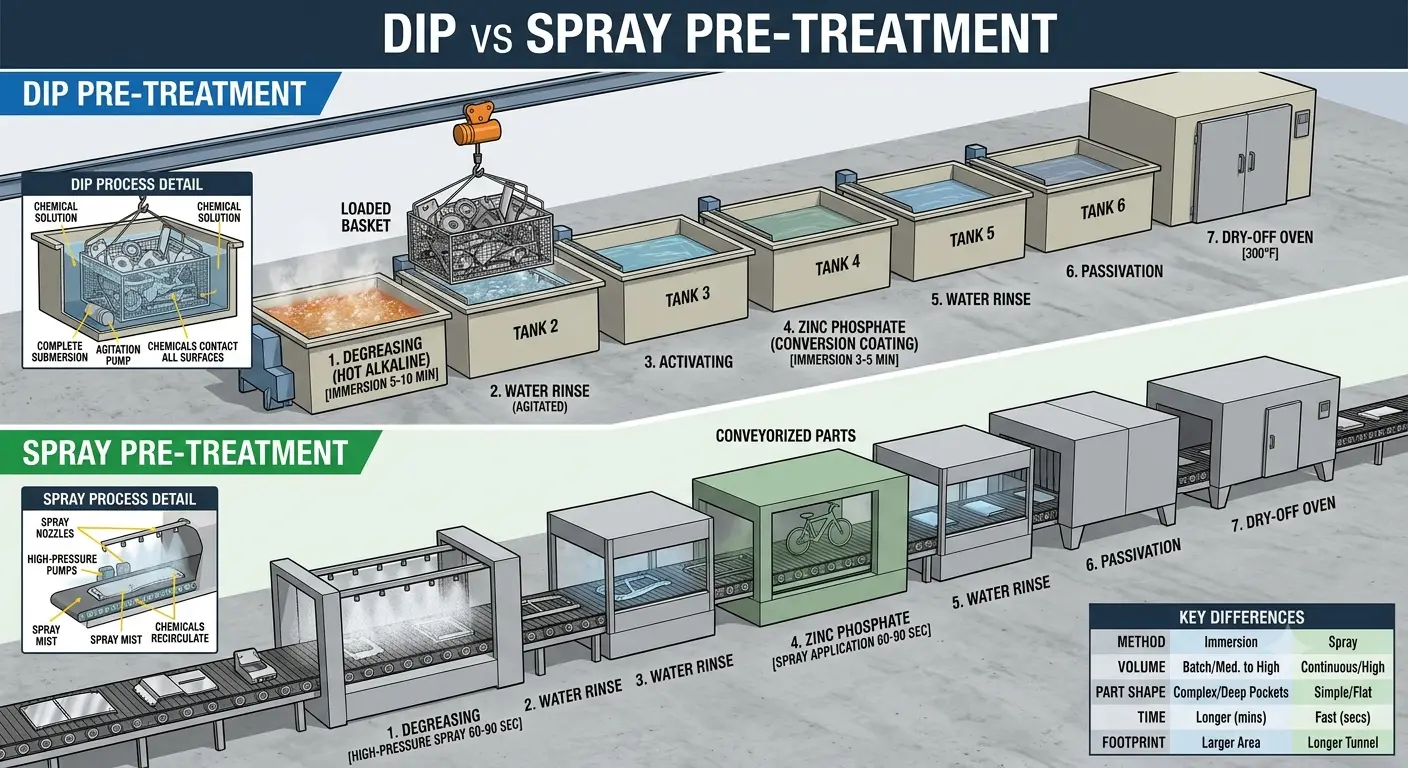
Dip-type pre-treatment tanks


Dip or immersion systems process components through a sequence of chemical and rinse tanks.
They can provide good chemical contact around components and are often suitable for factories handling different products or complex geometries.
A dip system may be considered where:
- components are processed in batches;
- product geometry is complex;
- internal or recessed surfaces require treatment;
- production is flexible rather than continuously repetitive;
- components can be immersed and drained correctly;
- floor layout permits multiple process tanks.
Dip systems can use manual handling, hoists or automated transporter arrangements depending on production needs.
Not sure whether immersion or spray is the better option? Read our detailed comparison of dip vs spray pre-treatment.
Spray pre-treatment system


A spray pre-treatment system uses pumps, piping and spray nozzles to apply cleaning and treatment solutions as components move through enclosed process stages.
Spray systems are commonly considered for:
- continuous manufacturing;
- conveyorised production;
- repetitive component sizes;
- medium- to high-volume production;
- applications where reduced manual handling is important;
- plants requiring integration with an automatic coating line.
Correct nozzle positioning, spray pressure, component orientation, filtration and process control are important parts of spray-system design.
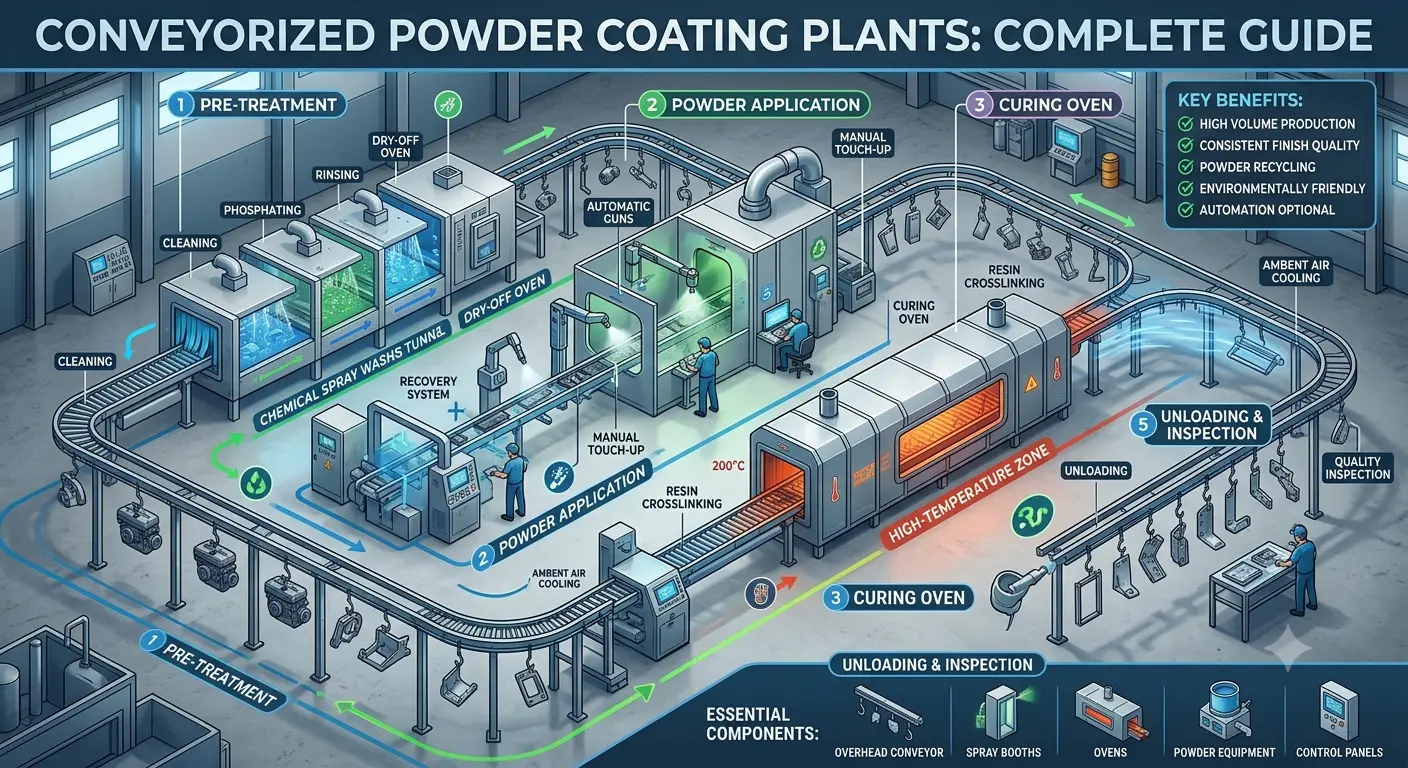
Spray pre-treatment can be integrated with a complete conveyorised powder coating plant where pretreatment, drying, powder application and curing form one connected production line.
Transporter-type dip pre-treatment plant

A transporter-type system combines immersion treatment with automated or semi-automated component movement.
Components are transferred from one process tank to another using a programmed handling system.
This configuration can be useful where manufacturers require:
- immersion treatment;
- repeatable process timing;
- reduced manual handling;
- controlled transfer between tanks;
- medium- or high-volume batch production;
- heavier or larger components;
- more consistent process movement.
The transporter capacity, lifting arrangement, tank spacing and process timing should be engineered around component weight, basket or fixture design and target production.
Which pre-treatment system should you choose?
There is no single pre-treatment system that is best for every powder coating plant.
Use the following as a starting point.
| Production requirement | System to investigate |
|---|---|
| Complex components and recessed areas | Dip / immersion |
| Mixed component sizes | Dip or transporter |
| Batch manufacturing | Dip / deep-tank |
| Continuous production | Spray |
| Conveyorised powder coating line | Spray |
| Heavy or bulky components | Deep-tank or engineered transporter |
| Repetitive high-volume components | Spray or automated transporter |
| Components needing full immersion | Dip |
| Reduced manual material handling | Spray or transporter |
| Frequent product changes | Evaluate dip vs flexible spray system |
The final decision should also consider substrate, contamination, component geometry, coating specification, factory space, utilities and production target.
For a more detailed decision framework, see Dip vs Spray Pre-Treatment: Which Is Better?.
3-stage, 5-stage and 7-stage pre-treatment systems
The number of stages does not by itself determine whether a pre-treatment process is suitable.
A system may use fewer or more stages depending on:
- substrate;
- incoming surface condition;
- contamination;
- required conversion treatment;
- rinsing requirements;
- coating specification;
- corrosion-performance target;
- production process;
- chemical supplier recommendations.
Typical stages can include combinations of:
- degreasing or cleaning;
- water rinsing;
- derusting/descaling where required;
- further rinsing;
- conversion treatment;
- final rinse;
- passivation or sealing where specified.
Not every component requires the same sequence.
For detailed technical information on process stages and surface preparation, use our pre-treatment systems technical guide.
How we select a pre-treatment plant configuration
A quotation should not start with “3 tank, 5 tank or 7 tank?”
It should start with the component and production requirement.
1. Component material
The first question is what is being coated.
Common substrates can include:
- mild steel;
- aluminium;
- galvanized steel;
- fabricated steel components;
- sheet-metal parts;
- cast or machined components;
- application-specific metal products.
Different substrates can require different cleaning and treatment approaches.
2. Component dimensions
Maximum:
Length × Width × Height
affects:
- tank size;
- spray tunnel dimensions;
- opening sizes;
- transporter design;
- component spacing;
- drying-system dimensions;
- factory layout.
Providing the largest component drawing or photograph can significantly improve initial system selection.
3. Component weight
Part weight influences:
- baskets;
- jigs and fixtures;
- hoist capacity;
- transporter design;
- conveyor loading;
- loading and unloading method.
4. Production target
The system should be designed around an actual production requirement such as:
- components per hour;
- components per shift;
- batches per shift;
- square metres processed;
- conveyor output.
This helps determine whether manual dip treatment, transporter handling or a continuous spray line is more appropriate.
5. Component geometry
Simple sheet-metal parts behave differently from:
- fabricated frames;
- hollow sections;
- recessed components;
- deep enclosures;
- large panels;
- long profiles;
- complex assemblies.
Geometry affects chemical contact, drainage, nozzle access and handling.
6. Coating-performance requirement
The intended service environment should be defined before the process is finalized.
For example:
- indoor use;
- outdoor exposure;
- industrial environment;
- customer-specific coating specification;
- corrosion-testing requirement;
- appearance-focused application;
- high-cleanliness or specialist application.
The pre-treatment process should be selected as part of the complete coating system rather than considered separately from the powder and curing process.
7. Available factory space
A technically suitable process must also fit the production floor.
Important considerations include:
- available length;
- available width;
- ceiling height;
- component loading area;
- unloading area;
- chemical storage;
- maintenance access;
- drainage;
- ventilation;
- future expansion;
- integration with existing equipment.
If you are planning a complete factory coating line, our powder coating plant guide explains how pretreatment fits with powder application, curing and material handling.
Dip vs spray pre-treatment: quick comparison
| Factor | Dip / immersion | Spray |
|---|---|---|
| Complex component geometry | Strong option | Depends on nozzle access |
| Batch flexibility | High | Moderate to high |
| Continuous production | Moderate | Strong |
| Conveyor integration | Possible | Strong |
| Full surface immersion | Yes | No |
| Material handling | Manual, hoist or transporter | Normally conveyor based |
| Floor-space requirement | Depends on tank sequence | Depends on tunnel length |
| Nozzle maintenance | Not applicable | Required |
| Tank/bath management | Required | Required |
| Automation potential | Medium to high | High |
| High-volume repetitive production | Possible | Strong |
| Product-mix flexibility | Strong | Depends on design |
Neither process should be selected from this table alone.
The better option is the one that can repeatedly achieve the required surface condition for your actual component and production process.
Read the full dip vs spray pre-treatment comparison for a deeper engineering discussion.
Pre-treatment for different manufacturing applications
Aluminium sections and profiles
Long aluminium profiles can create specific requirements around:
- handling;
- tank or tunnel dimensions;
- drainage;
- hanging;
- line layout;
- production speed;
- integration with downstream powder coating.
Manufacturers planning complete aluminium finishing lines can also review our powder coating plant guide for aluminium sections.
Automotive components
Automotive and engineering components can require repeatable surface preparation, controlled processing and production integration.
System selection should consider:
- component material;
- part geometry;
- cleanliness;
- customer coating specification;
- production takt;
- traceability requirements;
- downstream curing and inspection.
See our guide to selecting a powder coating system for automotive parts.
Control panels and electrical enclosures
Sheet-metal enclosures and control-panel components commonly require consistent cleaning and surface preparation before coating.
Important considerations can include:
- fabrication oil;
- weld contamination;
- recesses;
- panel dimensions;
- production mix;
- batch vs conveyorised processing;
- grounding and subsequent powder application.
For complete-line selection, explore our powder coating equipment and plant options.
Metal furniture
Furniture manufacturers may process frames, cabinets, racks, tables, storage products and other fabricated steel parts.
System selection can depend on:
- product size variation;
- production volume;
- oil and fabrication contamination;
- colour changes;
- factory space;
- batch vs conveyorised production.
Read our detailed guide to powder coating plants for metal furniture.
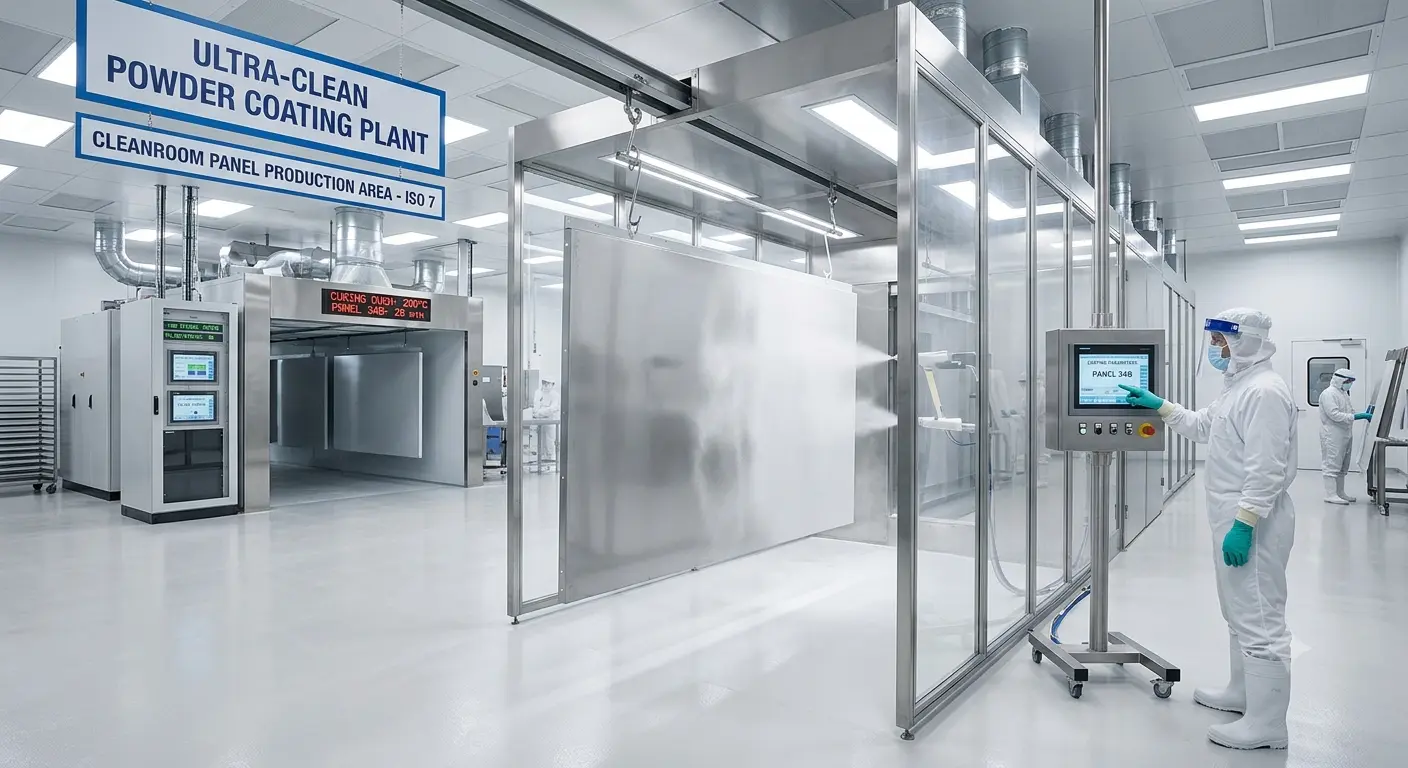
Cleanroom panels and industrial panels
Large sheet-metal panels require planning around handling, cleanliness, consistent treatment and downstream coating quality.
Our cleanroom panel powder coating guide explains how pretreatment integrates with the complete finishing process.
Key equipment in an industrial pre-treatment plant
Depending on the selected system, a pre-treatment plant may include:
Process tanks
Used for cleaning, rinsing and chemical treatment in immersion systems.
Tank dimensions and material should be selected for the actual process chemistry, component size, operating temperature and production requirement.
Spray tunnels
Enclosed treatment zones used in continuous spray systems.
The tunnel is designed around component dimensions, stage sequence, nozzle arrangement and conveyor movement.
Pumps and piping
Used to circulate treatment solutions and supply spray stages where applicable.
Spray nozzles
Nozzle type, orientation and maintenance access influence coverage in spray systems.
Heating system
Some treatment stages may require temperature control depending on the selected chemical process.
Filtration and circulation
Process cleanliness and bath management can influence repeatability and maintenance.
Component handling
Handling can include:
- manual loading;
- baskets;
- jigs;
- hoists;
- transporters;
- overhead conveyors.
Drying system
Components should reach the powder application stage in the surface condition required by the coating process.
Drying requirements depend on component mass, trapped moisture, production rate and line design.
For complete finishing-line equipment options, see our powder coating equipment range.
Integration with a complete powder coating plant
Pretreatment is only one part of a complete finishing process.
A typical production flow can be:
Loading → Pre-treatment → Drying → Powder application → Powder recovery → Curing → Cooling → Inspection
The individual systems must be sized to work together.
For example, increasing conveyor speed without checking chemical contact time, dry-off requirements, powder application capacity and curing time can create a line imbalance.
For higher-volume continuous production, review our conveyorised powder coating plant solutions.
Powder application can then be completed using a suitable powder coating booth, followed by controlled curing in a powder curing oven.
What affects pre-treatment plant cost?
The price of a pre-treatment plant cannot be determined accurately from the number of tanks alone.
Important cost factors include:
- maximum component dimensions;
- tank or tunnel size;
- number of process stages;
- tank construction material;
- spray vs immersion configuration;
- heating requirement;
- pumps and filtration;
- exhaust or ventilation requirement;
- hoist or transporter system;
- conveyor integration;
- automation level;
- controls;
- drying system;
- production capacity;
- installation scope;
- factory layout;
- utilities and site conditions.
A compact manually handled dip system and an automated transporter or continuous spray line can have very different engineering requirements.
For a deeper commercial evaluation, read our pre-treatment plant cost and ROI guide.
Want a realistic estimate for your plant?
Send us:
- component material;
- maximum L × W × H;
- maximum weight;
- parts per hour or shift;
- existing or new line;
- required treatment stages, if known;
- factory dimensions;
- installation location.
Pre-treatment wastewater and process-water planning
Chemical cleaning and rinsing can generate process water that needs appropriate handling.
Wastewater requirements vary with:
- chemical process;
- rinse configuration;
- production volume;
- water quality;
- local environmental requirements;
- reuse or discharge strategy.
The pre-treatment plant and the wastewater-management strategy should therefore be considered together during project planning.
For this topic, use our dedicated pre-treatment wastewater management guide.
This page intentionally focuses on the coating pre-treatment equipment itself rather than general STP or municipal wastewater treatment.
Pre-treatment plant manufacturing and project support
Brahma Fabricon manufactures industrial coating equipment from its facility in Vadodara, Gujarat.
For buyers evaluating a manufacturer, the useful questions are not limited to price.
Ask:
- Who designs the system?
- What information is required before quotation?
- Can the supplier provide a plant layout?
- How are tanks, tunnels and structures fabricated?
- How are pumps, piping and controls selected?
- How will the system integrate with the rest of the coating line?
- What will be tested before dispatch or commissioning?
- What installation scope is included?
- What support is available after commissioning?
You can review our manufacturing facility and powder coating plant projects before discussing your requirement.
Pre-treatment engineering resources
If you are comparing system options, continue with these guides:
Pre-treatment systems for powder coating: complete technical guide
Understand cleaning, rinsing, conversion treatment, substrates and process-selection considerations.
Read the technical pre-treatment guide
Dip vs spray pre-treatment
Compare production volume, component geometry, factory space, automation and process considerations.
Pre-treatment plant cost and ROI
Understand the variables that affect investment and the business case for improving surface preparation.
Pre-treatment wastewater management
Understand how process water and wastewater planning relates to a powder coating pretreatment line.
Read the wastewater management guide
Powder coating process
See how pretreatment connects with drying, electrostatic powder application and curing.
Applications
A pre treatment plant powder coating system is essential for achieving superior finish quality and long-term corrosion protection. Proper cleaning and chemical treatment improve powder adhesion and coating durability.
Our pre treatment plants support optimal surface prep for:
Control panels and enclosures
Aluminium sections and profiles
Automotive and industrial components
Appliance and furniture parts
Why Choose Brahma Fabricon Pre Treatment Plants?
ISO 9001:2015 certified quality and process reliability
Custom designs tailored to your Vadodara factory or pan-India requirements
Focus on efficiency: better adhesion, lower rejection rates, eco-friendly chemical use
Expert installation, operator training, and responsive after-sales support
Essential foundation for superior powder coating results in any line
Locations We Serve
As a trusted pre-treatment manufacturer, we design and supply customized systems for various industries. Our company is among the reliable pre treatment plant manufacturers offering spray and dip pretreatment solutions across India.
Major Cities in Gujarat
Ahmedabad, Surat, Vadodara, Rajkot, Bhavnagar, Jamnagar, Gandhinagar, Anand, Bharuch, Vapi, Valsad, Navsari, Morbi, Junagadh, Porbandar, Mehsana, Bhuj
Key Industrial Areas (GIDC)
Dahej GIDC, Saykha GIDC, Ankleshwar GIDC, Jhagadia GIDC, Panoli GIDC, Vapi GIDC, Hazira GIDC, Sachin GIDC, Nandesari GIDC, Makarpura GIDC, Savli GIDC, Sanand GIDC, Changodar GIDC, Odhav GIDC, Naroda GIDC, Halol GIDC, Kalol GIDC
What Our Clients Say


What information is required to design a powder coating pre-treatment plant?
To design the right pre-treatment plant, we need the component material, minimum and maximum part dimensions, weight, geometry, contamination level, production volume, required coating performance and available factory space. Details about water, electricity, fuel, drainage, conveyor requirements and wastewater treatment also help determine the correct plant configuration.
Should I choose dip or spray pre-treatment?
Choose based on the component geometry, production volume and process requirements rather than assuming one method is always better. Dip pre-treatment is often suitable for complex or varied parts that benefit from full immersion, while spray pre-treatment is commonly preferred for continuous, high-volume conveyorised production. See our detailed dip vs spray pre-treatment comparison for a deeper comparison.
Do I need 3, 5 or 7 stages?
There is no universal rule that more stages automatically produce a better result. The number of stages should be determined by the substrate, incoming contamination, required cleaning and conversion process, rinse requirements and expected corrosion performance. A properly controlled 3- or 5-stage process can be more appropriate than an unnecessary 7-stage system for some applications.
Which pre-treatment is suitable for mild steel?
Mild steel normally requires effective degreasing and cleaning followed by a suitable conversion treatment, which may include iron phosphate, zinc phosphate or another approved modern conversion system depending on the required corrosion performance. The exact chemistry and number of rinse stages should be selected with the chemical supplier according to the component and coating specification.
Which pre-treatment is suitable for aluminium?
Aluminium generally requires a cleaning process designed specifically for aluminium, followed where necessary by etching or deoxidizing and an appropriate conversion treatment. Chrome-free conversion technologies are commonly available, but the final process should be selected according to the aluminium alloy, service environment and required coating performance rather than applying a mild-steel treatment unchanged.
Can a spray pre-treatment system be integrated with a conveyorised line?
Yes. Spray pre-treatment systems are particularly well suited to continuous conveyorised powder coating plants because components can remain on the conveyor through cleaning, rinsing, surface treatment and drying. Conveyor speed, spray-stage length and required chemical contact time should be engineered together so every stage receives sufficient treatment time.
How is pre-treatment plant capacity calculated?
Capacity depends on the type of plant. For a dip system, calculations consider batch size, component dimensions, tank capacity, treatment dwell time and loading/transfer cycle. For a spray conveyorised system, capacity is based on conveyor speed, hanger pitch, parts per hanger, stage dwell time and the number of production hours available.
What determines the size of pre-treatment tanks?
Tank dimensions depend mainly on the largest component or batch that must be immersed, required clearance around the parts, batch weight, solution displacement and treatment volume. The design should also allow for freeboard, heating or circulation equipment, drainage, sludge accumulation, maintenance access and safe loading and unloading.
What factory utilities does a pre-treatment plant require?
Requirements vary by process but can include process water, electricity, heating energy, compressed air, drainage, exhaust or ventilation and an effluent-treatment arrangement. Heated chemical stages may use electric, gas, steam or another suitable heat source depending on the plant design and available factory utilities.
How much space is required for a pre-treatment plant?
There is no fixed footprint because space depends on the number of process stages, maximum component size, dip or spray configuration, production capacity and material-handling method. The layout should also include loading and unloading areas, chemical storage, pumps, maintenance access, drainage, drying equipment and wastewater-treatment facilities where required.
What affects the price of a pre-treatment plant?
The main cost factors include plant type, number of stages, tank or tunnel dimensions, production capacity, construction materials, heating system, pumps and spray equipment, transporter or conveyor automation, controls, drying requirements and wastewater-treatment integration. Comparing quotations only by the number of tanks can therefore be misleading; the complete technical scope should be compared.
How should wastewater from the pre-treatment process be managed?
Wastewater from degreasing, rinsing and conversion-treatment stages may contain oils, suspended solids, chemicals, phosphates, metals, acids or alkalis depending on the process. Waste streams should be collected and treated through an appropriate effluent-treatment system, with processes such as segregation, equalization, pH adjustment, solids removal and sludge management selected according to the wastewater chemistry and applicable local discharge requirements. Read our pre-treatment wastewater management guide for more detail.
Do you provide layout, installation and commissioning?
Yes. Brahma Fabricon can support pre-treatment plant projects with customized equipment layout, integration with the powder coating line, installation, commissioning and operator training based on the project scope. For integrated projects, the pre-treatment system can also be engineered around conveyor, drying, powder application and curing requirements.
What details should I send for a quotation?
For an accurate quotation, send the component material, minimum and maximum dimensions, maximum weight, photos or drawings, parts per hour or shift, required pre-treatment process if already defined, coating specification, factory layout and available utilities. Also mention whether you require dip or spray treatment, manual or automated handling, a conveyorised line, drying equipment and wastewater-treatment integration. You can send these details through our project enquiry page.
Get a pre-treatment
system quotation
Prepare surfaces perfectly with Brahma Fabricon. Contact us today for customized solutions.
Address: 332 Survey Block, Por-Kayavarohan Road, B/S D-Mart Ware House, Ankhi Village, Por, Vadodara, Gujarat – 391243,
Phone: 8320244173/9227534580
Email: powdercoatingplants@gmail.com